Decision comparison
Dynatrace vs SigNoz
Dynatrace and SigNoz are aimed at opposite ends of the operator-time question. Dynatrace deploys an agent that discovers topology automatically and applies causal AI to propose a root cause, which is designed to save expert time on large estates and is priced accordingly. SigNoz is open source and OpenTelemetry-native on ClickHouse: it gives you the signals and leaves the analysis to your engineers, with cost moving to infrastructure and the person running it.
Architecture choice. These take different approaches to the same problem. Read the table as a fit question rather than a feature race.
Applies to: when a team wants to evaluate observability as part of a broader operating model that also includes automation and application security; the trade-off is moving away from SigNoz’s open-source, OpenTelemetry-native, self-hostable emphasis.
All 2 are observability platforms.
Quick Comparison
| Decision factor | Dynatrace | SigNoz |
|---|---|---|
| What it is | An enterprise observability platform built around automatic discovery and causal AI analysis | An open-source OpenTelemetry-native platform storing telemetry in ClickHouse |
| Instrumentation model | OneAgent discovers processes and dependencies automatically, with minimal manual configuration | OpenTelemetry SDKs and the collector, configured by you |
| Root cause analysis | Davis AI correlates signals and proposes a causal root cause rather than a list of alerts | Correlated dashboards and alerting; root cause analysis is the engineer's work |
| Deployment | SaaS or Dynatrace Managed in your own environment, with agents across AWS, GCP and Azure | Self-hosted on Docker or Kubernetes anywhere, or SigNoz Cloud |
| Cost model | Enterprise licensing on hosts and consumption units, typically with an annual commitment | Free software; you pay for the ClickHouse cluster and the engineering time |
| Time to value | Fast once agents are deployed, because discovery and baselines are automatic | Proportional to the instrumentation and dashboard work you invest |
| Language coverage | Automatic instrumentation for Java, Python, Node.js, Go and .NET without code changes | OpenTelemetry SDKs for Java, Python, Node.js, Go and .NET, added to the application by you |
| Data storage | Dynatrace's own store, in SaaS or in your Dynatrace Managed cluster | ClickHouse, sized and retained by you; object storage on S3 or equivalent for archives |
| Best fit | Large estates where automatic topology and causal analysis save real operator time | Teams with Kubernetes capacity that want cost control and vendor-neutral instrumentation |
Dynatrace
- What it is:
- An enterprise observability platform built around automatic discovery and causal AI analysis
- Instrumentation model:
- OneAgent discovers processes and dependencies automatically, with minimal manual configuration
- Root cause analysis:
- Davis AI correlates signals and proposes a causal root cause rather than a list of alerts
- Deployment:
- SaaS or Dynatrace Managed in your own environment, with agents across AWS, GCP and Azure
- Cost model:
- Enterprise licensing on hosts and consumption units, typically with an annual commitment
- Time to value:
- Fast once agents are deployed, because discovery and baselines are automatic
- Language coverage:
- Automatic instrumentation for Java, Python, Node.js, Go and .NET without code changes
- Data storage:
- Dynatrace's own store, in SaaS or in your Dynatrace Managed cluster
- Best fit:
- Large estates where automatic topology and causal analysis save real operator time
SigNoz
- What it is:
- An open-source OpenTelemetry-native platform storing telemetry in ClickHouse
- Instrumentation model:
- OpenTelemetry SDKs and the collector, configured by you
- Root cause analysis:
- Correlated dashboards and alerting; root cause analysis is the engineer's work
- Deployment:
- Self-hosted on Docker or Kubernetes anywhere, or SigNoz Cloud
- Cost model:
- Free software; you pay for the ClickHouse cluster and the engineering time
- Time to value:
- Proportional to the instrumentation and dashboard work you invest
- Language coverage:
- OpenTelemetry SDKs for Java, Python, Node.js, Go and .NET, added to the application by you
- Data storage:
- ClickHouse, sized and retained by you; object storage on S3 or equivalent for archives
- Best fit:
- Teams with Kubernetes capacity that want cost control and vendor-neutral instrumentation
Public signals
Verified factual signals only. Bars appear only for like-for-like metrics with five weekly assessments for every tool; missing evidence stays explicit. These signals do not establish enterprise adoption, product quality, or total cost.
| Metric | Dynatrace | SigNoz |
|---|---|---|
| GitHub commits, 90d(Developer adoption) | 275 | Not available |
| GitHub stars(Developer adoption) | 220 | Not available |
| Search interest(Market interest) | 4 | 1 |
| Hacker News mentions, 90d(Community interest) | 4 | 3 |
| PyPI weekly downloads(Developer adoption) | 20.2k | Not available |
| Stack Overflow questions(Community interest) | 199 | 9 |
| Docker Hub pulls(Product adoption) | Not available | 1.0M |
| GitHub commits, 90d(Product adoption) | Not available | 609 |
| GitHub stars(Product adoption) | Not available | 32,000+ |
As of September 14, 2026 — updated weekly.
Health & risk evidence
Observed public-source checks for mapped package versions and repositories.
Dynatrace
September 14, 2026Package vulnerabilities
PyPI · oneagent-sdk@1.5.2.20260107.153442
0 vulnerabilities
across 1 package
Repository security score
Not available
SigNoz
Package vulnerabilities
Not available
Repository security score
Not available
Interface Preview
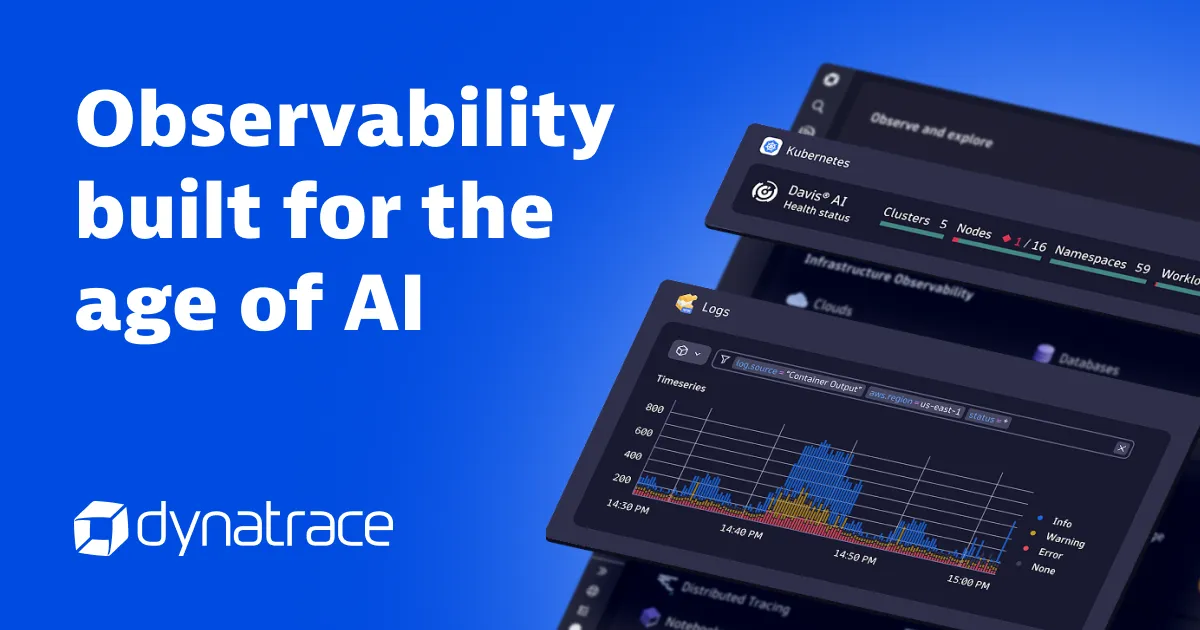
Dynatrace
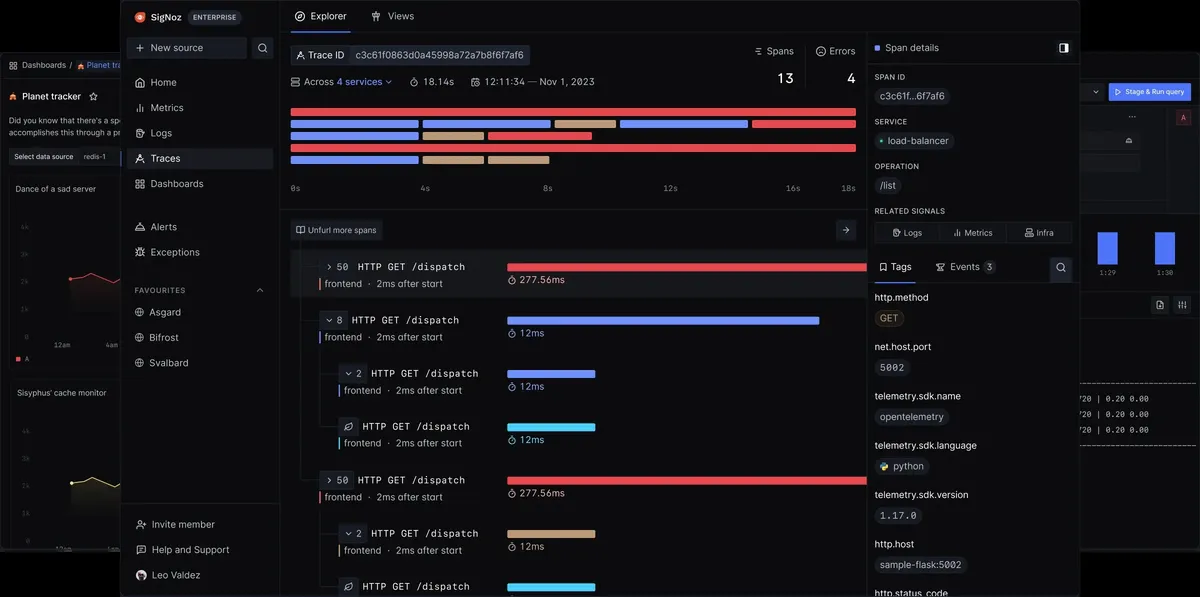
SigNoz
Feature Comparison
| Feature | Dynatrace | SigNoz |
|---|---|---|
| Telemetry | ||
| Distributed tracing | Full support | Full support |
| Metrics and dashboards | Full support | Full support |
| Log management | Full support | Full support |
| Real user monitoring | Full support | Partial support |
| Analysis | ||
| Automatic dependency discovery | Full support | Not verified |
| Causal root cause analysis | Full support | Not verified |
| Automatic baselining | Full support | Partial support |
| Manual dashboard building | Full support | Full support |
| Operations | ||
| Fully managed option | Full support | Full support |
| Self-hosted deployment | Full support | Full support |
| Vendor-neutral instrumentation | Partial support | Full support |
| Data residency under your control | Full support | Full support |
| Commercial | ||
| Open-source licence | Not verified | Full support |
| Predictable cost at growing volume | Partial support | Full support |
| Enterprise support | Full support | Partial support |
| Long retention without indexing charges | Partial support | Full support |
Telemetry
Distributed tracing
Metrics and dashboards
Log management
Real user monitoring
Analysis
Automatic dependency discovery
Causal root cause analysis
Automatic baselining
Manual dashboard building
Operations
Fully managed option
Self-hosted deployment
Vendor-neutral instrumentation
Data residency under your control
Commercial
Open-source licence
Predictable cost at growing volume
Enterprise support
Long retention without indexing charges
Which approach fits
Dynatrace and SigNoz are aimed at opposite ends of the operator-time question. Dynatrace deploys an agent that discovers topology automatically and applies causal AI to propose a root cause, which is designed to save expert time on large estates and is priced accordingly. SigNoz is open source and OpenTelemetry-native on ClickHouse: it gives you the signals and leaves the analysis to your engineers, with cost moving to infrastructure and the person running it.
When each approach fits
Choose Dynatrace if:
Choose Dynatrace when the estate is large enough that manual instrumentation and dashboard maintenance would consume real engineering time. OneAgent discovers processes and dependencies without being told, baselines form automatically, and Davis AI proposes a causal root cause rather than handing over a wall of correlated alerts. On a sprawling enterprise estate that automation is the product, and it is worth enterprise pricing.
Choose SigNoz if:
Choose SigNoz when you have the engineering capacity to run a ClickHouse-backed service and want cost control with no instrumentation lock-in. OpenTelemetry throughout means the backend is a routing decision rather than a commitment, retention is a storage question, and there is no per-host licence. Accept that root cause analysis is your engineers' work rather than the platform's.
These scenarios reflect the available product evidence. Your requirements, existing stack, and team expertise should guide the final decision.
Frequently Asked Questions
Is automatic discovery worth the price difference?
It depends on estate size and how much expert time you are spending today. On a few dozen services that a team knows well, engineers find root causes quickly and automatic topology saves less than it costs. On hundreds of services with dependencies nobody holds in their head, automatic discovery and causal analysis genuinely shorten incidents, and the licence competes against engineer-hours rather than against another tool's subscription.
What does causal analysis do that correlation does not?
Correlation tells you several things changed at once. Causal analysis attempts to say which change caused the others, using the dependency topology it discovered. When twelve services alert simultaneously because one database degraded, the difference is between twelve alerts and one answer. It is not infallible, and it is most valuable exactly where manual analysis is hardest — deep dependency chains under time pressure.
Can SigNoz cover an enterprise estate?
Functionally, yes: ClickHouse handles substantial telemetry volume and OpenTelemetry instruments most runtimes. What differs is the labour model. Instrumentation is explicit rather than discovered, dashboards and alerts are built rather than inferred, and someone maintains the cluster. That is entirely workable with a platform team and is a significant undertaking without one.
How does data residency compare?
Both can keep data in your environment, which is unusual in this category. Dynatrace Managed runs in your own infrastructure, and SigNoz is self-hosted by default. If regulatory constraints rule out SaaS, both remain candidates — which is worth knowing, because it is often the constraint that eliminates most of the field.
Does OpenTelemetry narrow the gap?
It narrows the instrumentation gap considerably: applications emit OTLP and any backend can consume it, so the signals themselves are portable. What it does not replicate is automatic discovery and causal analysis, which are analysis layers built on top of the signals rather than a property of them. That remains the substantive difference between these two.