Decision comparison
Hex vs Tableau
Hex and Tableau serve different analytical workflows. Hex is purpose-built for data teams that think in code — combining SQL, Python, and AI agents in collaborative notebooks that double as shareable data apps. Tableau is the industry standard for visual analytics, offering unmatched drag-and-drop dashboarding, a massive connector ecosystem, and deep Salesforce integration. We recommend Hex for technical data teams that want a code-first, AI-native analytics platform, and Tableau for organizations that prioritize visual dashboarding at scale with governed, role-based access across large user bases.
Architecture choice. These take different approaches to the same problem. Read the table as a fit question rather than a feature race.
These are different kinds of product — Analytics Notebook and BI Platform.
Quick Comparison
| Decision factor | Hex | Tableau |
|---|---|---|
| Best For | Data teams combining SQL, Python, and AI-driven notebooks | Organizations needing advanced visual analytics and interactive dashboards |
| Pricing Model | Price starts at $36/month, with $75/month for higher usage, and $2.93 per hour for CPU usage. | Tableau Cloud Standard Edition: Viewer $15/user/month, Explorer $42/user/month, Creator $75/user/month; Enterprise Edition: Viewer $35/user/month, Explorer $70/user/month, Creator $115/user/month; Tableau+ Bundle requires contact sales for pricing details. |
| Starting Price | $36/month | $15/user/month (Viewer), $75/user/month (Creator) |
| Learning Curve | Moderate — familiar for analysts who know SQL and Python | Steep for advanced features; drag-and-drop basics are accessible |
| AI Capabilities | Built-in agentic data notebooks, conversational self-serve analytics | Agentforce integration, AI-assisted semantic layer, Tableau Next agentic analytics |
| Deployment Options | Cloud-hosted (SaaS) | Cloud (Tableau Cloud), self-hosted (Tableau Server), Desktop |
Hex
- Best For:
- Data teams combining SQL, Python, and AI-driven notebooks
- Pricing Model:
- Price starts at $36/month, with $75/month for higher usage, and $2.93 per hour for CPU usage.
- Starting Price:
- $36/month
- Learning Curve:
- Moderate — familiar for analysts who know SQL and Python
- AI Capabilities:
- Built-in agentic data notebooks, conversational self-serve analytics
- Deployment Options:
- Cloud-hosted (SaaS)
Tableau
- Best For:
- Organizations needing advanced visual analytics and interactive dashboards
- Pricing Model:
- Tableau Cloud Standard Edition: Viewer $15/user/month, Explorer $42/user/month, Creator $75/user/month; Enterprise Edition: Viewer $35/user/month, Explorer $70/user/month, Creator $115/user/month; Tableau+ Bundle requires contact sales for pricing details.
- Starting Price:
- $15/user/month (Viewer), $75/user/month (Creator)
- Learning Curve:
- Steep for advanced features; drag-and-drop basics are accessible
- AI Capabilities:
- Agentforce integration, AI-assisted semantic layer, Tableau Next agentic analytics
- Deployment Options:
- Cloud (Tableau Cloud), self-hosted (Tableau Server), Desktop
Public signals
Verified factual signals only. Bars appear only for like-for-like metrics with five weekly assessments for every tool; missing evidence stays explicit. These signals do not establish enterprise adoption, product quality, or total cost.
| Metric | Hex | Tableau |
|---|---|---|
| GitHub commits, 90d(Developer adoption) | 0 | 37 |
| GitHub stars(Developer adoption) | 24 | 716 |
| Search interest(Market interest) | 1 | 85 |
| Hacker News mentions, 90d(Community interest) | 0 | 2 |
| Product Hunt comments(Community interest) | 25 | 3 |
| Product Hunt rating(Community interest) | 4.9/5 | 4.2/5 |
| Product Hunt reviews(Community interest) | 11 | 5 |
| Product Hunt votes(Community interest) | 294 | 7 |
| npm weekly downloads(Developer adoption) | Not available | 32.2k |
| PyPI weekly downloads(Developer adoption) | Not available | 965.7k |
| Stack Overflow questions(Community interest) | Not available | 5.4k |
As of September 21, 2026 — updated weekly.
Health & risk evidence
Observed public-source checks for mapped package versions and repositories.
Hex
Package vulnerabilities
Not available
Repository security score
Not available
Tableau
September 21, 2026Package vulnerabilities
npm · @tableau/embedding-api@3.16.1 · PyPI · tableauserverclient@0.41
0 vulnerabilities
across 2 packages
Repository security score
github.com/tableau/server-client-python
5.5/10
Interface Preview
Hex
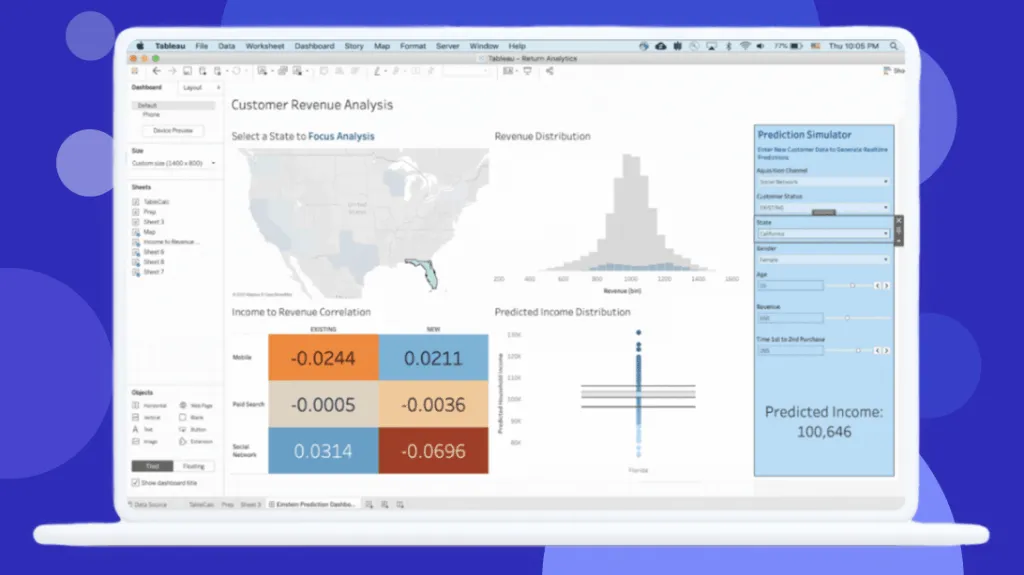
Tableau
Feature Comparison
| Feature | Hex | Tableau |
|---|---|---|
| Data Analysis | ||
| SQL Support | Native SQL cells in notebooks | Custom SQL queries for data connections |
| Python Support | Native Python cells with full library support | Limited — requires TabPy external service |
| Drag-and-Drop Visualization | Available through app builder | Core strength — industry-leading visual analytics |
| AI and Automation | ||
| AI-Powered Analysis | Agentic data notebooks with built-in AI agent | Agentforce Tableau for proactive insights |
| Conversational Analytics | Conversational self-serve for natural-language questions | Natural language queries via Agentforce in Slack |
| Semantic Layer | Not a core feature | Tableau Semantics — AI-infused semantic layer with Data 360 |
| Collaboration and Sharing | ||
| Interactive Dashboards | Data apps with filters, dropdowns, and exploration | Advanced interactive dashboards with drill-down |
| Notebook Collaboration | Real-time collaborative notebooks | Not available — dashboard-centric workflow |
| Publishing and Embedding | Publish apps directly from notebooks | Embedded analytics available (Enterprise edition required) |
| Platform and Integrations | ||
| Data Warehouse Connectivity | Direct connections to major warehouses | Extensive connector library for databases and cloud sources |
| Slack Integration | Not a highlighted feature | Permission-aware analytics directly in Slack channels |
| Salesforce Integration | Not verified | Native CRM integration as a Salesforce product |
| Data Preparation | ||
| Built-in Data Prep | SQL and Python cells handle data wrangling in-notebook | Tableau Prep Builder included with Creator license |
| Scheduled Runs | Scheduled notebook runs available | Scheduled extract refreshes (10/day on standard Cloud) |
| Version History | Built-in notebook version history | Revision history on Tableau Server/Cloud |
Data Analysis
SQL Support
Python Support
Drag-and-Drop Visualization
AI and Automation
AI-Powered Analysis
Conversational Analytics
Semantic Layer
Collaboration and Sharing
Interactive Dashboards
Notebook Collaboration
Publishing and Embedding
Platform and Integrations
Data Warehouse Connectivity
Slack Integration
Salesforce Integration
Data Preparation
Built-in Data Prep
Scheduled Runs
Version History
Which approach fits
Hex and Tableau serve different analytical workflows. Hex is purpose-built for data teams that think in code — combining SQL, Python, and AI agents in collaborative notebooks that double as shareable data apps. Tableau is the industry standard for visual analytics, offering unmatched drag-and-drop dashboarding, a massive connector ecosystem, and deep Salesforce integration. We recommend Hex for technical data teams that want a code-first, AI-native analytics platform, and Tableau for organizations that prioritize visual dashboarding at scale with governed, role-based access across large user bases.
When each approach fits
Choose Hex if:
Choose Hex if your team works primarily in SQL and Python and wants AI-assisted analysis in a notebook environment. Hex excels when data analysts and engineers need to explore data programmatically, build quick visualizations from code, and share interactive data apps — all without leaving a single platform. The conversational self-serve feature makes it accessible for less technical team members to ask questions against governed data models. At $36/month to start, Hex offers a cost-effective entry point for small to mid-size data teams that do not need enterprise-scale dashboard distribution.
Choose Tableau if:
Choose Tableau if your organization needs polished, interactive dashboards consumed by hundreds or thousands of users across departments. Tableau's drag-and-drop interface, role-based licensing (Viewer at $15/user/month, Explorer at $42/user/month, Creator at $75/user/month), and deployment flexibility (Cloud, Server, Desktop) make it the stronger choice for enterprise-wide BI rollouts. The Agentforce integration and Tableau Next platform bring agentic analytics capabilities to large organizations already in the Salesforce ecosystem. Tableau is rated 8.4/10 based on 2,320 user reviews, with users praising its data visualization, ease of use, and drag-and-drop interface. Be prepared for higher total cost at scale when deploying across large teams with mixed license types.
These scenarios reflect the available product evidence. Your requirements, existing stack, and team expertise should guide the final decision.
Frequently Asked Questions
Is Hex or Tableau better for data teams that use Python?
Hex is the stronger choice for Python-heavy workflows. It provides native Python cells directly in its notebooks, letting analysts write and execute Python code alongside SQL queries and visualizations in a single environment. Tableau has limited Python support through TabPy, an external service that requires separate setup and maintenance. If your team relies on Python for data manipulation, statistical analysis, or machine learning, Hex provides a far more integrated experience.
How does pricing compare between Hex and Tableau for a mid-size team?
Hex starts at $36/month with usage-based pricing that scales with compute needs ($75/month for higher usage tiers). Tableau uses role-based per-seat pricing: Viewer at $15/user/month, Explorer at $42/user/month, and Creator at $75/user/month on the Standard Cloud edition. Enterprise editions cost more — Creator at $115/user/month, Explorer at $70/user/month, and Viewer at $35/user/month. Hex can be significantly cheaper for smaller technical teams but does not offer the same breadth of viewer-tier access for distributing dashboards across large organizations.
Can Hex replace Tableau for enterprise dashboarding?
Not directly. Hex produces data apps and interactive notebooks that work well for technical teams and stakeholder presentations, but it lacks Tableau's enterprise-grade dashboard governance, role-based viewer access at scale, and deep connector ecosystem. Tableau offers deployment flexibility across Cloud, Server, and Desktop, plus Salesforce CRM integration and embedded analytics for external-facing applications. Many organizations use both tools — Hex for exploratory analysis and Tableau for polished, widely distributed dashboards.
Which tool has better AI capabilities in 2026?
Both platforms have invested heavily in AI, but their approaches differ. Hex offers agentic data notebooks with a built-in AI agent that helps analysts write code, generate charts, and answer follow-up questions within the notebook context. Tableau has launched Tableau Next with Agentforce integration, delivering agentic analytics through Slack, permission-aware insights, and an AI-infused semantic layer called Tableau Semantics powered by Data 360. Hex's AI is oriented toward code-writing data teams, while Tableau's AI targets broader enterprise consumption through natural language and automated insights.