Decision comparison
Holistics vs Looker
Holistics and Looker both champion the semantic layer approach to business intelligence, but they serve different market segments and use cases. Holistics is a focused, self-service BI platform that bundles data modeling, transformation, and visualization with DevOps-friendly workflows, making it a strong choice for data teams that want a streamlined analytics tool without the complexity of a large enterprise platform. Looker is a full-scale enterprise BI platform backed by Google Cloud, offering LookML-based semantic modeling, embedded analytics, API-first extensibility, and AI-powered features through Gemini and Vertex AI integration. The right choice depends on whether your team needs a lean, integrated analytics workflow or an enterprise platform with deep cloud ecosystem integration and embedded analytics capabilities.
Direct comparison. These are reviewed substitutes bought for the same job, so the differences below are the ones that decide between them.
All 2 are BI platforms.
Quick Comparison
| Decision factor | Holistics | Looker |
|---|---|---|
| Semantic Layer Approach | Code-based modeling layer that lets data teams define metrics, relationships, and business logic for self-service consumption | LookML modeling language for defining reusable metrics, joins, derived tables, and permissions in version-controlled Git repositories |
| Deployment & Ecosystem | Standalone cloud BI platform; connects to major warehouses without vendor lock-in to a specific cloud provider | Part of Google Cloud Platform; close integration with BigQuery, Vertex AI, Gemini, and the extensive GCP ecosystem |
| Embedded Analytics | Supports embedding dashboards and reports into external applications | Enterprise-grade embedding with white-labeling, API-first architecture, and SDKs for building custom data applications |
| Data Transformation | Built-in transformation pipeline for preparing and modeling data before visualization | Direct query against warehouses with no data storage; relies on LookML derived tables and Persistent Derived Tables for transformation |
| Pricing Model | Entry is $960/month, or $800/month billed annually. Standard is $1200/month, or $1000/month annually. Security Compliance Suite is $2400/month, or $2000/month annually. Each includes the first 10 users; additional users are $15/month ($12.5 annually), and $18/month ($15 annually) on Security Compliance Suite. Custom Plan and Embedded Analytics are quote-based. A free trial is available. | Looker (Google Cloud core) publishes no platform or per-user price. It offers three platform editions — Standard for organisations under 50 users, Enterprise, and Embed — each including one production instance, 10 Standard Users and 2 Developer Users, and each requiring a custom quote. Data-token overages beyond an instance's monthly allocation are published, at $3.00 per 1M input tokens and $20.00 per 1M output tokens. |
| Best For | Data teams seeking a unified modeling, transformation, and self-service analytics platform with DevOps practices | Enterprises needing a governed BI platform with deep Google Cloud integration, embedded analytics, and API-first extensibility |
Holistics
- Semantic Layer Approach:
- Code-based modeling layer that lets data teams define metrics, relationships, and business logic for self-service consumption
- Deployment & Ecosystem:
- Standalone cloud BI platform; connects to major warehouses without vendor lock-in to a specific cloud provider
- Embedded Analytics:
- Supports embedding dashboards and reports into external applications
- Data Transformation:
- Built-in transformation pipeline for preparing and modeling data before visualization
- Pricing Model:
- Entry is $960/month, or $800/month billed annually. Standard is $1200/month, or $1000/month annually. Security Compliance Suite is $2400/month, or $2000/month annually. Each includes the first 10 users; additional users are $15/month ($12.5 annually), and $18/month ($15 annually) on Security Compliance Suite. Custom Plan and Embedded Analytics are quote-based. A free trial is available.
- Best For:
- Data teams seeking a unified modeling, transformation, and self-service analytics platform with DevOps practices
Looker
- Semantic Layer Approach:
- LookML modeling language for defining reusable metrics, joins, derived tables, and permissions in version-controlled Git repositories
- Deployment & Ecosystem:
- Part of Google Cloud Platform; close integration with BigQuery, Vertex AI, Gemini, and the extensive GCP ecosystem
- Embedded Analytics:
- Enterprise-grade embedding with white-labeling, API-first architecture, and SDKs for building custom data applications
- Data Transformation:
- Direct query against warehouses with no data storage; relies on LookML derived tables and Persistent Derived Tables for transformation
- Pricing Model:
- Looker (Google Cloud core) publishes no platform or per-user price. It offers three platform editions — Standard for organisations under 50 users, Enterprise, and Embed — each including one production instance, 10 Standard Users and 2 Developer Users, and each requiring a custom quote. Data-token overages beyond an instance's monthly allocation are published, at $3.00 per 1M input tokens and $20.00 per 1M output tokens.
- Best For:
- Enterprises needing a governed BI platform with deep Google Cloud integration, embedded analytics, and API-first extensibility
Public signals
Verified factual signals only. Bars appear only for like-for-like metrics with five weekly assessments for every tool; missing evidence stays explicit. These signals do not establish enterprise adoption, product quality, or total cost.
| Metric | Holistics | Looker |
|---|---|---|
| GitHub commits, 90d(Developer adoption) | 0 | Not available |
| GitHub stars(Developer adoption) | 1 | Not available |
| Search interest(Market interest) | 0 | 2 |
| Hacker News mentions, 90d(Community interest) | 0 | 2 |
| Product Hunt comments(Community interest) | 0 | 5 |
| Product Hunt rating(Community interest) | 5.0/5 | Unavailable |
| Product Hunt reviews(Community interest) | 1 | 0 |
| Product Hunt votes(Community interest) | 7 | 83 |
| npm weekly downloads(Developer adoption) | Not available | 104.6k |
| PyPI weekly downloads(Developer adoption) | Not available | 2.0M |
| Stack Overflow questions(Community interest) | Not available | 226 |
As of September 21, 2026 — updated weekly.
Health & risk evidence
Observed public-source checks for mapped package versions and repositories.
Holistics
Package vulnerabilities
Not available
Repository security score
Not available
Looker
September 21, 2026Package vulnerabilities
npm · @looker/sdk@26.12.0 · PyPI · looker-sdk@26.12.0
0 vulnerabilities
across 2 packages
Repository security score
Not available
Interface Preview
Looker
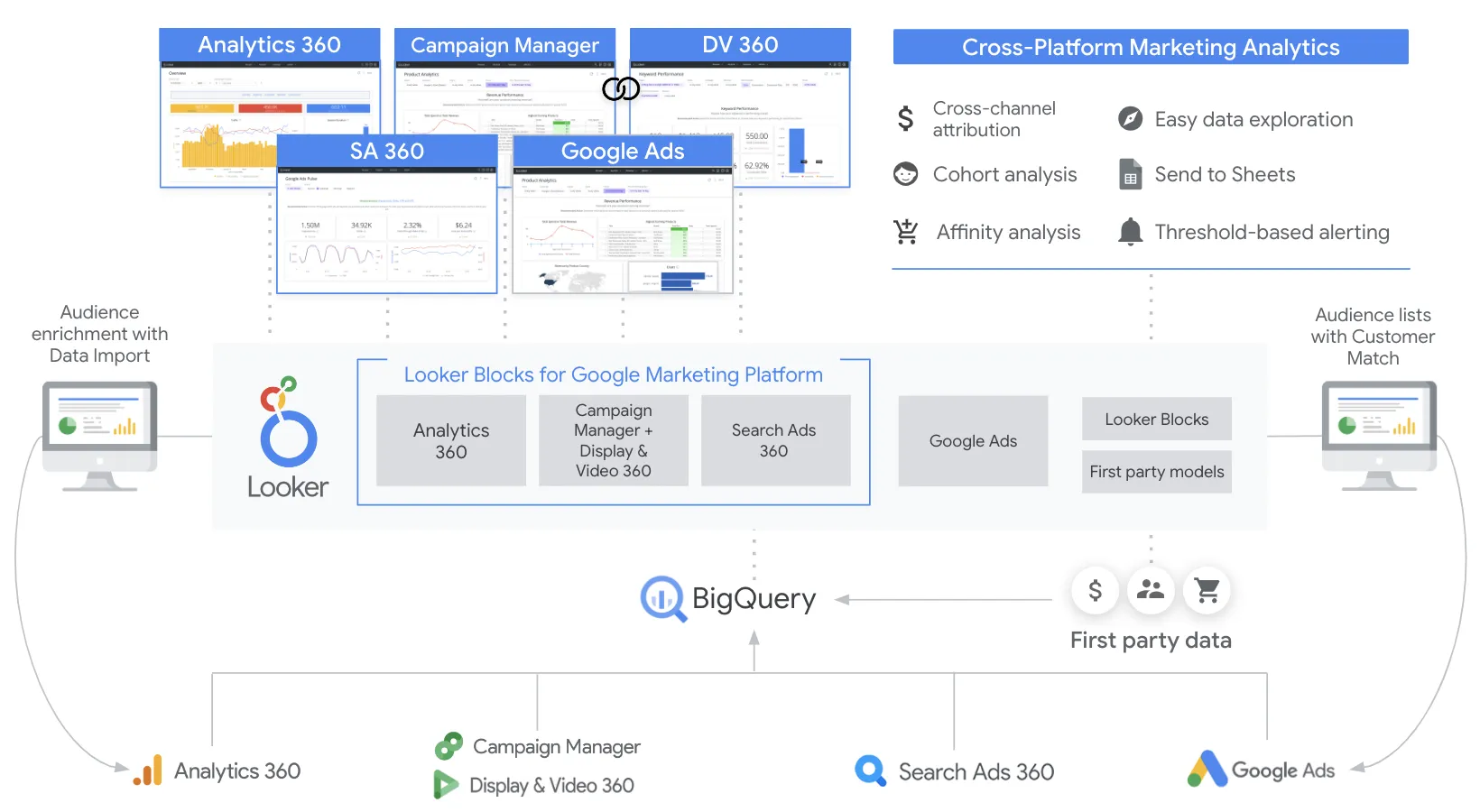
Feature Comparison
| Feature | Holistics | Looker |
|---|---|---|
| Semantic Modeling | ||
| Modeling Language | Code-based modeling layer for defining metrics, dimensions, and relationships across datasets | LookML language for declaring reusable metrics, joins, derived tables, and access permissions |
| Version Control | Supports version-controlled modeling workflows aligned with DevOps best practices | Native Git integration with branch-based development and pull request workflows for LookML models |
| Reusable Metrics | Centralized metric definitions in the semantic layer consumed across dashboards and reports | Governed metric definitions in LookML that produce consistent results across explores, dashboards, and APIs |
| Self-Service Analytics | ||
| Data Exploration | Self-service exploration for business users on top of governed data models | Explores allow business users to ask questions, expand filters, and drill down to row-level detail on governed data |
| Dashboard & Visualization | Interactive dashboards with visualization tools and drill-down capabilities | Enterprise dashboards with real-time data, repeatable analysis, and Looker Studio for drag-and-drop ad hoc reporting |
| Natural Language Interface | Not a core advertised capability | Conversational Analytics powered by Gemini for natural language data exploration |
| Data Pipeline & Transformation | ||
| Built-in Transformation | Integrated transformation pipeline for preparing and modeling data before visualization | Derived tables and Persistent Derived Tables (PDTs) within LookML for in-warehouse transformation |
| Direct Warehouse Querying | Queries data warehouses directly for analysis and reporting | Always queries warehouses directly with no intermediate data storage, ensuring fresh results |
| Data Source Connectivity | Connects to major cloud data warehouses and relational databases | Connects to Snowflake, BigQuery, Redshift, Databricks, and 60+ SQL dialects with optimized query generation |
| Embedded Analytics & APIs | ||
| Embedding Capabilities | Dashboard embedding for integrating analytics into external applications | Full embedded analytics suite with white-labeling, SSO, and interactive dashboards inside customer applications |
| API & SDK Access | API access for programmatic interaction with the platform | API-first architecture with REST APIs, SDKs, and comprehensive programmatic control over content and permissions |
| Custom Application Building | Not a primary use case; focused on internal analytics workflows | Purpose-built for creating custom data applications and data products with Looker extensions and Vertex AI integration |
| Governance & Security | ||
| Access Control | Role-based access control for managing user permissions across models and dashboards | Row-level and column-level security with audit features, SSO via Google Cloud IAM, and private networking |
| Data Governance | Governed semantic layer ensures consistent metrics across the organization | Governed LookML models serve as single source of truth; Gartner recognized Google as a Leader in 2025 Magic Quadrant for Analytics and BI |
| AI & Advanced Analytics | Focused on core BI capabilities; not a primary AI platform | Gemini-powered Conversational Analytics, Vertex AI integration, and gen AI extension framework |
Semantic Modeling
Modeling Language
Version Control
Reusable Metrics
Self-Service Analytics
Data Exploration
Dashboard & Visualization
Natural Language Interface
Data Pipeline & Transformation
Built-in Transformation
Direct Warehouse Querying
Data Source Connectivity
Embedded Analytics & APIs
Embedding Capabilities
API & SDK Access
Custom Application Building
Governance & Security
Access Control
Data Governance
AI & Advanced Analytics
Which to choose
Holistics and Looker both champion the semantic layer approach to business intelligence, but they serve different market segments and use cases. Holistics is a focused, self-service BI platform that bundles data modeling, transformation, and visualization with DevOps-friendly workflows, making it a strong choice for data teams that want a streamlined analytics tool without the complexity of a large enterprise platform. Looker is a full-scale enterprise BI platform backed by Google Cloud, offering LookML-based semantic modeling, embedded analytics, API-first extensibility, and AI-powered features through Gemini and Vertex AI integration. The right choice depends on whether your team needs a lean, integrated analytics workflow or an enterprise platform with deep cloud ecosystem integration and embedded analytics capabilities.
Best-fit scenarios
Choose Holistics if:
Choose Holistics if your team values a streamlined, all-in-one BI platform that combines data modeling, transformation, and self-service analytics with DevOps best practices. Holistics is well-suited for data teams that want to build a governed semantic layer and empower business users with self-service capabilities without the overhead of a large enterprise BI platform. Its built-in transformation pipeline reduces tool sprawl, and its code-first approach appeals to analytics engineers who want full control over their data models.
Choose Looker if:
Choose Looker if you need an enterprise-grade BI platform with deep embedded analytics, API-first architecture, and tight integration with Google Cloud services. Looker is the stronger option for organizations building customer-facing data products, those heavily invested in the GCP ecosystem, or teams that need AI-powered analytics through Gemini and Vertex AI. Its LookML modeling language, Git-native development workflows, and extensive marketplace of pre-built blocks and applications make it the more extensible platform for large-scale deployments.
These scenarios reflect the available product evidence. Your requirements, existing stack, and team expertise should guide the final decision.
Frequently Asked Questions
What is the main difference between Holistics and Looker?
Holistics is a self-service BI platform that combines data modeling, transformation, and visualization in a single tool with DevOps-friendly workflows. Looker is an enterprise BI platform built around LookML, a proprietary semantic modeling language, and now integrated deeply into Google Cloud Platform. Both platforms use a semantic layer approach to govern metrics, but Looker offers an extensive ecosystem with embedded analytics, API-first architecture, and AI-powered features through its Google Cloud integration.
Which platform is better for embedded analytics?
Looker is the stronger choice for embedded analytics. Its API-first architecture, white-labeling capabilities, SSO integration, and SDKs make it purpose-built for embedding interactive dashboards and analytics into SaaS products and customer-facing applications. Looker also supports building entirely custom data applications through its extension framework. Holistics supports dashboard embedding but does not match Looker's depth of embedding customization and programmatic control.
Do Holistics and Looker both support a semantic layer?
Yes. Both platforms take a modeling-first approach where data teams define metrics, relationships, and business logic in a central semantic layer that business users consume through self-service exploration. Holistics uses a code-based modeling layer, while Looker uses LookML, a purpose-built modeling language with Git-based version control. Both approaches ensure consistent metric definitions across dashboards and reports, reducing the risk of conflicting numbers across the organization.
How do Holistics and Looker compare on pricing?
Neither platform publishes transparent list prices. Holistics uses enterprise pricing that requires contacting their sales team for a custom quote. Looker operates on an annual commitment model with per-seat and usage-based components, also requiring contact with sales. Looker's pricing page mentions dollar amounts starting at $3.00 and $20.00 in the context of its usage pricing, but the total cost depends on user count, features, and data volume. Both platforms are positioned for mid-market and enterprise buyers.
Which platform integrates better with a modern data stack?
Both platforms connect directly to cloud data warehouses and support a modeling-first approach that fits modern analytics workflows. Holistics offers built-in transformation capabilities alongside its BI layer, reducing the need for a separate transformation tool. Looker integrates deeply with the Google Cloud ecosystem including BigQuery, Vertex AI, and Gemini, making it particularly strong for organizations already invested in GCP. Looker also offers a marketplace with pre-built blocks, applications, and plug-ins that extend its functionality.