Decision comparison
Holistics vs Tableau
Holistics and Tableau serve different BI philosophies. Holistics targets data teams that want a code-first, modeling-centric platform where transformation, semantic definitions, and dashboards live in one governed workflow. Tableau is a prominent provider of visual analytics with extensive visualization depth, a sizable ecosystem, AI-powered agentic capabilities through Agentforce, and flexible deployment across cloud, server, and desktop. The right choice depends on whether your priority is a streamlined code-driven analytics workflow or best-in-class visualization with enterprise-scale deployment options.
Direct comparison. These are reviewed substitutes bought for the same job, so the differences below are the ones that decide between them.
All 2 are BI platforms.
Quick Comparison
| Decision factor | Holistics | Tableau |
|---|---|---|
| Primary Focus | Code-first self-service BI with built-in data modeling and transformation | Visual analytics and interactive dashboarding at enterprise scale |
| Data Modeling | Native semantic layer with code-based metric definitions and version-controlled models | AI-infused Tableau Semantics layer integrated with Data 360 for unified business data |
| Deployment Model | Cloud-hosted SaaS platform | Tableau Cloud (SaaS), Tableau Server (self-hosted), or Tableau Desktop (local) |
| Pricing Approach | Entry is $960/month, or $800/month billed annually. Standard is $1200/month, or $1000/month annually. Security Compliance Suite is $2400/month, or $2000/month annually. Each includes the first 10 users; additional users are $15/month ($12.5 annually), and $18/month ($15 annually) on Security Compliance Suite. Custom Plan and Embedded Analytics are quote-based. A free trial is available. | Tableau Cloud Standard Edition: Viewer $15/user/month, Explorer $42/user/month, Creator $75/user/month; Enterprise Edition: Viewer $35/user/month, Explorer $70/user/month, Creator $115/user/month; Tableau+ Bundle requires contact sales for pricing details. |
| AI Capabilities | Focused on analytics automation through the semantic layer rather than agentic AI | Agentic analytics via Agentforce integration with autonomous AI agents for proactive insights |
| Best For | Data teams that prefer code-driven workflows, need built-in transformation, and want governed self-service analytics | Organizations needing strong visualization, broad deployment flexibility, and close Salesforce ecosystem integration |
Holistics
- Primary Focus:
- Code-first self-service BI with built-in data modeling and transformation
- Data Modeling:
- Native semantic layer with code-based metric definitions and version-controlled models
- Deployment Model:
- Cloud-hosted SaaS platform
- Pricing Approach:
- Entry is $960/month, or $800/month billed annually. Standard is $1200/month, or $1000/month annually. Security Compliance Suite is $2400/month, or $2000/month annually. Each includes the first 10 users; additional users are $15/month ($12.5 annually), and $18/month ($15 annually) on Security Compliance Suite. Custom Plan and Embedded Analytics are quote-based. A free trial is available.
- AI Capabilities:
- Focused on analytics automation through the semantic layer rather than agentic AI
- Best For:
- Data teams that prefer code-driven workflows, need built-in transformation, and want governed self-service analytics
Tableau
- Primary Focus:
- Visual analytics and interactive dashboarding at enterprise scale
- Data Modeling:
- AI-infused Tableau Semantics layer integrated with Data 360 for unified business data
- Deployment Model:
- Tableau Cloud (SaaS), Tableau Server (self-hosted), or Tableau Desktop (local)
- Pricing Approach:
- Tableau Cloud Standard Edition: Viewer $15/user/month, Explorer $42/user/month, Creator $75/user/month; Enterprise Edition: Viewer $35/user/month, Explorer $70/user/month, Creator $115/user/month; Tableau+ Bundle requires contact sales for pricing details.
- AI Capabilities:
- Agentic analytics via Agentforce integration with autonomous AI agents for proactive insights
- Best For:
- Organizations needing strong visualization, broad deployment flexibility, and close Salesforce ecosystem integration
Public signals
Verified factual signals only. Bars appear only for like-for-like metrics with five weekly assessments for every tool; missing evidence stays explicit. These signals do not establish enterprise adoption, product quality, or total cost.
| Metric | Holistics | Tableau |
|---|---|---|
| GitHub commits, 90d(Developer adoption) | 0 | 37 |
| GitHub stars(Developer adoption) | 1 | 716 |
| Search interest(Market interest) | 0 | 85 |
| Hacker News mentions, 90d(Community interest) | 0 | 2 |
| Product Hunt comments(Community interest) | 0 | 3 |
| Product Hunt rating(Community interest) | 5.0/5 | 4.2/5 |
| Product Hunt reviews(Community interest) | 1 | 5 |
| Product Hunt votes(Community interest) | 7 | 7 |
| npm weekly downloads(Developer adoption) | Not available | 32.2k |
| PyPI weekly downloads(Developer adoption) | Not available | 965.7k |
| Stack Overflow questions(Community interest) | Not available | 5.4k |
As of September 21, 2026 — updated weekly.
Health & risk evidence
Observed public-source checks for mapped package versions and repositories.
Holistics
Package vulnerabilities
Not available
Repository security score
Not available
Tableau
September 21, 2026Package vulnerabilities
npm · @tableau/embedding-api@3.16.1 · PyPI · tableauserverclient@0.41
0 vulnerabilities
across 2 packages
Repository security score
github.com/tableau/server-client-python
5.5/10
Interface Preview
Tableau
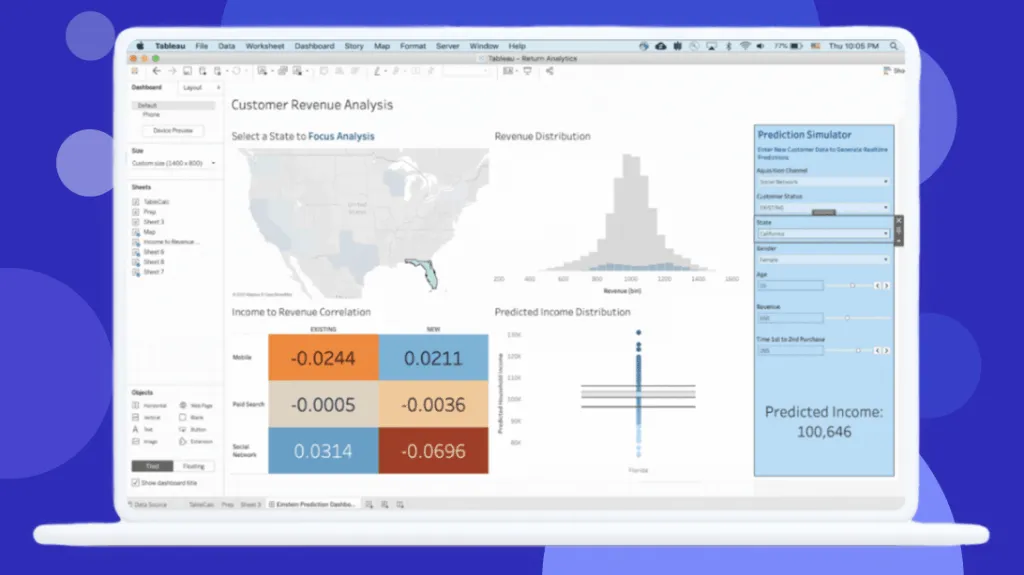
Feature Comparison
| Feature | Holistics | Tableau |
|---|---|---|
| Data Modeling & Transformation | ||
| Semantic Layer | Native code-based semantic layer where analysts define metrics, dimensions, and relationships as versioned code | AI-infused Tableau Semantics integrated with Data 360, with AI-assisted semantic model creation |
| Built-in Data Transformation | Integrated transformation pipelines that run inside the BI platform, reducing reliance on external ETL tools | Tableau Prep Builder included with Creator license for data cleaning and shaping; complex ETL typically requires external tools like dbt |
| Version Control for Analytics | Git-based version control and DevOps workflows for data models and dashboard definitions | Content versioning through Tableau Server/Cloud revision history; no native Git integration for dashboard code |
| Visualization & Dashboards | ||
| Dashboard Builder | Drag-and-drop dashboard creation on top of governed semantic models with self-service exploration | Industry-leading drag-and-drop visual analytics with advanced chart types, drill-downs, and interactive filters |
| Chart Type Variety | Standard chart types covering common business reporting needs | Extensive visualization library including geographic maps, scatter plots, waterfall charts, and custom calculated visuals |
| Mobile Access | Responsive dashboards accessible through web browsers on mobile devices | Dedicated Tableau Mobile app with offline capabilities and touch-optimized interactions |
| AI & Automation | ||
| AI-Powered Insights | Analytics automation driven by the semantic layer; no dedicated AI agent features | Agentforce Tableau delivers proactive insights, natural language Q&A, and autonomous data preparation agents |
| Natural Language Queries | Not a core feature; users interact through the governed exploration interface | Ask Data and Agentforce enable natural language questions directly within dashboards and Slack |
| Workflow Automation | Scheduled report delivery and automated transformation pipeline execution | Built-in enterprise workflow solution enabling action at the point of insight with Salesforce integration |
| Deployment & Integration | ||
| Deployment Options | Cloud-hosted SaaS; connects to cloud data warehouses | Tableau Cloud (SaaS), Tableau Server (self-hosted on-premises or private cloud), and Tableau Desktop (local authoring) |
| Ecosystem Integration | Integrates with major cloud data warehouses; focused on the analytics workflow | Deep Salesforce CRM integration, Slack analytics, 80+ native connectors, and API-first composable architecture |
| Embedded Analytics | Embedding capabilities for integrating dashboards into external applications | Enterprise-grade embedded analytics available through Enterprise edition with additional licensing |
| Governance & Collaboration | ||
| Access Controls | Role-based access controls with governed data models ensuring consistent metric definitions | Row-level security, site roles (Creator/Explorer/Viewer), and enterprise SSO with advanced security in Enterprise edition |
| Collaboration Features | Shared dashboards with team-based governance through the semantic layer | Comments, subscriptions, Slack channel sharing with permission-aware metrics, and Tableau Public for community sharing |
| Community & Support | Growing community with documentation and direct support channels | One of the largest BI communities with millions of members, Tableau Public gallery, annual Tableau Conference, and extensive training catalog |
Data Modeling & Transformation
Semantic Layer
Built-in Data Transformation
Version Control for Analytics
Visualization & Dashboards
Dashboard Builder
Chart Type Variety
Mobile Access
AI & Automation
AI-Powered Insights
Natural Language Queries
Workflow Automation
Deployment & Integration
Deployment Options
Ecosystem Integration
Embedded Analytics
Governance & Collaboration
Access Controls
Collaboration Features
Community & Support
Which to choose
Holistics and Tableau serve different BI philosophies. Holistics targets data teams that want a code-first, modeling-centric platform where transformation, semantic definitions, and dashboards live in one governed workflow. Tableau is a prominent provider of visual analytics with extensive visualization depth, a sizable ecosystem, AI-powered agentic capabilities through Agentforce, and flexible deployment across cloud, server, and desktop. The right choice depends on whether your priority is a streamlined code-driven analytics workflow or best-in-class visualization with enterprise-scale deployment options.
Best-fit scenarios
Choose Holistics if:
Choose Holistics if your data team values a code-first approach to analytics. Holistics combines data modeling, transformation pipelines, and visualization into one platform, which eliminates the need for a separate semantic layer tool and reduces the number of moving parts in your data stack. The DevOps-style version control for analytics assets makes it a strong fit for teams that already work with Git-based workflows and want to treat their BI layer with the same rigor as production code. Holistics is particularly well suited for mid-size data teams that need governed self-service analytics without the complexity and per-user cost escalation of enterprise BI platforms.
Choose Tableau if:
Choose Tableau if your organization needs best-in-class data visualization and a proven enterprise analytics platform. Tableau offers the deepest visualization library in the BI market, flexible deployment across Cloud, Server, and Desktop, and a mature ecosystem that includes Salesforce CRM integration, Slack-native analytics, and agentic AI through Agentforce. The per-user pricing (Viewer at $15/month, Explorer at $42/month, Creator at $75/month for Standard Cloud) does scale up quickly for large teams, so careful license mix planning is essential. Tableau makes the most sense for organizations that already invest in the Salesforce ecosystem, need advanced interactive dashboards, and have dedicated analysts who can leverage the full Creator toolset.
These scenarios reflect the available product evidence. Your requirements, existing stack, and team expertise should guide the final decision.
Frequently Asked Questions
Is Holistics a direct replacement for Tableau?
Not exactly. Holistics and Tableau solve overlapping but different problems. Holistics focuses on a code-first BI workflow that bundles data modeling, transformation, and visualization in one platform, making it a good fit for data teams that want a streamlined, governed analytics pipeline. Tableau is a visualization-first platform with extensive charting capabilities, a sizable connector ecosystem, and enterprise deployment options. Teams that prioritize advanced visualization and have separate tools for data modeling (like dbt) will find Tableau more capable on the dashboard side, while teams that want an all-in-one analytics platform with built-in modeling will prefer Holistics.
How does pricing compare between Holistics and Tableau?
Holistics uses enterprise pricing that requires contacting their sales team for a custom quote. Tableau uses per-user tiered pricing: Standard Cloud edition starts at $15/user/month for Viewers, $42/user/month for Explorers, and $75/user/month for Creators (billed annually). Tableau Enterprise edition roughly doubles those rates (Viewer $35, Explorer $70, Creator $115 per user/month). For a mid-size team of 5 Creators, 15 Explorers, and 50 Viewers, Tableau Standard Cloud costs approximately $60,900 per year. Holistics pricing depends on the negotiated deal, so teams should request quotes from both vendors to compare total cost of ownership.
Which tool is better for teams that use dbt?
Tableau pairs naturally with dbt because Tableau is a pure visualization layer that consumes data models built externally. Teams already using dbt for transformation and modeling can connect Tableau directly to their warehouse and build dashboards on top of dbt-managed tables. Holistics takes a different approach by providing its own built-in data modeling and transformation layer, which can overlap with what dbt already does. If your team is invested in dbt, Tableau avoids that overlap; if you want to consolidate your modeling and BI into one platform, Holistics offers that integrated experience.
Can both tools handle self-service analytics for non-technical users?
Both platforms support self-service analytics, but they approach it differently. Tableau gives business users interactive dashboards with drag-and-drop filtering, drill-downs, natural language queries through Ask Data, and AI-powered Agentforce for conversational analytics. The Explorer license ($42/month) enables web-based editing for power users. Holistics empowers business users through a governed semantic layer where data teams define the metrics and dimensions, and business users explore data within those guardrails. Holistics aims to prevent inconsistent metric definitions by design, while Tableau offers more ad-hoc exploration freedom with governance enforced through permissions and published data sources.