Decision comparison
MLflow vs Amazon SageMaker
MLflow and Amazon SageMaker serve different segments of the MLOps market with minimal overlap in their core value propositions. MLflow dominates as the open-source standard for experiment tracking and LLM observability, while SageMaker provides unmatched managed infrastructure for teams committed to AWS. The right choice depends entirely on whether your team prioritizes vendor independence and community-driven innovation or fully managed infrastructure with enterprise governance.
Architecture choice. These take different approaches to the same problem. Read the table as a fit question rather than a feature race.
These are different kinds of product — Experiment Tracking and ML Platform.
Quick Comparison
| Decision factor | MLflow | Amazon SageMaker |
|---|---|---|
| Pricing | Open-source license (Apache-2.0), self-hosted for free | Pay-as-you-go by component. SageMaker Unified Studio has a free tier: the first 2 months of 250 hours of sc.t3.medium notebook instances, plus 20 MB of metadata storage, 4,000 API requests and 0.2 compute units a month. Beyond that, notebooks bill by instance type and storage duration, the Data Agent is $0.04 per credit, and SageMaker Catalog is $10 per 100,000 requests, $0.40 per GB of metadata storage and $1.776 per compute unit. |
| Ease of Setup | Single command install via pip or Docker; tracking server launches in 30 seconds with minimal configuration | Fully managed AWS service requiring IAM setup and VPC configuration; steeper learning curve for non-AWS teams |
| Experiment Tracking | Prominent tracking with parameters, metrics, and artifacts; 30M+ monthly downloads demonstrate established adoption | SageMaker Experiments provides managed tracking integrated with training jobs; tighter AWS coupling limits portability |
| Model Deployment | Agent Server deploys models via FastAPI with streaming and tracing; requires self-managed scaling infrastructure | One-click real-time endpoints with auto-scaling, serverless inference, and shadow testing for production validation |
| Integrations | Works with 100+ frameworks including LangChain, OpenAI, PyTorch; supports any cloud without vendor lock-in | Deep AWS ecosystem integration with Lambda, S3, Redshift, and Bedrock; limited flexibility outside AWS perimeter |
| User Ratings | Rated 8/10 based on 3 reviews; 27,000+ GitHub stars and 900+ contributors reflect strong community trust | Rated 8.8/10 across 59 reviews; 4.4/5 across 171 web reviews with enterprise teams praising stability |
MLflow
- Pricing:
- Open-source license (Apache-2.0), self-hosted for free
- Ease of Setup:
- Single command install via pip or Docker; tracking server launches in 30 seconds with minimal configuration
- Experiment Tracking:
- Prominent tracking with parameters, metrics, and artifacts; 30M+ monthly downloads demonstrate established adoption
- Model Deployment:
- Agent Server deploys models via FastAPI with streaming and tracing; requires self-managed scaling infrastructure
- Integrations:
- Works with 100+ frameworks including LangChain, OpenAI, PyTorch; supports any cloud without vendor lock-in
- User Ratings:
- Rated 8/10 based on 3 reviews; 27,000+ GitHub stars and 900+ contributors reflect strong community trust
Amazon SageMaker
- Pricing:
- Pay-as-you-go by component. SageMaker Unified Studio has a free tier: the first 2 months of 250 hours of sc.t3.medium notebook instances, plus 20 MB of metadata storage, 4,000 API requests and 0.2 compute units a month. Beyond that, notebooks bill by instance type and storage duration, the Data Agent is $0.04 per credit, and SageMaker Catalog is $10 per 100,000 requests, $0.40 per GB of metadata storage and $1.776 per compute unit.
- Ease of Setup:
- Fully managed AWS service requiring IAM setup and VPC configuration; steeper learning curve for non-AWS teams
- Experiment Tracking:
- SageMaker Experiments provides managed tracking integrated with training jobs; tighter AWS coupling limits portability
- Model Deployment:
- One-click real-time endpoints with auto-scaling, serverless inference, and shadow testing for production validation
- Integrations:
- Deep AWS ecosystem integration with Lambda, S3, Redshift, and Bedrock; limited flexibility outside AWS perimeter
- User Ratings:
- Rated 8.8/10 across 59 reviews; 4.4/5 across 171 web reviews with enterprise teams praising stability
Public signals
Verified factual signals only. Bars appear only for like-for-like metrics with five weekly assessments for every tool; missing evidence stays explicit. These signals do not establish enterprise adoption, product quality, or total cost.
| Metric | MLflow | Amazon SageMaker |
|---|---|---|
| GitHub commits, 90d(Product adoption) | 874 | Not available |
| GitHub stars(Product adoption) | 27,000+ | Not available |
| Search interest(Market interest) | 2 | 1 |
| Hacker News mentions, 90d(Community interest) | 1 | 2 |
| PyPI weekly downloads(Product adoption) | 4.9M | Not available |
| Stack Overflow questions(Community interest) | 771 | 3.0k |
| GitHub commits, 90d(Developer adoption) | Not available | 153 |
| GitHub stars(Developer adoption) | Not available | 2,000+ |
| npm weekly downloads(Developer adoption) | Not available | 434.9k |
| Product Hunt comments(Community interest) | Not available | 1 |
| Product Hunt rating(Community interest) | Not available | 4.6/5 |
| Product Hunt reviews(Community interest) | Not available | 17 |
| Product Hunt votes(Community interest) | Not available | 10 |
| PyPI weekly downloads(Developer adoption) | Not available | 4.2M |
As of September 14, 2026 — updated weekly.
Health & risk evidence
Observed public-source checks for mapped package versions and repositories.
MLflow
September 14, 2026Package vulnerabilities
PyPI · mlflow@3.16.0
0 vulnerabilities
across 1 package
Repository security score
Not available
Amazon SageMaker
September 14, 2026Package vulnerabilities
npm · @aws-sdk/client-sagemaker@3.1131.0 · PyPI · sagemaker@3.21.0
0 vulnerabilities
across 2 packages
Repository security score
github.com/aws/sagemaker-python-sdk
5.4/10
Interface Preview
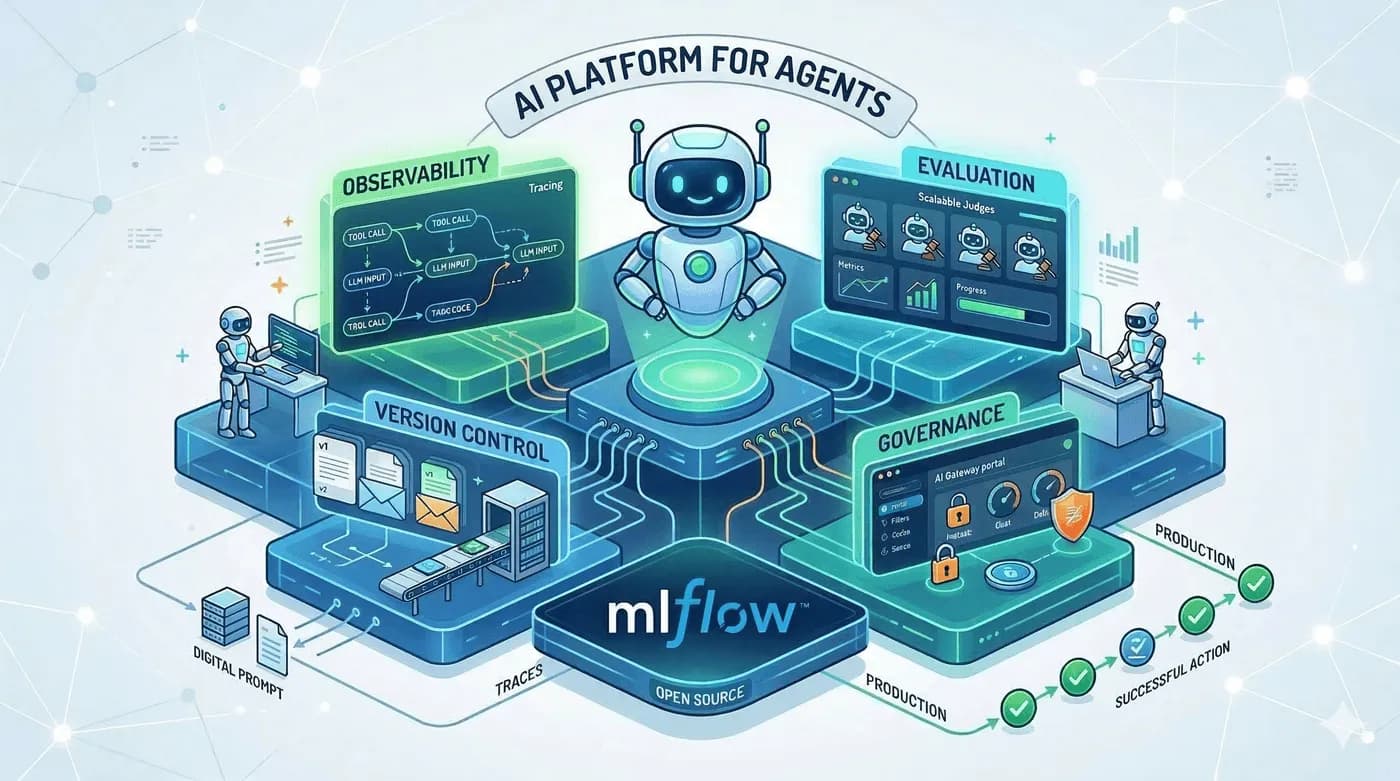
MLflow
Amazon SageMaker
Feature Comparison
| Feature | MLflow | Amazon SageMaker |
|---|---|---|
| Experiment Tracking & Observability | ||
| Experiment Logging | Tracks parameters, metrics, artifacts, and code versions with OpenTelemetry-based distributed tracing | SageMaker Experiments logs training metrics and parameters tied to managed training jobs and trials |
| LLM Observability | Captures complete LLM traces with 50+ built-in metrics and LLM judges for quality scoring | Integrates with Amazon Bedrock for foundation model monitoring and toxicity detection via guardrails |
| Production Monitoring | Monitors production quality, costs, and safety through real-time trace analysis dashboards | Model Monitor detects data drift and bias with scheduled or real-time endpoint monitoring jobs |
| Model Training & Development | ||
| Training Infrastructure | Framework-agnostic training that runs on any compute; user provisions and manages GPU clusters | HyperPod provides resilient distributed training with automatic faulty node replacement across GPU clusters |
| AutoML Capabilities | Focuses on prompt optimization with state-of-the-art algorithms for LLM performance improvement | SageMaker Autopilot automatically selects algorithms, tunes hyperparameters, and generates production-ready models |
| Development Environment | Lightweight Python SDK with autologging; integrates with any IDE or notebook environment natively | Unified Studio provides managed JupyterLab notebooks with built-in AI agent and serverless compute |
| Deployment & Serving | ||
| Model Serving | Agent Server provides FastAPI-based hosting with request validation, streaming, and built-in tracing | Real-time endpoints, serverless inference, and async batch processing with managed auto-scaling |
| Edge Deployment | Supports model export in standard formats for deployment on any target platform or device | SageMaker Edge Manager optimizes and deploys models directly to IoT and edge devices |
| CI/CD Pipelines | Integrates with external CI/CD tools through flexible APIs and model registry webhooks | SageMaker Pipelines provides purpose-built ML CI/CD with CodePipeline and CloudFormation integration |
| Data Management & Governance | ||
| Feature Store | Relies on third-party feature stores like Feast or Tecton via open integration architecture | SageMaker Feature Store provides managed online and offline feature storage with real-time serving |
| Model Registry | Central model registry with versioning, stage transitions, and lineage tracking across teams | Model Package registry with approval workflows, deployment metadata, and marketplace certification |
| Data Governance | Tracks experiment lineage and model provenance through comprehensive metadata logging capabilities | SageMaker Catalog provides fine-grained access controls, data classification, and ML lineage tracking |
| AI & LLM Operations | ||
| LLM Gateway | AI Gateway provides unified OpenAI-compatible API for routing requests across all LLM providers | Routes LLM requests through Amazon Bedrock with access to Claude, Llama, and proprietary models |
| Prompt Management | Version, test, and deploy prompts with full lineage tracking and automated optimization algorithms | Manages prompts through Bedrock console with template versioning and playground testing capabilities |
| Bias & Explainability | Evaluation framework with custom metrics and LLM judges for fairness and quality assessment | SageMaker Clarify detects bias in data and models with SHAP-based explainability reports |
Experiment Tracking & Observability
Experiment Logging
LLM Observability
Production Monitoring
Model Training & Development
Training Infrastructure
AutoML Capabilities
Development Environment
Deployment & Serving
Model Serving
Edge Deployment
CI/CD Pipelines
Data Management & Governance
Feature Store
Model Registry
Data Governance
AI & LLM Operations
LLM Gateway
Prompt Management
Bias & Explainability
Which approach fits
MLflow and Amazon SageMaker serve different segments of the MLOps market with minimal overlap in their core value propositions. MLflow dominates as the open-source standard for experiment tracking and LLM observability, while SageMaker provides unmatched managed infrastructure for teams committed to AWS. The right choice depends entirely on whether your team prioritizes vendor independence and community-driven innovation or fully managed infrastructure with enterprise governance.
When each approach fits
Choose MLflow if:
Choose MLflow if your team values vendor independence, operates across multiple cloud providers, or needs best-in-class LLM observability and experiment tracking. With 30 million monthly downloads, 25,450 GitHub stars, and 900+ contributors, MLflow delivers a widely adopted open-source platform for tracking experiments, managing prompts, and monitoring AI applications in production. Its Apache-2.0 license means zero software costs, and the AI Gateway provides a unified interface across all LLM providers without lock-in.
Choose Amazon SageMaker if:
Choose Amazon SageMaker if your organization is already invested in AWS infrastructure and needs fully managed, enterprise-grade ML operations with minimal DevOps burden. SageMaker eliminates infrastructure management through HyperPod for resilient distributed training, Autopilot for automated model building, and one-click endpoints with auto-scaling. Its 8.8/10 rating across 59 reviews reflects strong enterprise satisfaction, and the Unified Studio with lakehouse architecture provides an integrated experience for teams that need data engineering and ML operations in a single governed environment.
These scenarios reflect the available product evidence. Your requirements, existing stack, and team expertise should guide the final decision.
Frequently Asked Questions
Can MLflow and Amazon SageMaker be used together?
Yes, and AWS explicitly supports this combination. Amazon SageMaker includes a managed MLflow Tracking Server as a native CloudFormation resource (AWS::SageMaker::MlflowTrackingServer), which means you can run MLflow experiment tracking on fully managed AWS infrastructure. This lets teams use MLflow's open-source tracking UI and API while leveraging SageMaker's managed training jobs and endpoints for compute. Many organizations adopt this hybrid approach to get MLflow's vendor-neutral experiment tracking alongside SageMaker's managed infrastructure capabilities.
Which platform is more cost-effective for a small data science team?
MLflow is significantly more cost-effective for small teams because the software itself is completely free under the Apache-2.0 license. You only pay for the infrastructure you choose to host it on, which can be as simple as a single server or a small cloud instance. Amazon SageMaker's usage-based pricing starts at $0.04/hr for basic notebook instances and scales to $0.23/hr+ for training on ml.m5.xlarge instances, with additional charges for storage, data processing, and endpoint hosting. For teams running occasional experiments, SageMaker's costs add up quickly compared to MLflow on modest self-managed infrastructure.
Which tool provides better support for LLM and agent development workflows?
MLflow has a clear advantage for LLM and agent development. It offers purpose-built LLMOps features including OpenTelemetry-based trace capture for LLM applications, an AI Gateway that provides a unified OpenAI-compatible API across all LLM providers, automated prompt optimization, and an Agent Server that deploys agents to production with a single command. SageMaker addresses LLM workflows primarily through Amazon Bedrock integration for accessing foundation models and basic monitoring. Teams building LLM-powered applications and AI agents will find MLflow's tooling more comprehensive and framework-agnostic.
How do the two platforms compare for enterprise governance and compliance?
Amazon SageMaker provides deeper enterprise governance capabilities out of the box. It includes SageMaker Catalog with fine-grained access controls, IAM-based authentication, VPC isolation, KMS encryption for data at rest and in transit, Model Cards for documentation compliance, and SageMaker Clarify for automated bias detection with SHAP-based explainability. MLflow offers experiment lineage tracking, model versioning with stage gates, and role-based access in its managed offerings, but self-hosted deployments require teams to implement their own security layers. Organizations in regulated industries with existing AWS infrastructure will find SageMaker's governance more turnkey.