Decision comparison
Monte Carlo vs OpenMetadata
Monte Carlo and OpenMetadata represent two distinct philosophies for managing data quality and reliability. Monte Carlo is a fully managed, commercial observability platform that goes deep on automated incident detection, ML-driven monitoring, and AI agent observability. It is built for enterprise teams that need fast deployment, automatic coverage scaling, and end-to-end visibility from ingestion to consumption. OpenMetadata is an open-source, community-driven metadata platform that goes wide across discovery, quality, observability, governance, and collaboration. It gives teams full control over their metadata infrastructure with no licensing cost and no vendor lock-in. The right choice depends on whether your priority is deep, automated observability with managed operations or a broad, self-hosted metadata platform that covers the entire data lifecycle.
Architecture choice. These take different approaches to the same problem. Read the table as a fit question rather than a feature race.
These are different kinds of product — Data Observability and Data Catalog.
Quick Comparison
| Decision factor | Monte Carlo | OpenMetadata |
|---|---|---|
| Primary Focus | End-to-end data and AI observability with automated incident detection and resolution | Unified metadata management for discovery, quality, observability, and governance |
| Deployment Model | Fully managed SaaS with cloud-native architecture | Self-hosted open source (Apache 2.0) or managed SaaS via Collate |
| Data Quality Approach | ML-driven anomaly detection with automatic baseline monitors for freshness, volume, and schema | Built-in data profiling and quality checks integrated into the metadata platform |
| Connector Ecosystem | Deep integrations across warehouses, BI tools, ETL, lakes, and AI agent frameworks | 120+ native connectors covering databases, dashboards, pipelines, ML models, and storage |
| Pricing Model | Monte Carlo publishes no amounts. Its tiers are Start, Scale, Enterprise and Business Critical, purchased as credits, and all are quote-only. Every tier includes agent, ML and data observability. | Free and open-source under Apache 2.0 license |
| Best For | Enterprise teams needing automated observability across data pipelines and AI agents | Teams wanting an all-in-one open-source platform for metadata, discovery, and governance |
Monte Carlo
- Primary Focus:
- End-to-end data and AI observability with automated incident detection and resolution
- Deployment Model:
- Fully managed SaaS with cloud-native architecture
- Data Quality Approach:
- ML-driven anomaly detection with automatic baseline monitors for freshness, volume, and schema
- Connector Ecosystem:
- Deep integrations across warehouses, BI tools, ETL, lakes, and AI agent frameworks
- Pricing Model:
- Monte Carlo publishes no amounts. Its tiers are Start, Scale, Enterprise and Business Critical, purchased as credits, and all are quote-only. Every tier includes agent, ML and data observability.
- Best For:
- Enterprise teams needing automated observability across data pipelines and AI agents
OpenMetadata
- Primary Focus:
- Unified metadata management for discovery, quality, observability, and governance
- Deployment Model:
- Self-hosted open source (Apache 2.0) or managed SaaS via Collate
- Data Quality Approach:
- Built-in data profiling and quality checks integrated into the metadata platform
- Connector Ecosystem:
- 120+ native connectors covering databases, dashboards, pipelines, ML models, and storage
- Pricing Model:
- Free and open-source under Apache 2.0 license
- Best For:
- Teams wanting an all-in-one open-source platform for metadata, discovery, and governance
Public signals
Verified factual signals only. Bars appear only for like-for-like metrics with five weekly assessments for every tool; missing evidence stays explicit. These signals do not establish enterprise adoption, product quality, or total cost.
| Metric | Monte Carlo | OpenMetadata |
|---|---|---|
| GitHub commits, 90d(Developer adoption) | 231 | Not available |
| GitHub stars(Developer adoption) | 2 | Not available |
| Search interest(Market interest) | 0 | 1 |
| Hacker News mentions, 90d(Community interest) | 0 | Not available |
| PyPI weekly downloads(Developer adoption) | 41.2k | Not available |
| Docker Hub pulls(Product adoption) | Not available | 5.3M |
| GitHub commits, 90d(Product adoption) | Not available | 2.0k |
| GitHub stars(Product adoption) | Not available | 15,000+ |
| PyPI weekly downloads(Product adoption) | Not available | 39.9k |
As of September 21, 2026 — updated weekly.
Health & risk evidence
Observed public-source checks for mapped package versions and repositories.
Monte Carlo
September 21, 2026Package vulnerabilities
PyPI · montecarlodata@0.175.0
0 vulnerabilities
across 1 package
Repository security score
Not available
OpenMetadata
September 21, 2026Package vulnerabilities
PyPI · openmetadata-ingestion@2.0.2.0
0 vulnerabilities
across 1 package
Repository security score
github.com/open-metadata/OpenMetadata
4.6/10
Interface Preview
Monte Carlo
Feature Comparison
| Feature | Monte Carlo | OpenMetadata |
|---|---|---|
| Observability & Monitoring | ||
| Anomaly Detection | ML-driven anomaly detection with automatic baseline coverage out of the box | Data profiling with configurable quality tests and threshold-based alerts |
| Incident Management | Full incident lifecycle with intelligent alerting, lineage grouping, and root cause analysis | Alerting and notification framework tied to metadata events and test results |
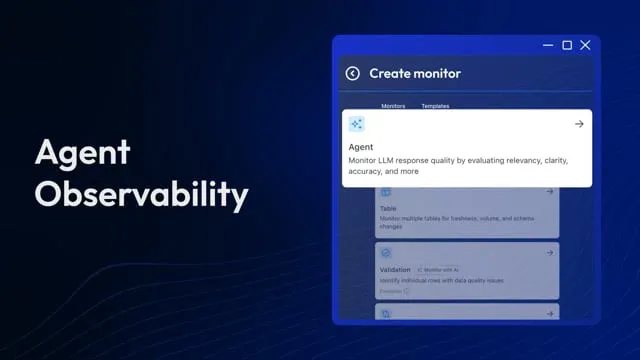
| AI/Agent Observability | Dedicated agent observability for monitoring AI inputs, outputs, and behavior in production | Not a core capability; focused on data asset metadata rather than AI agent monitoring |
| Data Discovery & Catalog | ||
| Data Catalog | Not a standalone catalog; provides observability dashboards and asset health views | Full-featured catalog with search, faceted discovery, and preview across the data estate |
| Metadata Management | Collects operational metadata for monitoring purposes; not a metadata store | Centralized metadata repository with versioning, standardized schemas, and APIs |
| Data Lineage | End-to-end column-level lineage with visual tracking from ingestion to consumption | Column-level lineage and data transformation tracking across connected services |
| Governance & Collaboration | ||
| Data Governance | Governance through observability; SLA tracking and coverage monitoring for data assets | Full governance workflows with metadata versioning, ownership, and policy management |
| Team Collaboration | Contextual incident notifications routed to relevant data owners and stakeholders | Built-in collaboration with conversations, task assignments, and announcements on data assets |
| Business Glossary | Not a core feature; focused on operational metadata | Centralized glossary with hierarchical terms, ownership, and asset linking |
| Integration & Deployment | ||
| Connector Breadth | Deep integrations with warehouses, BI, ETL, lakes, and AI agent frameworks like Langchain and Databricks Genie | 120+ native connectors spanning databases, dashboards, pipelines, ML models, messaging, and storage |
| API & Extensibility | REST APIs and webhooks available at Scale tier and above for automation and data exports | API-first architecture with standardized schemas; fully extensible metadata entities |
| Deployment Flexibility | Fully managed SaaS; self-hosted storage option available at Scale tier | Self-hosted open source, Docker, Kubernetes, or managed SaaS via Collate |
| Scalability & Enterprise Readiness | ||
| User Management | Up to 10 users on Start tier; unlimited users on Scale, Enterprise, and Business Critical | Built-in user management with teams, roles, and policies; no per-user limits in open source |
| Enterprise Security | SSO, SCIM, self-hosted storage, PII filtering, and audit logging from Scale tier onward | SSO support, role-based access control, and data classification in the open-source edition |
| Multi-Environment Support | Multi-workspace support for testing and development at Enterprise tier | Multi-service support with configurable environments through the ingestion framework |
Observability & Monitoring
Anomaly Detection
Incident Management
AI/Agent Observability
Data Discovery & Catalog
Data Catalog
Metadata Management
Data Lineage
Governance & Collaboration
Data Governance
Team Collaboration
Business Glossary
Integration & Deployment
Connector Breadth
API & Extensibility
Deployment Flexibility
Scalability & Enterprise Readiness
User Management
Enterprise Security
Multi-Environment Support
Which approach fits
Monte Carlo and OpenMetadata represent two distinct philosophies for managing data quality and reliability. Monte Carlo is a fully managed, commercial observability platform that goes deep on automated incident detection, ML-driven monitoring, and AI agent observability. It is built for enterprise teams that need fast deployment, automatic coverage scaling, and end-to-end visibility from ingestion to consumption. OpenMetadata is an open-source, community-driven metadata platform that goes wide across discovery, quality, observability, governance, and collaboration. It gives teams full control over their metadata infrastructure with no licensing cost and no vendor lock-in. The right choice depends on whether your priority is deep, automated observability with managed operations or a broad, self-hosted metadata platform that covers the entire data lifecycle.
When each approach fits
Choose Monte Carlo if:
Choose Monte Carlo if your top priority is automated data and AI observability at enterprise scale. The platform delivers ML-driven anomaly detection, automatic baseline monitors, full incident lifecycle management, and dedicated agent observability out of the box. It connects in seconds, scales automatically with your environment, and has been battle-tested across hundreds of production environments including customers like Nasdaq, JetBlue, and Axios. Teams that need to reduce data downtime, catch quality issues before they reach stakeholders, and monitor AI agents in production will get immediate value from Monte Carlo.
Choose OpenMetadata if:
Choose OpenMetadata if you want a unified, open-source platform that covers metadata management, data discovery, quality, governance, and collaboration without licensing costs. With 120+ native connectors, an API-first architecture, and a streamlined four-component deployment, OpenMetadata provides comprehensive data operations capabilities that scale with your organization. Teams that value open-source flexibility, community-driven development, and full control over their metadata infrastructure will find OpenMetadata the stronger long-term foundation for their data stack.
These scenarios reflect the available product evidence. Your requirements, existing stack, and team expertise should guide the final decision.
Frequently Asked Questions
What is the main difference between Monte Carlo and OpenMetadata?
Monte Carlo is a commercial data and AI observability platform purpose-built for detecting, diagnosing, and resolving data incidents across the full data stack. OpenMetadata is an open-source unified metadata platform that combines data discovery, quality, observability, governance, and collaboration in a single solution. Monte Carlo goes deep on automated monitoring and incident management, while OpenMetadata provides a broader but more self-managed approach to metadata-driven data operations.
Can OpenMetadata replace Monte Carlo for data observability?
OpenMetadata includes built-in data quality and observability features such as profiling, quality tests, and alerting. However, Monte Carlo offers significantly deeper observability capabilities including ML-driven anomaly detection, automatic baseline monitors, full incident lifecycle management, and dedicated AI agent observability. For teams with basic observability needs, OpenMetadata may be sufficient. For enterprises running mission-critical pipelines that require automated detection and root cause analysis, Monte Carlo remains the more capable platform.
Is OpenMetadata really free to use?
Yes. OpenMetadata is released under the Apache 2.0 license and is free to download, deploy, and use. The project has 15,000+ GitHub stars, 450+ contributors, and 4,000+ enterprise deployments. The trade-off is that you manage the infrastructure yourself. For teams that prefer a managed experience, the founders also offer Collate, a SaaS version of OpenMetadata with additional enterprise features and support.
Which tool is better for a team just starting with data quality?
For teams with limited budgets and strong engineering capacity, OpenMetadata is a strong starting point. It provides data discovery, quality checks, profiling, lineage, and governance in a single open-source package. For teams that need fast time-to-value with minimal setup and prefer a managed service, Monte Carlo connects in seconds and starts monitoring out of the box with automatic baseline coverage. The right choice depends on whether you prioritize cost savings and platform control or speed of deployment and depth of automated monitoring.
Can Monte Carlo and OpenMetadata be used together?
Yes. The two platforms serve complementary roles. OpenMetadata can serve as your central metadata catalog and governance layer, managing data discovery, business glossary, and ownership across the organization. Monte Carlo can handle the operational observability layer, continuously monitoring pipeline health, detecting anomalies, and managing incidents. Using both together gives you comprehensive metadata management alongside deep automated observability.