Decision comparison
New Relic vs SigNoz
New Relic and SigNoz are both credible answers for a team that wants tracing, metrics and logs without building a platform, and they diverge on where the cost sits. New Relic's free tier — 100 GB a month and one full user — makes it the easiest commercial APM to start with, and its pricing is per ingested GB plus per user rather than per host. SigNoz is open source and OpenTelemetry-native on ClickHouse, so cost moves to infrastructure and the person who runs it.
Architecture choice. These take different approaches to the same problem. Read the table as a fit question rather than a feature race.
Applies to: SaaS-managed web and mobile APM workloads across cloud and datacenter environments
All 2 are observability platforms.
Quick Comparison
| Decision factor | New Relic | SigNoz |
|---|---|---|
| What it is | A commercial SaaS observability platform with a consumption model and a large free tier | An open-source OpenTelemetry-native platform storing telemetry in ClickHouse |
| Entry cost | A free tier covering 100 GB per month and one full user, which takes small teams a long way | Free software; the cost is the ClickHouse cluster and the time to operate it |
| Pricing shape | Free tier available, paid plans start at $19/mo per host, additional costs based on usage and features | Community Edition is free and open source for self-hosting. SigNoz Cloud Teams is $49/month and includes $49 of ingestion credits, with logs and traces at $0.30/GB ingested on 15-day retention and metrics at $0.10 per million samples on 1-month retention. Enterprise starts at $4,000/month and is quote-based. A startup programme offers $19/month for the first 12 months. |
| Instrumentation | New Relic agents and libraries, with OpenTelemetry ingestion supported | OpenTelemetry throughout; no proprietary agent exists |
| Deployment | SaaS only, in the region you select, with agents on hosts across AWS, GCP and Azure | Self-hosted on Docker or Kubernetes on any cloud or on-premise, or the vendor's managed cloud |
| Data residency | New Relic's cloud in a chosen region | Wherever you run it, including on-premise and air-gapped networks |
| Best fit | Teams that want managed APM and fit inside or near the free tier | Teams with Kubernetes capacity whose telemetry volume makes per-GB pricing painful |
New Relic
- What it is:
- A commercial SaaS observability platform with a consumption model and a large free tier
- Entry cost:
- A free tier covering 100 GB per month and one full user, which takes small teams a long way
- Pricing shape:
- Free tier available, paid plans start at $19/mo per host, additional costs based on usage and features
- Instrumentation:
- New Relic agents and libraries, with OpenTelemetry ingestion supported
- Deployment:
- SaaS only, in the region you select, with agents on hosts across AWS, GCP and Azure
- Data residency:
- New Relic's cloud in a chosen region
- Best fit:
- Teams that want managed APM and fit inside or near the free tier
SigNoz
- What it is:
- An open-source OpenTelemetry-native platform storing telemetry in ClickHouse
- Entry cost:
- Free software; the cost is the ClickHouse cluster and the time to operate it
- Pricing shape:
- Community Edition is free and open source for self-hosting. SigNoz Cloud Teams is $49/month and includes $49 of ingestion credits, with logs and traces at $0.30/GB ingested on 15-day retention and metrics at $0.10 per million samples on 1-month retention. Enterprise starts at $4,000/month and is quote-based. A startup programme offers $19/month for the first 12 months.
- Instrumentation:
- OpenTelemetry throughout; no proprietary agent exists
- Deployment:
- Self-hosted on Docker or Kubernetes on any cloud or on-premise, or the vendor's managed cloud
- Data residency:
- Wherever you run it, including on-premise and air-gapped networks
- Best fit:
- Teams with Kubernetes capacity whose telemetry volume makes per-GB pricing painful
Public signals
Verified factual signals only. Bars appear only for like-for-like metrics with five weekly assessments for every tool; missing evidence stays explicit. These signals do not establish enterprise adoption, product quality, or total cost.
| Metric | New Relic | SigNoz |
|---|---|---|
| GitHub commits, 90d(Developer adoption) | 303 | Not available |
| GitHub stars(Developer adoption) | 9 | Not available |
| Search interest(Market interest) | 4 | 1 |
| Hacker News mentions, 90d(Community interest) | 1 | 3 |
| npm weekly downloads(Developer adoption) | 894.3k | Not available |
| Product Hunt comments(Community interest) | 1 | Not available |
| Product Hunt reviews(Community interest) | 0 | Not available |
| Product Hunt votes(Community interest) | 16 | Not available |
| PyPI weekly downloads(Developer adoption) | 817.2k | Not available |
| Stack Overflow questions(Community interest) | 1.5k | 9 |
| Docker Hub pulls(Product adoption) | Not available | 1.0M |
| GitHub commits, 90d(Product adoption) | Not available | 609 |
| GitHub stars(Product adoption) | Not available | 32,000+ |
As of September 14, 2026 — updated weekly.
Health & risk evidence
Observed public-source checks for mapped package versions and repositories.
New Relic
September 14, 2026Package vulnerabilities
npm · newrelic@14.4.0 · PyPI · newrelic@13.5.0
0 vulnerabilities
across 2 packages
Repository security score
Not available
SigNoz
Package vulnerabilities
Not available
Repository security score
Not available
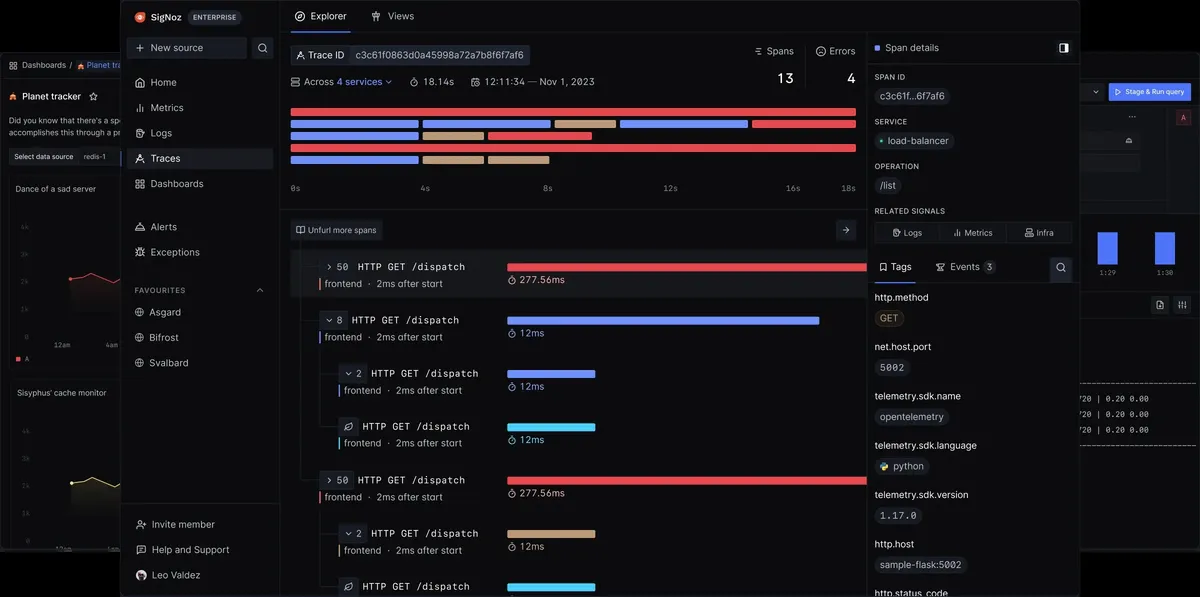
Interface Preview
SigNoz
Feature Comparison
| Feature | New Relic | SigNoz |
|---|---|---|
| Telemetry | ||
| Distributed tracing | Full support | Full support |
| Metrics and dashboards | Full support | Full support |
| Log management | Full support | Full support |
| Real user and mobile monitoring | Full support | Partial support |
| Integration | ||
| OpenTelemetry ingestion | Full support | Full support |
| Vendor-neutral instrumentation | Partial support | Full support |
| Prebuilt cloud integrations | Full support | Partial support |
| Alerting and on-call workflows | Full support | Full support |
| Operations | ||
| Fully managed option | Full support | Full support |
| Self-hosted deployment | Not verified | Full support |
| Data residency under your control | Partial support | Full support |
| Generous free entry point | Full support | Full support |
| Commercial | ||
| Open-source licence | Not verified | Full support |
| Predictable cost at high volume | Partial support | Full support |
| Per-user charging | Full support | Not verified |
| Long retention without indexing charges | Partial support | Full support |
Telemetry
Distributed tracing
Metrics and dashboards
Log management
Real user and mobile monitoring
Integration
OpenTelemetry ingestion
Vendor-neutral instrumentation
Prebuilt cloud integrations
Alerting and on-call workflows
Operations
Fully managed option
Self-hosted deployment
Data residency under your control
Generous free entry point
Commercial
Open-source licence
Predictable cost at high volume
Per-user charging
Long retention without indexing charges
Which approach fits
New Relic and SigNoz are both credible answers for a team that wants tracing, metrics and logs without building a platform, and they diverge on where the cost sits. New Relic's free tier — 100 GB a month and one full user — makes it the easiest commercial APM to start with, and its pricing is per ingested GB plus per user rather than per host. SigNoz is open source and OpenTelemetry-native on ClickHouse, so cost moves to infrastructure and the person who runs it.
When each approach fits
Choose New Relic if:
Choose New Relic when you want managed APM quickly and your volume sits inside or near the free tier. 100 GB a month covers a surprising amount of production telemetry for a small estate, agents deploy in minutes, and nobody is operating a database. The per-user element matters as the team grows, so count full platform users as well as ingest when modelling cost.
Choose SigNoz if:
Choose SigNoz when telemetry volume makes per-GB pricing uncomfortable and you have the Kubernetes capacity to run a ClickHouse-backed service. OpenTelemetry-native means instrumentation is not an investment in one vendor, retention is a storage decision rather than a pricing tier, and adding users costs nothing. Data stays wherever you choose to run it, including on-premise.
These scenarios reflect the available product evidence. Your requirements, existing stack, and team expertise should guide the final decision.
Frequently Asked Questions
How far does the New Relic free tier actually go?
Further than most free tiers in this category. 100 GB of ingest a month and one full platform user will cover a small production estate — a handful of services with reasonable log volume — and that is enough for many teams to run real observability without a bill. The limits that bite first are usually the single full user, once more than one person needs to configure alerts, and log volume as service count grows.
What does per-user pricing change?
It changes who you let in. Per-host or per-GB models cost the same whether two people or twenty look at dashboards, so access can be liberal. Per-user models create a quiet incentive to limit seats, which works against the reason you bought observability. SigNoz has no per-user charge at all, which for a large engineering organisation is a meaningful structural difference rather than a line item.
Is self-hosting SigNoz realistic for a small team?
It depends entirely on whether you already run stateful workloads on Kubernetes. If yes, a ClickHouse-backed service is a known shape and the ongoing cost is modest. If this would be your first, you are taking on storage sizing, retention planning, upgrades and monitoring the monitoring — real work that competes with building your product. SigNoz Cloud exists precisely for teams that want the software without that.
Can we migrate between them later?
More easily than you might expect, because both ingest OpenTelemetry. If you instrument with OTel rather than a vendor agent, moving backends is a collector configuration change. What you rebuild is dashboards, alerts and on-call routing, which is a week or two of work rather than a re-instrumentation project.
Which handles high log volume better?
SigNoz has the structural advantage, because ClickHouse stores logs efficiently and self-hosted retention is a disk decision rather than a priced tier. New Relic bills ingest by the GB, so logs are the line item that grows fastest as service count rises. If logs dominate your telemetry, model that specifically — it is usually the variable that decides this comparison.