Tiger Data tool details
Our decision in this Timescale review: Tiger Data is a strong choice for teams that want time-series and live telemetry workloads on PostgreSQL without giving up the operational benefits of a managed cloud platform. Its value is clearest when sensor data, event data, tick data, or metrics must stay queryable as they accumulate; it is not a general-purpose warehouse replacement simply because it is categorized as a data-warehouse tool. We recommend Tiger Data for PostgreSQL-oriented engineering teams that need automatic partitioning, compression, and continuous aggregates, and that can accept usage-based cloud pricing or engage sales for enterprise requirements.
Overview
Tiger Data is the company behind TimescaleDB and positions Tiger Cloud as an elastic cloud platform for startups and enterprises. The core product identity is straightforward: TimescaleDB is a time-series database built on PostgreSQL for time-series, real-time analytics, and events. Tiger Data also presents its platform around live telemetry data, sensor data, event data, and tick data, which gives it a more precise focus than a broad, catch-all analytics database.
That focus matters. Tiger Data is best evaluated as a PostgreSQL-centered platform for workloads where time is a primary dimension of the data model and where continuous ingestion must remain useful for analysis. The supplied product description names IoT, DevOps, and financial data as ideal domains. Those are credible matches for a system designed around metrics, events, and ticks rather than a generic enterprise reporting estate.
The scale claims are substantial: Tiger Data states that it stores 1 quadrillion data points, represents 3 petabytes of data volume, and processes 3 trillion metrics per day. We treat these as product-scale signals, not proof that every deployment will achieve the same outcome. They do, however, establish that Tiger Data is designed for serious telemetry volume rather than small, occasional time-series tables.
Tiger Data’s website also identifies open-source TimescaleDB alongside Tiger Cloud, plus search capabilities described as vector and keyword search on PostgreSQL. The product’s central trade-off is deliberate: it extends the PostgreSQL world for specialized temporal workloads rather than asking teams to adopt an entirely separate query ecosystem. That can reduce adoption friction for SQL and Postgres-experienced teams, but it also means organizations should validate whether PostgreSQL-centered architecture is the right foundation for every workload they intend to place on the platform.
Key Features and Architecture
Tiger Data’s architecture begins with TimescaleDB on PostgreSQL. The product description explicitly identifies TimescaleDB as a time-series database built on PostgreSQL, while Tiger Cloud is the managed elastic cloud platform. This distinction is important in procurement: teams can consider an open-source TimescaleDB path, a cloud path, or a sales-led enterprise engagement rather than treating the offering as a single deployment model.
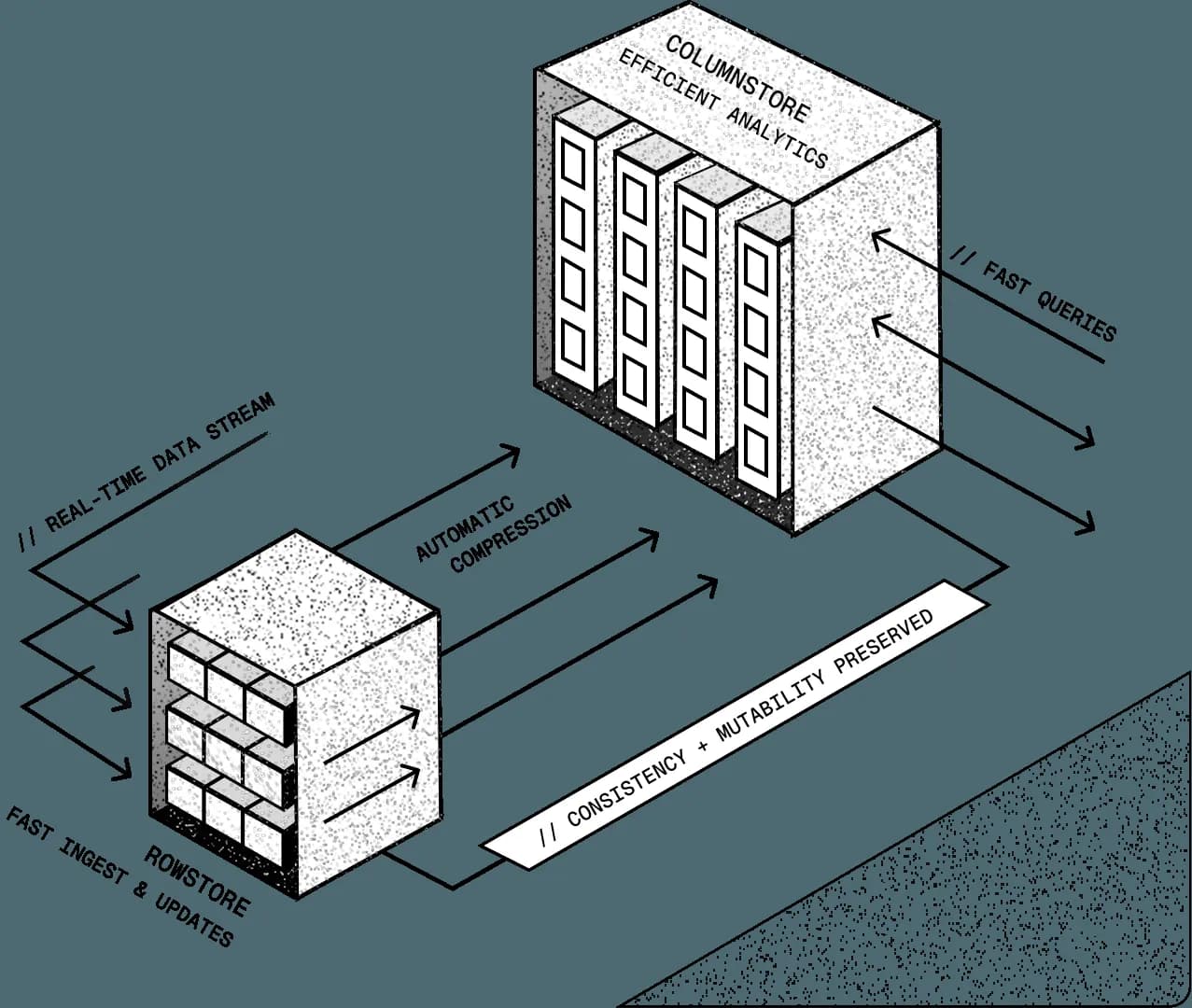
The most concrete time-series capabilities are automatic partitioning, compression, and continuous aggregates. Automatic partitioning addresses the practical problem of organizing growing temporal data without requiring every team to maintain the same manual partition-management process. Compression is intended to reduce the storage burden of time-series data, while continuous aggregates provide a way to maintain aggregate-oriented views as new data arrives. Together, these features target the lifecycle of a metrics or events dataset: ingest, organize, retain, and summarize.
Key architectural capabilities include:
- PostgreSQL foundation: TimescaleDB is explicitly built on PostgreSQL, which keeps the platform centered on Postgres for time-series, real-time analytics, and events.
- Automatic partitioning: Tiger Data provides automatic partitioning for time-series data, reducing the need to make partition management a recurring application concern.
- Compression: The product includes compression for time-series data, directly addressing the storage pressure created by high-volume metrics, telemetry, sensor readings, and tick data.
- Continuous aggregates: Continuous aggregates support maintained summaries for data that keeps arriving, an important capability when raw telemetry and derived operational views must coexist.
- Tiger Cloud: The cloud product is described as a robust elastic platform for startups and enterprises, making managed elasticity part of the product positioning.
- Search on PostgreSQL: Tiger Data identifies vector and keyword search on PostgreSQL as part of its product portfolio, extending its Postgres-centered message beyond time-series alone.
The official website summarizes the promise as “speed without sacrifice for time-series workloads.” That is a useful product objective, but buyers should ask for workload-specific validation rather than treating it as a universal benchmark. The supplied material does not provide query latency, ingestion throughput per deployment, availability commitments, retention mechanics, regional coverage, or hardware assumptions. Those omissions matter if performance targets, service-level commitments, or migration risk are deciding factors.
The platform’s named workload vocabulary is unusually clear: live telemetry, sensor data, event data, and tick data. That is stronger guidance than generic “analytics” positioning. A team storing product clickstream or application events may find the event orientation relevant, while an industrial or energy team can map sensor data directly to the stated use case. The cost of this specialization is that Tiger Data should be selected because time-series behavior is central to the system, not merely because an organization happens to already use PostgreSQL.
Ideal Use Cases
Tiger Data is most compelling for a DevOps or platform engineering team collecting a continuously growing stream of operational metrics. A team responsible for infrastructure telemetry can use a PostgreSQL-based time-series platform when it needs automatic partitioning, compression, and continuous aggregates in the same product story. The relevant question is not whether the organization has “data,” but whether it has metrics and events whose time dimension drives storage and analysis decisions.
A second strong scenario is IoT or industrial telemetry. The supplied description explicitly names IoT and sensor data, while the website identifies live telemetry data as a core workload. For an engineering team that receives device or sensor readings continuously and wants to preserve both detailed observations and maintained summaries, Tiger Data’s feature set maps directly to the ingestion-and-analysis pattern. The platform’s stated scale of 1 quadrillion data points and 3 petabytes of data volume is relevant context for teams planning beyond a small proof of concept, although those figures should not be read as sizing guidance for an individual deployment.
Financial data is a third fit, specifically where tick data is central. Tiger Data explicitly calls out financial data and tick data, making this a more defensible use case than generic business intelligence. Teams working with temporal market-style observations should still test their exact model, data retention needs, and query patterns. The provided information does not establish support for any specific financial workflow, exchange feed, regulatory requirement, or latency target.
Analytics engineering teams may also consider Tiger Data when their transformation and query environment is already anchored in PostgreSQL and their source data is event-heavy or time-series-heavy. Continuous aggregates are particularly relevant when consumers repeatedly need summaries over fresh incoming data. This is a focused use case; it does not establish that Tiger Data replaces a broad warehouse used for every finance, marketing, and enterprise reporting dataset.
Don’t use this if time-series, telemetry, events, sensor readings, or tick data are peripheral to your data estate. Avoid choosing Tiger Data solely because it uses PostgreSQL if your primary requirement is an unspecified general-purpose warehouse, since the supplied product evidence centers on specialized temporal workloads. We also recommend looking elsewhere if your decision depends on published guarantees for latency, uptime, regional deployment, compliance, or detailed connector coverage; those facts are not provided here and should be confirmed before commitment.
Pricing and Licensing
Tiger Data uses a mixed pricing and licensing approach: free-trial, usage-based, open-source, and contact-sales. This is not a single flat subscription model. The supplied pricing material identifies a free tier, paid plans starting at $29/mo, and official pricing-page amounts of $0.17, $0.21, $30/mo, $36/mo, and $0.02. It also identifies TimescaleDB as open source and Tiger Cloud as the elastic cloud platform, so teams should separate the cost of a managed cloud service from the availability of the open-source database.
| Plan or pricing component | Price | What the supplied data establishes |
|---|---|---|
| Free tier | $0 | Includes up to 10GB storage. |
| Paid plans | Starting at $29/mo | Paid Tiger Data plans begin at this amount; the supplied data does not specify a plan name or feature bundle. |
| Official pricing-page rate | $0.17 | An official pricing amount is listed, but no unit or plan name is supplied. |
| Official pricing-page rate | $0.21 | An official pricing amount is listed, but no unit or plan name is supplied. |
| Official monthly price | $30/mo | An official monthly amount is listed, but no plan name or included entitlement is supplied. |
| Official monthly price | $36/mo | An official monthly amount is listed, but no plan name or included entitlement is supplied. |
| Official pricing-page rate | $0.02 | An official pricing amount is listed, but no unit or plan name is supplied. |
| External pricing reference | $0.01 cost/unit | A third-party source identifies this cost per unit; its relationship to official plans is not defined. |
| Enterprise | Contact sales | Tiger Data identifies an Enterprise tier, but the supplied data gives no public dollar amount or included entitlement. |
The free tier’s hard limit is clear: 10GB storage. That makes it suitable for evaluation, small projects, or a tightly bounded workload, but it is not enough information to estimate production spend. The source material does not identify whether free-tier capabilities differ from paid plans beyond storage, nor does it define trial duration, billing units, metering dimensions, overage handling, or support levels.
The pricing page also explicitly uses the language of a free trial and describes plans for early-stage startups and growing enterprises. That supports a staged evaluation approach: begin with the free tier or trial, establish actual storage and workload behavior, then model the usage-based charges before moving to a paid plan. The trade-off is pricing precision. The official dollar figures are real supplied amounts, but their exact plan and unit mappings are not included, so we would not approve a budget based on them alone.
Open-source TimescaleDB is an important licensing option, but “open-source” should not be collapsed into “zero operational cost.” Self-managed deployment and managed Tiger Cloud are different operating decisions. For enterprise buyers, the available pricing direction is contact sales; insist on a written breakdown of usage rates, monthly commitments, included storage or compute, support, and commercial terms.
Pros and Cons
In our evaluation, Tiger Data’s strengths are concentrated and practical rather than broad. Its PostgreSQL foundation, stated time-series feature set, and managed Tiger Cloud positioning make it an opinionated platform for organizations with genuine temporal data pressure. The drawbacks are equally specific: the available evidence is strong on product direction but thin on operational and commercial detail.
Pros
- PostgreSQL-centered time-series design: TimescaleDB is built on PostgreSQL, giving teams a clear database foundation rather than requiring them to assess an unnamed or proprietary query environment.
- Automatic partitioning for growing temporal data: The platform explicitly provides automatic partitioning, which directly targets an operational burden common to time-series datasets.
- Storage-focused capability: Compression is named as a core feature, making Tiger Data relevant when metrics, sensor data, or events create sustained storage growth.
- Fresh-summary support: Continuous aggregates are a concrete capability for maintaining aggregate-oriented analysis as new data arrives, rather than relying only on periodic, manually refreshed reporting.
- Clear workload fit: Tiger Data explicitly names IoT, DevOps, financial data, live telemetry, sensor data, event data, and tick data. That clarity helps teams decide whether the platform matches their system.
- Meaningful public scale signals: The stated figures of 1 quadrillion data points, 3 petabytes of data volume, and 3 trillion metrics per day demonstrate the vendor’s focus on high-scale telemetry. They are adoption and product-scale signals, not a substitute for workload testing.
Cons
- Pricing details are incomplete: Although official amounts include $0.17, $0.21, $30/mo, $36/mo, and $0.02, the supplied data does not map those numbers to named plans or units. Budget owners need that mapping before treating the pricing model as predictable.
- The free tier is tightly bounded: Free usage is limited to 10GB storage. That is useful for evaluation but can be too restrictive for even modest continuous telemetry without a plan for paid usage.
- Enterprise commercial terms are opaque: Tiger Data identifies an Enterprise tier but provides no public enterprise dollar amount or included capabilities; the practical next step is contact sales.
- Operational evidence is missing: The provided material contains no documented availability target, latency benchmark, retention policy, geographic deployment information, or connector catalog. Teams with strict operational requirements cannot infer those details.
- Specialization can be a mismatch: Tiger Data is explicitly oriented around time-series, real-time analytics, events, and telemetry. It is weak as a selection rationale when a buyer’s central need is an unspecified general-purpose warehouse.
The clearest recommendation is to choose Tiger Data when the team’s core problem is temporal data at scale and PostgreSQL is a desirable architectural anchor. Treat the free 10GB tier as an evaluation boundary, then validate actual usage pricing and workload behavior. If the organization cannot obtain the missing commercial and operational evidence it needs, it should not proceed on product positioning alone.
Alternatives and How It Compares
The relevant alternatives named for this evaluation are InfluxDB, QuestDB, Trino, Apache Pinot, and DuckDB. We would not position these as interchangeable by default, because Tiger Data’s supplied product facts are specific: it is built around TimescaleDB on PostgreSQL, offers Tiger Cloud, and emphasizes automatic partitioning, compression, continuous aggregates, and time-series workloads. A fair selection process starts with whether that PostgreSQL-and-time-series posture is itself the requirement.
InfluxDB and QuestDB belong in a short list when the buyer is evaluating a dedicated time-series database direction. Tiger Data’s differentiator in the supplied material is its PostgreSQL foundation and its association with open-source TimescaleDB and managed Tiger Cloud. The decision point is therefore architectural preference: choose Tiger Data when PostgreSQL is a strategic fit and the stated features—automatic partitioning, compression, and continuous aggregates—match the workload. Do not claim a price or performance advantage from the supplied facts, because none is established for these alternatives.
Trino should be assessed separately from Tiger Data rather than treated as a direct drop-in. Tiger Data is presented as a platform for time-series, real-time analytics, and events on PostgreSQL, with live telemetry and tick data explicitly named. If the evaluation is driven by temporal ingestion, storage, and continuously maintained aggregates, Tiger Data has a more directly evidenced fit. We would not use the provided material to make assertions about Trino pricing, deployment model, or performance.
Apache Pinot should be included when the requirement centers on real-time analytics and event-style data, because Tiger Data itself names real-time analytics and events as product scope. Tiger Data’s concrete distinction is not a generic claim of speed; it is the stated combination of PostgreSQL, automatic partitioning, compression, continuous aggregates, and Tiger Cloud. Buyers should require a workload-specific evaluation rather than selecting either system based on category labels.
DuckDB is a useful comparison point when teams are tempted to use a broadly familiar analytics option for a time-series problem. Tiger Data’s evidence is stronger where persistent live telemetry, sensor data, tick data, or DevOps metrics are central and where managed elasticity is desired through Tiger Cloud. Conversely, do not select Tiger Data merely to satisfy a generic analytics preference: its pricing model includes usage-based and contact-sales paths, while its supplied product claims are tightly concentrated on temporal workloads.
The practical conclusion is simple. Choose Tiger Data instead of pursuing these alternatives when PostgreSQL alignment and time-series-specific capabilities are the decisive criteria. Choose another tool only after defining a materially different target audience, pricing model, or key differentiator that your evaluation can support with current evidence.
Frequently Asked Questions
What is Timescale?
Timescale is an open-source time-series database built on top of PostgreSQL, designed for handling large amounts of temporal data.
Is Timescale free to use?
Yes, Timescale is completely free and open-source, making it a cost-effective solution for businesses and organizations.
How does Timescale compare to InfluxDB?
Timescale offers improved performance and scalability compared to InfluxDB, particularly when handling large amounts of data. Additionally, its integration with PostgreSQL provides advanced SQL capabilities.
Can I use Timescale for IoT data analysis?
Yes, Timescale is well-suited for IoT data analysis due to its ability to handle high-volume and high-velocity time-series data from various sources.
Does Timescale support real-time analytics?
Yes, Timescale is designed to provide low-latency queries and real-time analytics capabilities, making it suitable for applications that require up-to-the-minute insights.
Can I integrate Timescale with my existing PostgreSQL database?
Yes, Timescale is built on top of PostgreSQL, allowing seamless integration with your existing database infrastructure.