ZenML: product and architecture
ZenML positions itself as the "AI control plane" for teams that need to move ML and LLM workloads from notebooks to production without rewriting everything. In this ZenML review, we evaluate the platform's pipeline orchestration, artifact versioning, and infrastructure abstraction capabilities. ZenML takes a framework-agnostic approach, letting teams plug in their preferred orchestrators, cloud providers, and ML libraries while adding the metadata and governance layer that raw orchestrators lack. The open-source core under Apache 2.0 keeps the barrier to entry low, while managed Pro tiers handle scaling concerns for larger organizations.
Overview
ZenML is an open-source MLOps framework designed to standardize the path from experimentation to production. Rather than replacing existing tools, it acts as a connective layer that binds data retrieval, model training, and serving steps into reproducible, versioned pipelines. The platform supports 60-plus integrations across the AI ecosystem, including PyTorch, Scikit-learn, LangChain, LlamaIndex, Kubernetes, AWS, GCP Gemini Enterprise Agent Platform (formerly Vertex AI), Kubeflow, and Apache Airflow.
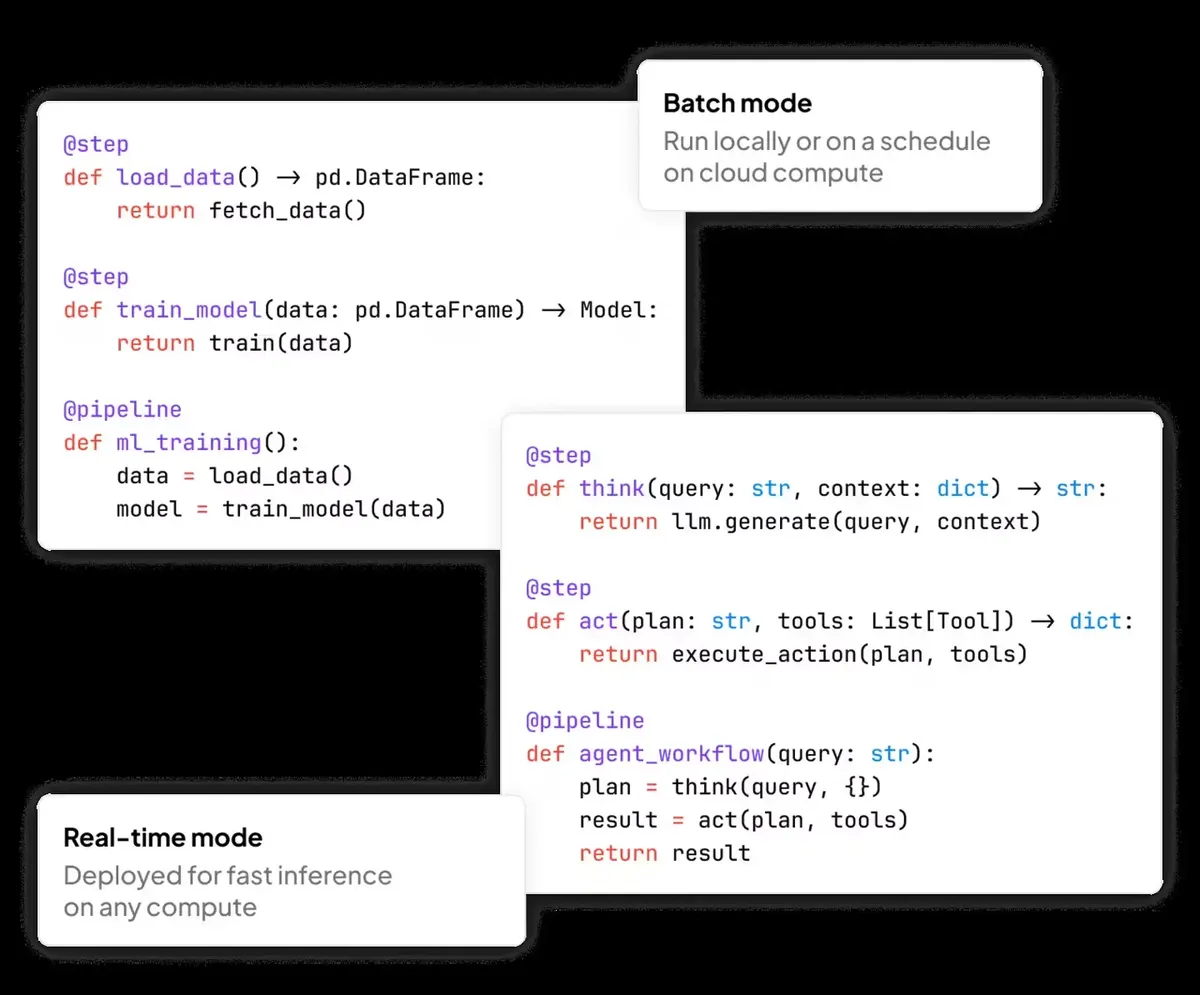
The core abstraction is straightforward: developers decorate existing Python functions with @step and @pipeline decorators, and ZenML handles containerization, data passing, state management, and caching. The same code runs locally during development and deploys to Kubernetes or Slurm clusters in production without modification. ZenML snapshots code, dependency versions, and container state for every step, making rollbacks and debugging deterministic rather than guesswork. SOC2 and ISO 27001 compliance round out the enterprise readiness story.
Key Features and Architecture
ZenML's architecture revolves around the concept of a "stack" -- a configurable set of infrastructure components that define where and how pipelines execute. Each stack combines an orchestrator, artifact store, container registry, and optional components like experiment trackers and model deployers. This modularity means teams can swap Kubeflow for Airflow or switch from AWS to GCP without rewriting pipeline logic.
Pipeline Orchestration and DAG Management. ZenML treats every workflow as a directed acyclic graph. Whether the workload involves Scikit-learn training jobs or LangGraph agent loops, ZenML manages state passing between steps, handles termination control, and ensures reliable execution. The framework does not impose its own orchestrator; instead, it delegates to whichever orchestrator lives in the stack configuration.
Artifact and Environment Versioning. Every pipeline run produces versioned artifacts with full lineage tracking. ZenML records the exact code commit, Python package versions, and container image used for each step. When a dependency upgrade breaks a model or agent, teams can inspect the diff between working and broken runs and roll back to a known-good artifact.
Infrastructure Abstraction. Hardware requirements are defined in Python rather than YAML manifests. ZenML handles dockerization, GPU provisioning, and pod scaling automatically. This eliminates the operational overhead of managing Kubernetes deployments directly while preserving full control over resource allocation.
Smart Caching and Deduplication. ZenML's caching system detects when a step's inputs and code have not changed and skips redundant computation. This applies to both traditional training epochs and expensive LLM API calls, reducing both compute costs and pipeline latency.
Governance and RBAC. The platform centralizes API key and credential management, enforces role-based access control, and provides execution traces with full audit lineage from raw data to final output. All data and compute remain within the customer's VPC, with ZenML operating as a metadata layer on top of existing infrastructure.
Ideal Use Cases
ZenML fits teams that have outgrown Jupyter notebooks but do not want to adopt a monolithic ML platform. It works best when organizations already use multiple ML tools and need a unifying layer rather than a replacement.
Teams running both traditional ML training and LLM/agent workloads benefit from ZenML's ability to handle both in one framework. Companies with strict compliance requirements value the VPC-native deployment model and SOC2/ISO 27001 certifications. The framework is particularly effective for organizations operating across multiple cloud providers or hybrid environments, since the stack abstraction insulates pipeline code from infrastructure specifics.
ZenML also suits teams that need to scale from a single data scientist prototyping locally to a full engineering team deploying on Kubernetes. The decorator-based SDK requires minimal ramp-up, and the same pipeline code works across all environments. Customer case studies highlight concrete results: ADEO Leroy Merlin reduced time-to-market from two months to two weeks, Brevo accelerated model development by 80 percent, and Cross Screen Media went from weeks to hours when training models across 210 markets.
Strengths & Trade-offs
Pros:
- Framework-agnostic design with 60-plus integrations avoids vendor lock-in
- Decorator-based Python SDK has a gentle learning curve
- Full artifact lineage and environment versioning enable reproducible pipelines
- VPC-native deployment keeps data sovereign; SOC2 and ISO 27001 compliant
- Smart caching reduces redundant compute and API costs
Cons:
- Managed Pro pricing starts at $399 per month, which can be steep for small teams
- Enterprise features like SSO, custom RBAC, and audit logs are gated behind the highest tier
- Several advanced features (webhooks, resource queueing, codespaces) remain in "coming soon" status
- Limited community review data makes independent validation of claimed benefits difficult