Decision comparison
ZenML vs MLflow
ZenML and MLflow address overlapping but distinct aspects of the ML lifecycle. ZenML excels as a pipeline orchestration and infrastructure abstraction layer that lets teams write once and deploy anywhere, while MLflow dominates experiment tracking, model registry, and LLM observability. Many mature MLOps teams actually use both together, with ZenML orchestrating the pipeline and MLflow tracking experiments within it. The right choice depends on whether your primary bottleneck is pipeline portability and infrastructure management or experiment tracking and model deployment.
Architecture choice. These take different approaches to the same problem. Read the table as a fit question rather than a feature race.
These are different kinds of product — ML Pipeline Framework and Experiment Tracking.
Quick Comparison
| Decision factor | ZenML | MLflow |
|---|---|---|
| Best For | Building portable, production-ready ML pipelines with pluggable stack components, artifact versioning, and infrastructure abstraction across orchestrators | End-to-end ML experiment tracking, model registry, LLM observability, and agent deployment backed by a sizable open-source MLOps community |
| Architecture | Python-native framework with decorator-based pipeline definitions, pluggable stack components, and a managed Pro platform with metadata control plane | Open-source platform with tracking server, model registry, AI gateway, and agent server; built on OpenTelemetry for observability |
| Pricing Model | Open source (self-hosted) free, Starter $399/mo, Growth $999/mo, Scale $2,499/mo, Enterprise custom | Open-source license (Apache-2.0), self-hosted for free |
| Ease of Use | Pythonic decorator-based SDK that transforms existing code into pipelines; same code runs locally and on Kubernetes without changes | Three-step setup from install to production tracing; autolog capabilities reduce instrumentation code to just a few lines |
| Scalability | Handles enterprise workloads with Kubernetes and Slurm orchestration, GPU provisioning, and smart caching to reduce redundant compute | Battle-tested at Fortune 500 scale with 30M+ monthly downloads; supports production deployment of agents and models at enterprise volume |
| Community/Support | Growing community with 6,200 GitHub stars and 60+ integrations; SOC2 and ISO 27001 certified with enterprise SLA options | Sizable MLOps community with 20K+ GitHub stars, 900+ contributors, Linux Foundation backing, and 100+ framework integrations |
ZenML
- Best For:
- Building portable, production-ready ML pipelines with pluggable stack components, artifact versioning, and infrastructure abstraction across orchestrators
- Architecture:
- Python-native framework with decorator-based pipeline definitions, pluggable stack components, and a managed Pro platform with metadata control plane
- Pricing Model:
- Open source (self-hosted) free, Starter $399/mo, Growth $999/mo, Scale $2,499/mo, Enterprise custom
- Ease of Use:
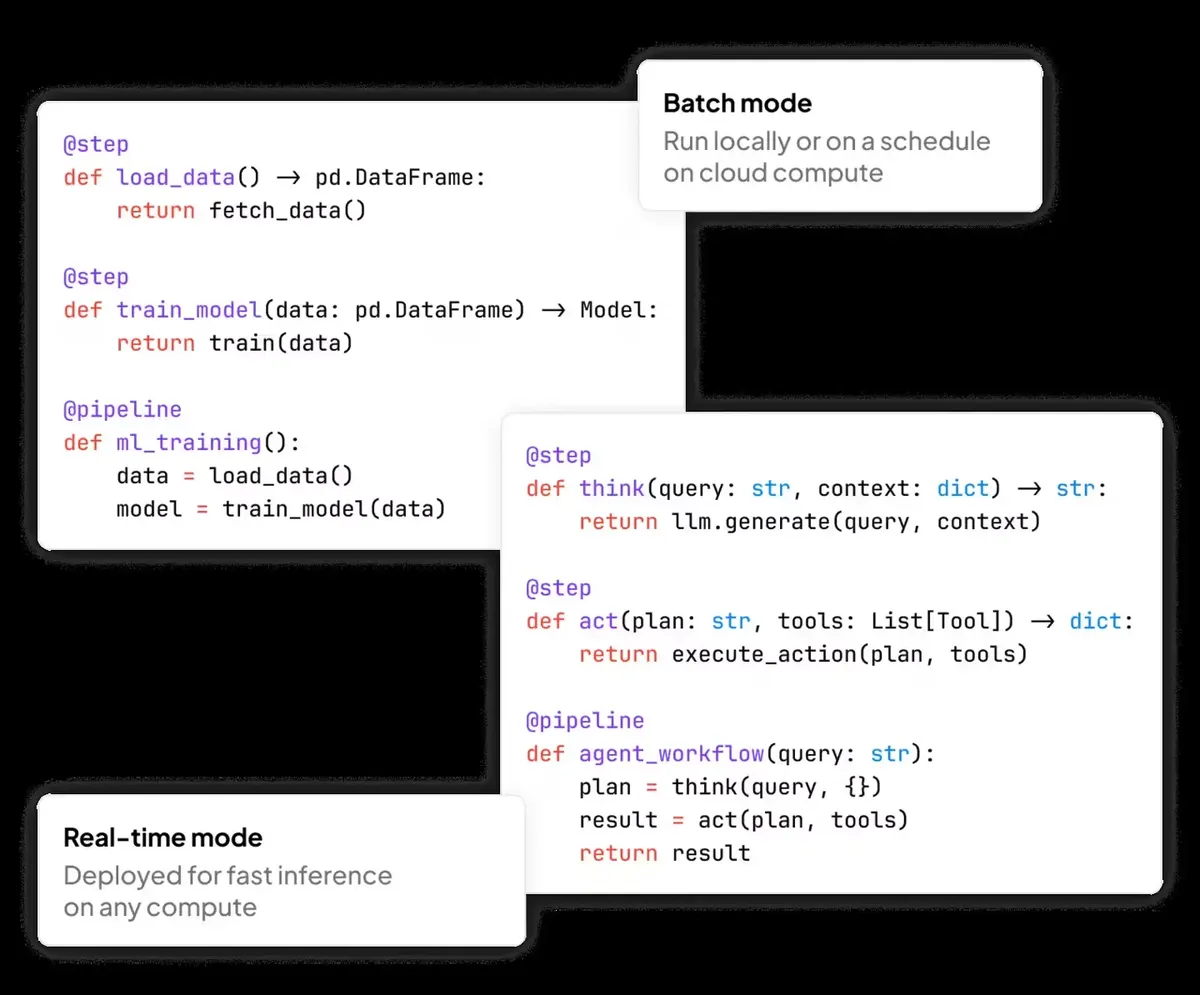
- Pythonic decorator-based SDK that transforms existing code into pipelines; same code runs locally and on Kubernetes without changes
- Scalability:
- Handles enterprise workloads with Kubernetes and Slurm orchestration, GPU provisioning, and smart caching to reduce redundant compute
- Community/Support:
- Growing community with 6,200 GitHub stars and 60+ integrations; SOC2 and ISO 27001 certified with enterprise SLA options
MLflow
- Best For:
- End-to-end ML experiment tracking, model registry, LLM observability, and agent deployment backed by a sizable open-source MLOps community
- Architecture:
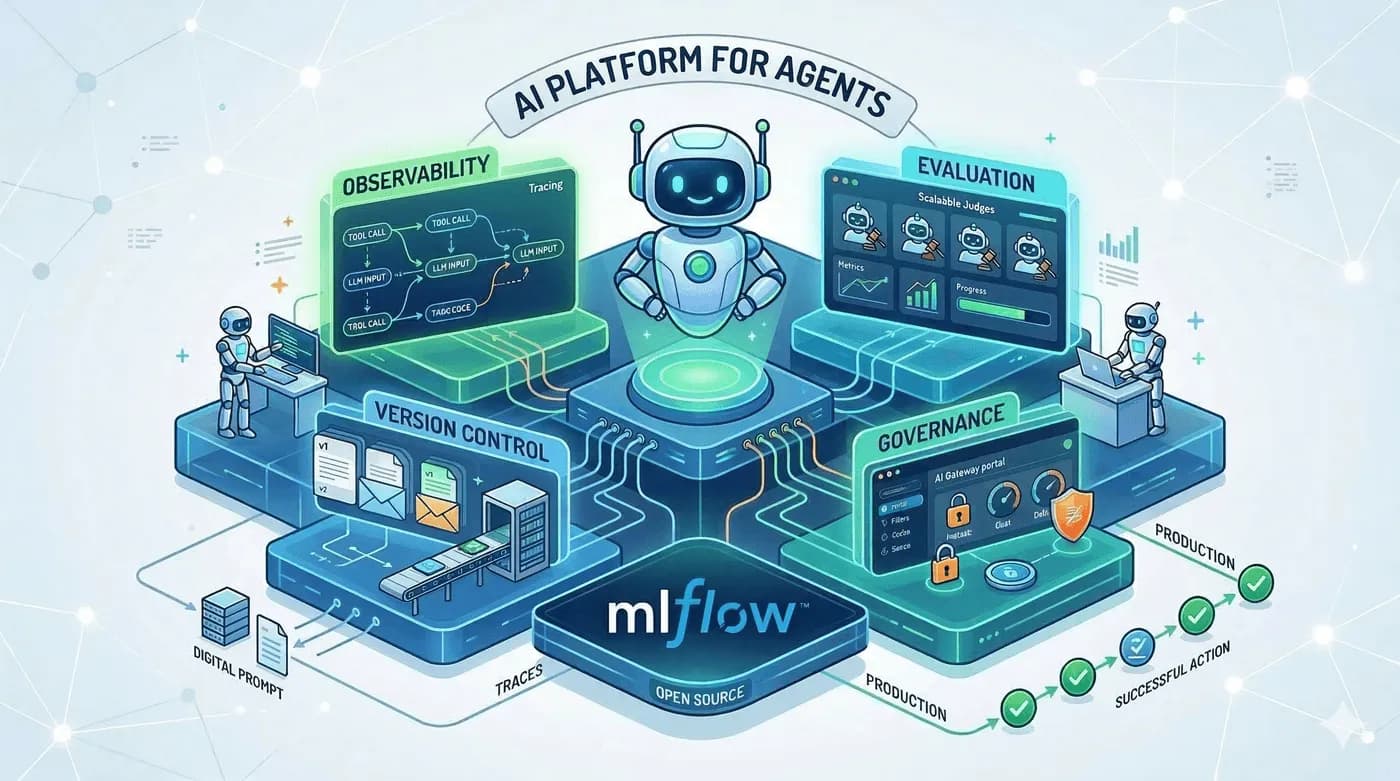
- Open-source platform with tracking server, model registry, AI gateway, and agent server; built on OpenTelemetry for observability
- Pricing Model:
- Open-source license (Apache-2.0), self-hosted for free
- Ease of Use:
- Three-step setup from install to production tracing; autolog capabilities reduce instrumentation code to just a few lines
- Scalability:
- Battle-tested at Fortune 500 scale with 30M+ monthly downloads; supports production deployment of agents and models at enterprise volume
- Community/Support:
- Sizable MLOps community with 20K+ GitHub stars, 900+ contributors, Linux Foundation backing, and 100+ framework integrations
Public signals
Verified factual signals only. Bars appear only for like-for-like metrics with five weekly assessments for every tool; missing evidence stays explicit. These signals do not establish enterprise adoption, product quality, or total cost.
| Metric | ZenML | MLflow |
|---|---|---|
| Docker Hub pulls(Product adoption) | 68.0k | Not available |
| GitHub commits, 90d(Ecosystem adoption) | 519 | Not available |
| GitHub stars(Ecosystem adoption) | 292 | Not available |
| Search interest(Market interest) | Unavailable | 2 |
| Hacker News mentions, 90d(Community interest) | 1 | 1 |
| Hugging Face downloads(Product adoption) | 1.1k | Not available |
| Hugging Face likes(Product adoption) | 28 | Not available |
| PyPI weekly downloads(Developer adoption) | 44.3k | Not available |
| GitHub commits, 90d(Product adoption) | Not available | 926 |
| GitHub stars(Product adoption) | Not available | 28,000+ |
| PyPI weekly downloads(Product adoption) | Not available | 4.6M |
| Stack Overflow questions(Community interest) | Not available | 771 |
As of September 21, 2026 — updated weekly.
Health & risk evidence
Observed public-source checks for mapped package versions and repositories.
ZenML
September 21, 2026Package vulnerabilities
PyPI · zenml@0.96.4
0 vulnerabilities
across 1 package
Repository security score
Not available
MLflow
September 21, 2026Package vulnerabilities
PyPI · mlflow@3.16.1
0 vulnerabilities
across 1 package
Repository security score
github.com/mlflow/mlflow
5.4/10
Interface Preview
ZenML
MLflow
Feature Comparison
| Feature | ZenML | MLflow |
|---|---|---|
| Pipeline & Workflow Orchestration | ||
| Pipeline Definition | Python decorator-based @step and @pipeline abstractions that convert existing code into reproducible workflows | Lightweight Projects format for packaging code; not a full pipeline orchestrator but integrates with external schedulers |
| Orchestrator Abstraction | Pluggable orchestrators supporting Kubernetes, Airflow, Kubeflow, Vertex AI, and custom backends from a single codebase | No built-in orchestration abstraction; relies on external orchestrators like Airflow or Databricks Jobs for scheduling |
| Smart Caching | Native step-level caching that skips redundant training epochs and expensive LLM calls based on input fingerprinting | No built-in pipeline caching; experiment tracking records all runs but does not deduplicate or skip repeated computations |
| Experiment Tracking & Observability | ||
| Experiment Tracking | Tracks artifacts, metadata, and lineage across pipeline runs; integrates with external trackers like MLflow and Weights & Biases | Industry-leading experiment tracking with parameters, metrics, artifacts, and full run comparison UI out of the box |
| LLM Observability | Pipeline-level tracing for LLM workflows including LangChain and LlamaIndex steps with artifact versioning | Deep OpenTelemetry-based tracing for LLM applications and agents with production quality, cost, and safety monitoring |
| Model Registry | Model Control Plane for tracking model versions, stages, and deployment status across the full lifecycle | Mature model registry with versioning, stage transitions, annotations, and integration with major deployment targets |
| Deployment & Serving | ||
| Model Deployment | Infrastructure abstraction handles containerization, GPU provisioning, and pod scaling through Python-defined hardware specs | Built-in model serving with MLflow Agent Server providing FastAPI-based hosting, streaming, and automatic request validation |
| Agent Deployment | Supports agent workflows through pipeline orchestration of LangGraph and LlamaIndex steps with production serving integration | Dedicated Agent Server deploys agents to production with a single command including built-in tracing and monitoring |
| AI Gateway | No built-in API gateway; relies on integration partners and custom stack components for model routing | Unified API gateway for all LLM providers with request routing, rate limiting, fallback handling, and cost control |
| Governance & Reproducibility | ||
| Artifact Versioning | Automatic snapshots of code, Pydantic versions, container state, and all artifacts for every pipeline step | Artifact logging and retrieval with URI-based tracking; supports model packaging with all dependencies |
| RBAC & Access Control | Standard and custom RBAC roles, execution trace visualization, and full lineage auditing in Pro plans | Basic access controls in open-source; advanced RBAC available through Databricks managed MLflow offering |
| Compliance Certifications | SOC2 and ISO 27001 certified with VPC deployment, data sovereignty, and enterprise-grade security controls | No standalone compliance certifications; inherits compliance posture from hosting infrastructure or Databricks |
| Integration & Ecosystem | ||
| Framework Integrations | 60+ integrations spanning scikit-learn, PyTorch, LangChain, LlamaIndex, LangGraph, and major cloud providers | 100+ integrations including LangChain, OpenAI, PyTorch, and native OpenTelemetry and MCP protocol support |
| Cloud Provider Support | Native support for AWS, GCP Vertex AI, Azure with Kubernetes orchestration and cloud-native artifact storage | Cloud-agnostic self-hosted deployment; first-class integration with Databricks across AWS, Azure, and GCP |
| Prompt Management | No dedicated prompt management; LLM prompts are managed as pipeline step parameters or external configurations | Full prompt versioning, testing, deployment with lineage tracking, and automated optimization using DSPy algorithms |
Pipeline & Workflow Orchestration
Pipeline Definition
Orchestrator Abstraction
Smart Caching
Experiment Tracking & Observability
Experiment Tracking
LLM Observability
Model Registry
Deployment & Serving
Model Deployment
Agent Deployment
AI Gateway
Governance & Reproducibility
Artifact Versioning
RBAC & Access Control
Compliance Certifications
Integration & Ecosystem
Framework Integrations
Cloud Provider Support
Prompt Management
Which approach fits
ZenML and MLflow address overlapping but distinct aspects of the ML lifecycle. ZenML excels as a pipeline orchestration and infrastructure abstraction layer that lets teams write once and deploy anywhere, while MLflow dominates experiment tracking, model registry, and LLM observability. Many mature MLOps teams actually use both together, with ZenML orchestrating the pipeline and MLflow tracking experiments within it. The right choice depends on whether your primary bottleneck is pipeline portability and infrastructure management or experiment tracking and model deployment.
When each approach fits
Choose ZenML if:
Choose ZenML when your team struggles with the transition from notebook prototypes to production ML pipelines, or when you need to orchestrate workflows across multiple infrastructure backends without rewriting code. ZenML is the stronger choice if you want a single Python codebase that runs identically on your laptop, on Kubernetes, and on managed cloud services like Vertex AI. Its decorator-based SDK, pluggable stack components, and smart caching make it ideal for teams that want infrastructure abstraction without vendor lock-in. The managed Pro plans with SOC2 and ISO 27001 certification also make ZenML suitable for regulated industries requiring compliance guarantees that the open-source MLflow cannot provide out of the box.
Choose MLflow if:
Choose MLflow when experiment tracking, model versioning, and LLM observability are your primary needs, or when you want a sizable ecosystem and community support in the MLOps space. MLflow is the clear winner if your team needs deep tracing of LLM applications and agents with production monitoring, a mature model registry with proven enterprise adoption, or a unified AI gateway to manage costs across multiple LLM providers. Its completely free, open-source nature with 30 million monthly downloads and Linux Foundation backing means you are investing in the most battle-tested MLOps platform available. MLflow is also the better starting point for teams new to MLOps who want quick setup without pipeline orchestration complexity.
These scenarios reflect the available product evidence. Your requirements, existing stack, and team expertise should guide the final decision.
Frequently Asked Questions
Can ZenML and MLflow be used together in the same ML workflow?
Yes, ZenML and MLflow are highly complementary and many production teams use them together. ZenML natively integrates with MLflow as an experiment tracker stack component, meaning you can define your ML pipeline in ZenML with its decorator-based steps while automatically logging all experiments, metrics, and artifacts to MLflow's tracking server. This combination gives you ZenML's infrastructure abstraction and pipeline portability alongside MLflow's industry-leading experiment tracking UI and model registry. The integration requires minimal configuration and lets each tool handle what it does best without duplication of effort.
Which platform has better support for LLM and GenAI use cases?
Both platforms have invested heavily in LLM and GenAI capabilities, but they approach the space differently. MLflow offers deeper LLM-specific tooling including OpenTelemetry-based trace capture for agent applications, automated prompt optimization with state-of-the-art algorithms, a dedicated Agent Server for one-command production deployment, and an AI Gateway for managing costs across LLM providers. ZenML approaches GenAI through its pipeline framework, supporting LangChain, LlamaIndex, and LangGraph workflows as orchestrated steps with full artifact versioning. If you need deep LLM observability and prompt management, MLflow is stronger. If you need to orchestrate complex multi-step GenAI workflows with reproducibility and caching, ZenML's pipeline approach offers more structure.
How do the pricing models compare for a mid-size data science team?
The pricing difference is significant. MLflow is entirely free under the Apache 2.0 license with no paid tiers for the core platform, though teams using Databricks managed MLflow will pay as part of their Databricks subscription. ZenML's open-source core is also free for self-hosting, but its managed Pro platform starts at $399 per month for the Starter plan with 500 pipeline runs, scales to $999 per month for Growth with 2,000 runs, and reaches $2,499 per month for Scale with 5,000 runs. Enterprise pricing is custom. For a mid-size team that can self-host, both platforms cost nothing in licensing. For teams wanting managed services, ZenML Pro adds meaningful cost while MLflow remains free unless you opt for Databricks integration.
Which platform is easier to adopt for a team new to MLOps?
MLflow has a lower barrier to entry for teams just starting their MLOps journey. You can install MLflow with a single command, start the tracking server in seconds, and add experiment logging with just two lines of Python code. The autolog feature automatically captures metrics and parameters for popular frameworks without any manual instrumentation. ZenML requires more upfront investment in understanding its pipeline abstraction, stack components, and decorator-based workflow definitions. However, ZenML's approach pays dividends when teams scale beyond individual experiments to production pipelines, because the abstractions that add initial complexity become essential for managing infrastructure portability and reproducibility. We recommend starting with MLflow for experiment tracking and adding ZenML when pipeline orchestration becomes a bottleneck.