September's clearest signals were about cost: more of the searches that reached Modern DataTools asked about price, in the same month that several vendors changed what they charge. Underneath, the base layer of data infrastructure kept growing.
- Pricing questions moved up. Among searches that reached Modern DataTools, pricing intent rose from 16.3% to 20.8% of impressions and passed comparison searches in rank.
- Vendors changed their published prices. Airbyte moved its Cloud plans to credits (Standard now starts at $20 a month instead of $10; Plus at $189 instead of $500). dltHub, the paid platform behind dlt (data load tool), went from $1,190 to $12,000 a month. Temporal Cloud's entry point became pay-as-you-go at $50 per million actions.
- PostgreSQL led container growth again, and pgvector grew fastest.
library/postgresadded 295,517,978 Docker Hub pulls (+2.6%).[pgvector](/tools/pgvector)/[pgvector](/tools/pgvector), the image that adds vector search to PostgreSQL, added 42,364,032 (+25.7%), well above the 0.34% to 2.6% range of the largest base images.
Verified Changes: Vendors Repriced
These changes come from each vendor's own pricing page.
| Tool | Change | Before | After | Observed |
|---|---|---|---|---|
| Airbyte | Cloud plans moved to credits | Standard from $10 a month; Plus from $500 a month | Standard from $20 a month, extra credits $5 each; Plus from $189 a month | 2026-09-21 |
| dlt (data load tool) | dltHub paid plan | From $1,190 a month, or $11,900 a year | $12,000 a month, 12-month minimum | 2026-09-21 |
| Temporal | Temporal Cloud entry price | Essentials from $100 a month | Pay-As-You-Go from $50 per million actions | 2026-09-21 |
| Fireworks AI | On-demand GPU prices, per hour | B200 $10.00; H100 $7.00 | B200 $13.00; H100 $8.00 | 2026-09-07 |
| BU | Entry pricing | Free plan at $0, then pay as you go | Credits from $5, no subscription; browsers still $0.02 an hour | 2026-09-07 |
The changes do not point in one direction. Airbyte's switch to credits raised the entry price of its cheapest Cloud plan and lowered the entry price of Plus. dltHub's paid plan, which adds a managed runtime, observability and data-quality checks, now costs $12,000 a month with a 12-month minimum; the open-source dlt library is still free. Temporal Cloud now starts with usage-based billing rather than a monthly plan, so the new $50 figure is not directly comparable with the old $100 one. Fireworks AI raised both of its listed on-demand GPU rates.
If one of these tools is on your shortlist, check the vendor's current page before you rely on an older quote or comparison.
Search Demand: Pricing Overtook Comparison
Search demand here means the searches that brought people to Modern DataTools. It reflects what the site covers as well as what people want to know, so read it as a change in what searchers asked, not as market-wide search volume.
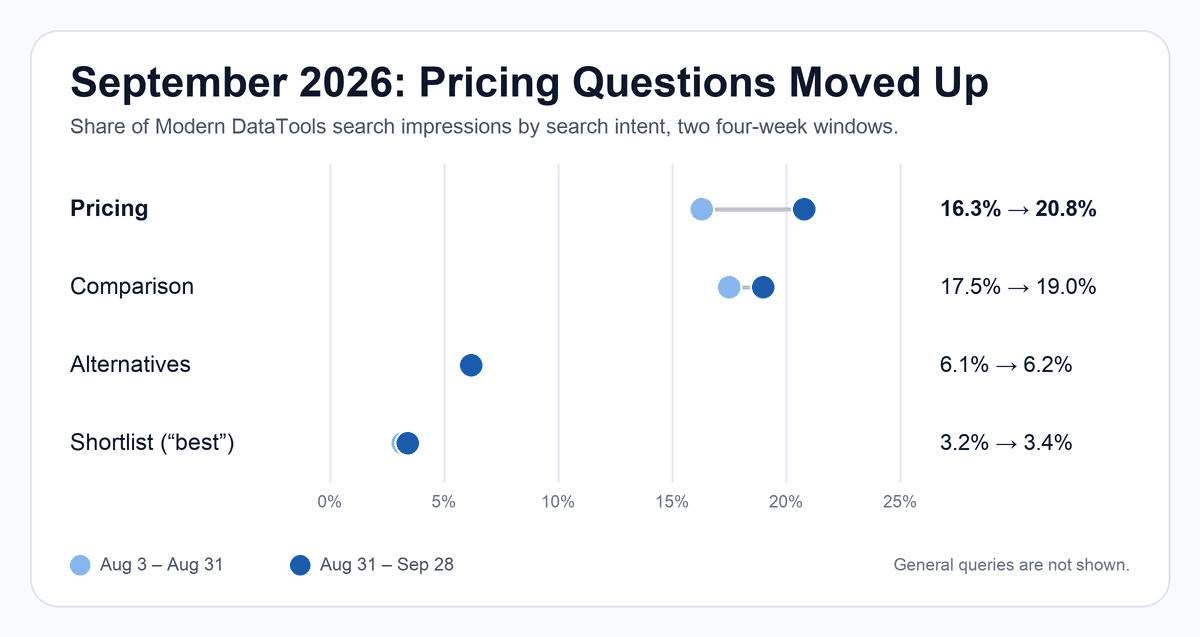
| Intent | Share, four weeks to 2026-08-31 | Share, four weeks to 2026-09-28 | Index (100 = no change) | Rank |
|---|---|---|---|---|
| Pricing | 16.3% | 20.8% | 141.8 | #3 -> #2 |
| Comparison | 17.5% | 19.0% | 120.2 | #2 -> #3 |
| Alternatives | 6.1% | 6.2% | 113.7 | unchanged |
| Shortlist ("best") | 3.2% | 3.4% | 118.7 | unchanged |
All four intents grew, but pricing grew fastest. Comparison searches tend to come early in an evaluation, when a team is still deciding which tools to look at. Pricing searches tend to come later, when a tool is closer to a decision. More pricing questions are consistent with more searchers checking cost before they commit.
Public Adoption Signals: Postgres Images Led the Volume
Docker Hub pulls are cumulative, so the absolute addition matters more than the percentage. A small percentage on a total of billions is steady scale, not a sudden change.
| Tool | Docker Hub image | Current pulls | 4-week change |
|---|---|---|---|
| PostgreSQL | library/postgres | 11,649,360,593 | +295,517,978 (+2.6%) |
| Redis | library/redis | 11,343,655,391 | +148,350,580 (+1.33%) |
| MySQL | library/mysql | 5,153,863,511 | +47,933,164 (+0.94%) |
| Memcached | library/memcached | 13,371,945,395 | +45,574,739 (+0.34%) |
| pgvector | [pgvector](/tools/pgvector)/[pgvector](/tools/pgvector) | 207,192,603 | +42,364,032 (+25.7%) |
| ClickHouse | clickhouse/clickhouse-server | 307,006,131 | +20,204,308 (+7.04%) |
PostgreSQL again added the most pulls, and more than it added in July's comparison. Redis, MySQL and Memcached kept adding tens to hundreds of millions of pulls at small percentages, as they did in July.
The move worth noting is pgvector. Its image is far smaller than the base images, yet it added more pulls than the Grafana or MongoDB images, and its total grew 25.7% in four weeks. The pgvector image is PostgreSQL with a vector-search extension, so its pulls and PostgreSQL's are related signals, not independent proof. Together they are consistent with continued interest in running vector search inside PostgreSQL. Container pulls also include CI pipelines and automated rebuilds: they measure how often an image is fetched, not how many teams run it. ClickHouse also grew faster than the base images, at +7.04%.
Package Activity: Kedro
The largest package-download move came from Kedro's PyPI package kedro. Weekly downloads rose from 214,315 to 503,317, an increase of 289,002 (+134.85%). This is a weekly rate, so it shows more downloads of the package, not that more teams chose Kedro as their pipeline framework. A one-month jump can come from a release, a dependency change or CI pipelines.
Project Health: Faster Development, One Queue Cleared, One Growing
These numbers describe development activity in each public repository. They are not usage.
| Tool | Repository | Signal | Before | After |
|---|---|---|---|---|
| HelixDB | [HelixDB](/tools/helixdb)/helix-db | Commits, 90-day count | 467 | 926 |
| AutoGPT | Significant-Gravitas/[AutoGPT](/tools/autogpt) | Commits, 90-day count | 341 | 659 |
| Sling | slingdata-io/sling-cli | Commits, 90-day count | 129 | 247 |
| InfluxDB | influxdata/influxdb | Releases, 180-day count | 6 | 11 |
| NATS | nats-io/nats-server | Open pull requests | 101 | 13 |
| Great Expectations | fivetran/great_expectations | Open pull requests | 15 | 35 |
HelixDB, AutoGPT and Sling nearly doubled their 90-day commit counts (+98.29%, +93.26% and +91.47%), which means more public development in recent weeks. NATS cleared most of its open pull-request queue. Great Expectations moved the other way: open pull requests rose from 15 to 35, and GitHub's open-issue count, which includes those pull requests, rose from 32 to 72. A growing queue can mean more contributions or slower review; the numbers alone do not say which.
Reader Interest: Databricks Drew Attention
Databricks drew more reader attention in September than in the four weeks before. It was not among this month's validated public-adoption movers, so the useful reading is narrow: more practitioners were researching Databricks, not that its usage changed.
What To Watch Next
- Does pricing stay ahead of comparison? If pricing searches keep a larger share than comparison searches in October, cost checks are becoming a steady part of how searchers evaluate tools here. If the order flips back, September was a short burst.
- Does pgvector keep outgrowing PostgreSQL? If
[pgvector](/tools/pgvector)/[pgvector](/tools/pgvector)again grows far faster in percentage terms thanlibrary/postgres, the case for growing interest in vector search inside PostgreSQL gets stronger. If its growth falls toward the base-image range, September looks like a one-off, such as a release or a CI change. - Does Kedro hold its new level? If weekly
kedrodownloads stay near 503,317, the increase reflects lasting package activity. A fall back toward 214,315 would point to a short-lived release or pipeline effect.
Methodology
- The report compares the Monday snapshots of
2026-08-31and2026-09-28, a four-week comparison. - Cumulative metrics, such as Docker Hub pulls, only rise and are read as absolute additions. Flow metrics, such as weekly PyPI downloads, 90-day commit counts and 180-day release counts, are rates over a period. State metrics, such as open pull requests, can move either way and are not a verdict on a project.
- Minimum starting values keep very small baselines from dominating percentage rankings.
- Package, image and repository metrics measure the named package, image or repository, not whole-platform adoption.
- Vendor changes are read from each vendor's own published pages. A change is listed only when both the old and the new value were captured.
- Search demand is measured on Modern DataTools' own search impressions, comparing the four weeks to
2026-09-28with the four weeks to2026-08-31. It is therefore shaped by what the site covers. Shares are of impressions; each intent's index compares its impressions with the previous four weeks. - These are directional proxies for public activity and reader interest, not measurements of market share or technology selection.