Decision comparison
Amplitude vs Tableau
Choose Amplitude when the central question is how people use a digital product and which experiments, messages, or experiences improve retention and conversion. Choose Tableau when the goal is broadly distributed business reporting, highly interactive dashboards, and governed visual analytics across Tableau Cloud or Tableau Server.
Architecture choice. These take different approaches to the same problem. Read the table as a fit question rather than a feature race.
These are different kinds of product — Product Analytics and BI Platform.
Quick Comparison
| Decision factor | Amplitude | Tableau |
|---|---|---|
| Best For | Digital product teams optimizing web and mobile user journeys through behavioral analytics, experimentation, in-app engagement, and audience activation. | Business intelligence teams building interactive dashboards, governed enterprise reporting, and visual analysis across cloud-hosted or self-hosted data deployments. |
| Architecture | Cloud product-intelligence platform consolidating behavioral data, analytics, session replay, experimentation, governance, integrations, and AI-driven workflows. | Visual analytics portfolio with Tableau Cloud for hosted delivery and Tableau Server for self-hosted control, plus API-first composability and Data 360. |
| Pricing Model | Amplitude publishes a Free plan with 2M events per month forever and no credit card, and a Plus plan that "Starts at $0" with the first 2M events free and scales with event volume. Growth and Enterprise are custom-priced. No fixed monthly plan is published for Plus. Verified 2026-09-16 against amplitude.com/pricing. | Tableau Cloud Standard Edition: Viewer $15/user/month, Explorer $42/user/month, Creator $75/user/month; Enterprise Edition: Viewer $35/user/month, Explorer $70/user/month, Creator $115/user/month; Tableau+ Bundle requires contact sales for pricing details. |
| Ease of Use | Natural-language AI analytics, visual product analysis, guides, and surveys help cross-functional teams investigate user behavior without exclusively technical workflows. | Drag-and-drop visual analysis is a reported strength, though calculated fields, data cleaning, desktop workflows, and onboarding can challenge users. |
| Scalability | Designed for organization-wide behavioral data use, with governed schemas, identity-oriented audience capabilities, integrations, and consolidated cross-silo decision workflows. | Supports enterprise deployments through Tableau Server, hosted Tableau Cloud, permission-aware Slack analytics, semantic modeling, and enterprise workflow integrations. |
| Community/Support | Commercial platform serving 11K digital products; its Python Analytics SDK repository has 36 GitHub stars, MIT licensing, and a 2026 release. | User feedback reports an 8.4/10 rating across 2,320 reviews; its Tableau Server REST API Python library has 714 stars and MIT licensing. |
Amplitude
- Best For:
- Digital product teams optimizing web and mobile user journeys through behavioral analytics, experimentation, in-app engagement, and audience activation.
- Architecture:
- Cloud product-intelligence platform consolidating behavioral data, analytics, session replay, experimentation, governance, integrations, and AI-driven workflows.
- Pricing Model:
- Amplitude publishes a Free plan with 2M events per month forever and no credit card, and a Plus plan that "Starts at $0" with the first 2M events free and scales with event volume. Growth and Enterprise are custom-priced. No fixed monthly plan is published for Plus. Verified 2026-09-16 against amplitude.com/pricing.
- Ease of Use:
- Natural-language AI analytics, visual product analysis, guides, and surveys help cross-functional teams investigate user behavior without exclusively technical workflows.
- Scalability:
- Designed for organization-wide behavioral data use, with governed schemas, identity-oriented audience capabilities, integrations, and consolidated cross-silo decision workflows.
- Community/Support:
- Commercial platform serving 11K digital products; its Python Analytics SDK repository has 36 GitHub stars, MIT licensing, and a 2026 release.
Tableau
- Best For:
- Business intelligence teams building interactive dashboards, governed enterprise reporting, and visual analysis across cloud-hosted or self-hosted data deployments.
- Architecture:
- Visual analytics portfolio with Tableau Cloud for hosted delivery and Tableau Server for self-hosted control, plus API-first composability and Data 360.
- Pricing Model:
- Tableau Cloud Standard Edition: Viewer $15/user/month, Explorer $42/user/month, Creator $75/user/month; Enterprise Edition: Viewer $35/user/month, Explorer $70/user/month, Creator $115/user/month; Tableau+ Bundle requires contact sales for pricing details.
- Ease of Use:
- Drag-and-drop visual analysis is a reported strength, though calculated fields, data cleaning, desktop workflows, and onboarding can challenge users.
- Scalability:
- Supports enterprise deployments through Tableau Server, hosted Tableau Cloud, permission-aware Slack analytics, semantic modeling, and enterprise workflow integrations.
- Community/Support:
- User feedback reports an 8.4/10 rating across 2,320 reviews; its Tableau Server REST API Python library has 714 stars and MIT licensing.
Public signals
Verified factual signals only. Bars appear only for like-for-like metrics with five weekly assessments for every tool; missing evidence stays explicit. These signals do not establish enterprise adoption, product quality, or total cost.
| Metric | Amplitude | Tableau |
|---|---|---|
| GitHub commits, 90d(Developer adoption) | 0 | 37 |
| GitHub stars(Developer adoption) | 37 | 716 |
| Search interest(Market interest) | 0 | 85 |
| Hacker News mentions, 90d(Community interest) | 0 | 2 |
| npm weekly downloads(Developer adoption) | 724.9k | 32.2k |
| Product Hunt comments(Community interest) | 0 | 3 |
| Product Hunt rating(Community interest) | 4.8/5 | 4.2/5 |
| Product Hunt reviews(Community interest) | 48 | 5 |
| Product Hunt votes(Community interest) | 13 | 7 |
| PyPI weekly downloads(Developer adoption) | 1.6M | 965.7k |
| Stack Overflow questions(Community interest) | 56 | 5.4k |
As of September 21, 2026 — updated weekly.
Health & risk evidence
Observed public-source checks for mapped package versions and repositories.
Amplitude
September 21, 2026Package vulnerabilities
npm · @amplitude/analytics-node@1.5.72 · PyPI · amplitude-analytics@1.2.3
0 vulnerabilities
across 2 packages
Repository security score
Not available
Tableau
September 21, 2026Package vulnerabilities
npm · @tableau/embedding-api@3.16.1 · PyPI · tableauserverclient@0.41
0 vulnerabilities
across 2 packages
Repository security score
github.com/tableau/server-client-python
5.5/10
Interface Preview
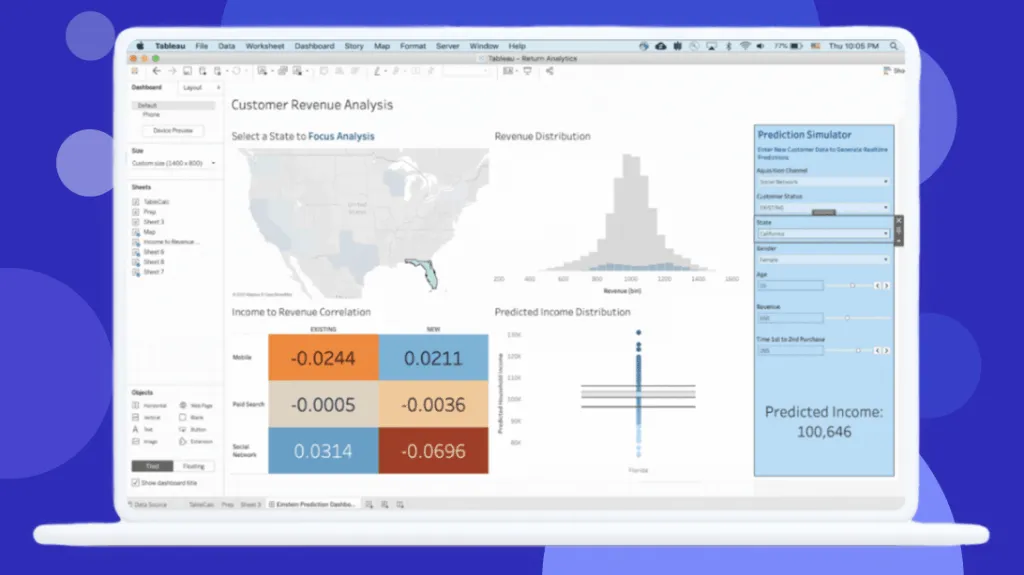
Tableau
Feature Comparison
| Feature | Amplitude | Tableau |
|---|---|---|
| Core analytics focus | ||
| Behavioral analysis | Analyzes user clicks, metrics, cohorts, and digital journeys. | Explores connected business data through interactive visual dashboards. |
| AI-assisted analysis | Answers analytics questions through natural-language AI analytics and agents. | Uses Tableau Next agentic analytics for trusted insights and action. |
| Data visualization | Visual exploration centers on product behavior and customer journeys. | Builds interactive visual analytics dashboards with drag-and-drop authoring. |
| Optimization and activation | ||
| Experimentation | Runs targeted feature and web A/B experiments with variant testing. | Not available in the supplied product feature data. |
| Audience engagement | Targets segmented audiences through activation channels, guides, and surveys. | Delivers permission-aware analytics through Slack and enterprise workflows. |
| Session-level evidence | Captures real-time session replay to interpret behavioral metrics. | Not available in the supplied product feature data. |
| Data foundation and governance | ||
| Data governance | Applies controls, schema enforcement, transformations, and diagnostic tools. | Uses a unified Data 360 layer and semantic modeling. |
| Semantic modeling | Organizes behavioral data through governed event and attribute controls. | Provides a semantic layer with AI-assisted model creation. |
| Data integration | Connects technology stacks for behavioral-data collection and utilization. | Connects data for Cloud or Server visual analytics deployments. |
| Deployment and extensibility | ||
| Deployment model | Operates as a consolidated cloud product-intelligence platform. | Offers hosted Tableau Cloud and self-hosted Tableau Server. |
| API and SDK ecosystem | Provides a Python Analytics SDK under the MIT license. | Provides an API-first design and MIT-licensed Python REST library. |
| AI ecosystem connection | MCP prompts Amplitude insights from Claude, Cursor, or AI platforms. | Integrates Agentforce capabilities with Tableau Next agentic analytics. |
| Commercial model and adoption | ||
| Entry plan | Offers a Starter tier at no charge. | Offers a free trial, while paid Cloud licensing starts at $15. |
| Paid licensing | Lists Plus from $0, scaling with event volume, and signals sales-led plans. | Licenses Viewer, Explorer, and Creator seats by edition. |
| External user feedback | Supplied reviews describe a broad product-intelligence and activation suite. | Users report visualization and data sources as strengths; cost as a weakness. |
Core analytics focus
Behavioral analysis
AI-assisted analysis
Data visualization
Optimization and activation
Experimentation
Audience engagement
Session-level evidence
Data foundation and governance
Data governance
Semantic modeling
Data integration
Deployment and extensibility
Deployment model
API and SDK ecosystem
AI ecosystem connection
Commercial model and adoption
Entry plan
Paid licensing
External user feedback
Which approach fits
Choose Amplitude when the central question is how people use a digital product and which experiments, messages, or experiences improve retention and conversion. Choose Tableau when the goal is broadly distributed business reporting, highly interactive dashboards, and governed visual analytics across Tableau Cloud or Tableau Server.
When each approach fits
Choose Amplitude if:
Choose Amplitude for product-led web or mobile businesses that need event-level behavioral analysis, session replay, cohorts, feature or web experiments, in-app feedback, and activation from the same platform.
Choose Tableau if:
Choose Tableau for organizations needing flexible executive and operational dashboards, drag-and-drop visual analysis, Cloud or self-hosted deployment options, semantic data models, and enterprise analytics workflows.
These scenarios reflect the available product evidence. Your requirements, existing stack, and team expertise should guide the final decision.
Frequently Asked Questions
What is the main difference between Amplitude and Tableau?
Amplitude is primarily a digital product-intelligence platform: it collects and analyzes behavioral signals such as user clicks, journeys, cohorts, and session replays, then connects that analysis to experiments, guides, surveys, and audience activation. Tableau is primarily a visual analytics and business-intelligence platform for connecting business data, creating interactive dashboards, and distributing governed insights. Tableau also offers agentic analytics through Tableau Next, but the supplied features do not position it as an experimentation and product-engagement suite.
Which is better for small teams?
Amplitude is often the more direct fit for a small product team that needs product analytics because it publishes a Starter tier at no charge and a Plus plan at from $0, scaling with events. The supplied pricing does not state Starter limits, so teams should validate event, seat, or retention limits before adopting it. Tableau offers a free trial rather than a stated free tier, and its Cloud Standard licenses begin at $15 per Viewer, $42 per Explorer, and $75 per Creator monthly, billed annually.
Can I migrate from Amplitude to Tableau?
Yes, but it is better understood as changing analytics layers than as a direct replacement. A team can export or make curated behavioral and business data available to Tableau, then recreate dashboards and reporting logic for visual analysis. However, Tableau dashboards do not replace Amplitude-specific workflows described in the supplied data, including session replay, feature experimentation, web experimentation, in-app guides, surveys, and product-audience activation. Define the target reporting questions and data model before migration.
What are the pricing differences?
Amplitude publishes a Starter tier at no charge and a Plus tier at from $0, scaling with events; the supplied pricing also signals contact-sales offerings, but does not provide their prices or Starter usage limits. Tableau uses per-user monthly licensing billed annually. Tableau Cloud Standard costs $15 for Viewer, $42 for Explorer, and $75 for Creator; Enterprise costs $35, $70, and $115 respectively. Tableau+ is exclusive to Tableau Cloud and requires a sales quote.