Decision comparison
Dagster vs Sling
Dagster and Sling serve different layers of the modern data stack. Dagster is a comprehensive data orchestration platform for managing complex multi-tool pipelines, while Sling is a focused ELT integration tool that excels at fast, efficient data replication between systems.
Used together. These are normally used together rather than chosen between. The comparison explains what each one does in the stack.
These are different kinds of product — Workflow Orchestrator and ELT Platform.
Quick Comparison
| Decision factor | Dagster | Sling |
|---|---|---|
| Primary Focus | Full data orchestration platform with asset-centric pipelines, lineage tracking, observability, and ML workflow support | Lightweight ELT data integration tool for replicating data between databases, files, and storage systems efficiently |
| Ease of Setup | Requires Python environment setup and pipeline code definition; steeper learning curve with asset-based paradigm | Single binary CLI install on Linux, macOS, and Windows; YAML-based configuration gets pipelines running in minutes |
| Pricing Entry Point | Open-source self-hosted free (Apache-2.0), Solo Plan $10/mo, Starter Plan $100/mo, Starter $1200/mo, Pro and Enterprise Plan contact sales | Free for up to 30 users, Premium at $2.00 per user per month, Business at $4.00 per user per month. Open-source self-hosted available under GPL-3.0 license. |
| Open Source License | Apache-2.0 license with 16,000+ GitHub stars; written in Python with active community and frequent releases | GPL-3.0 license with 800+ GitHub stars; core engine written in Go for high-performance streaming data movement |
| Best For | Data engineering teams needing full orchestration with dependency management, lineage, testing, and multi-tool coordination | Teams needing fast, no-fuss data replication between databases and file systems without complex orchestration overhead |
| Integration Breadth | Native integrations for Snowflake, BigQuery, dbt, Databricks, Fivetran, Spark, and Great Expectations out of the box | Connects to 20+ databases including PostgreSQL, MySQL, Snowflake, BigQuery, plus cloud storage and REST API sources |
Dagster
- Primary Focus:
- Full data orchestration platform with asset-centric pipelines, lineage tracking, observability, and ML workflow support
- Ease of Setup:
- Requires Python environment setup and pipeline code definition; steeper learning curve with asset-based paradigm
- Pricing Entry Point:
- Open-source self-hosted free (Apache-2.0), Solo Plan $10/mo, Starter Plan $100/mo, Starter $1200/mo, Pro and Enterprise Plan contact sales
- Open Source License:
- Apache-2.0 license with 16,000+ GitHub stars; written in Python with active community and frequent releases
- Best For:
- Data engineering teams needing full orchestration with dependency management, lineage, testing, and multi-tool coordination
- Integration Breadth:
- Native integrations for Snowflake, BigQuery, dbt, Databricks, Fivetran, Spark, and Great Expectations out of the box
Sling
- Primary Focus:
- Lightweight ELT data integration tool for replicating data between databases, files, and storage systems efficiently
- Ease of Setup:
- Single binary CLI install on Linux, macOS, and Windows; YAML-based configuration gets pipelines running in minutes
- Pricing Entry Point:
- Free for up to 30 users, Premium at $2.00 per user per month, Business at $4.00 per user per month. Open-source self-hosted available under GPL-3.0 license.
- Open Source License:
- GPL-3.0 license with 800+ GitHub stars; core engine written in Go for high-performance streaming data movement
- Best For:
- Teams needing fast, no-fuss data replication between databases and file systems without complex orchestration overhead
- Integration Breadth:
- Connects to 20+ databases including PostgreSQL, MySQL, Snowflake, BigQuery, plus cloud storage and REST API sources
Public signals
Verified factual signals only. Bars appear only for like-for-like metrics with five weekly assessments for every tool; missing evidence stays explicit. These signals do not establish enterprise adoption, product quality, or total cost.
| Metric | Dagster | Sling |
|---|---|---|
| Docker Hub pulls(Developer adoption) | 6.2M | Not available |
| GitHub commits, 90d(Product adoption) | 265 | 180 |
| GitHub stars(Product adoption) | 16,000+ | 906 |
| Search interest(Market interest) | 1 | 1 |
| Hacker News mentions, 90d(Community interest) | 3 | Not available |
| Product Hunt comments(Community interest) | 11 | Not available |
| Product Hunt rating(Community interest) | 5.0/5 | Not available |
| Product Hunt reviews(Community interest) | 1 | Not available |
| Product Hunt votes(Community interest) | 112 | Not available |
| PyPI weekly downloads(Product adoption) | 1.8M | 40.3k |
| Stack Overflow questions(Community interest) | 171 | Not available |
| Docker Hub pulls(Product adoption) | Not available | 17.2k |
As of September 21, 2026 — updated weekly.
Health & risk evidence
Observed public-source checks for mapped package versions and repositories.
Dagster
September 21, 2026Package vulnerabilities
PyPI · dagster@1.13.23
0 vulnerabilities
across 1 package
Repository security score
github.com/dagster-io/dagster
5.1/10
Sling
September 21, 2026Package vulnerabilities
PyPI · sling@1.6.3
0 vulnerabilities
across 1 package
Repository security score
github.com/slingdata-io/sling-cli
3.8/10
Interface Preview
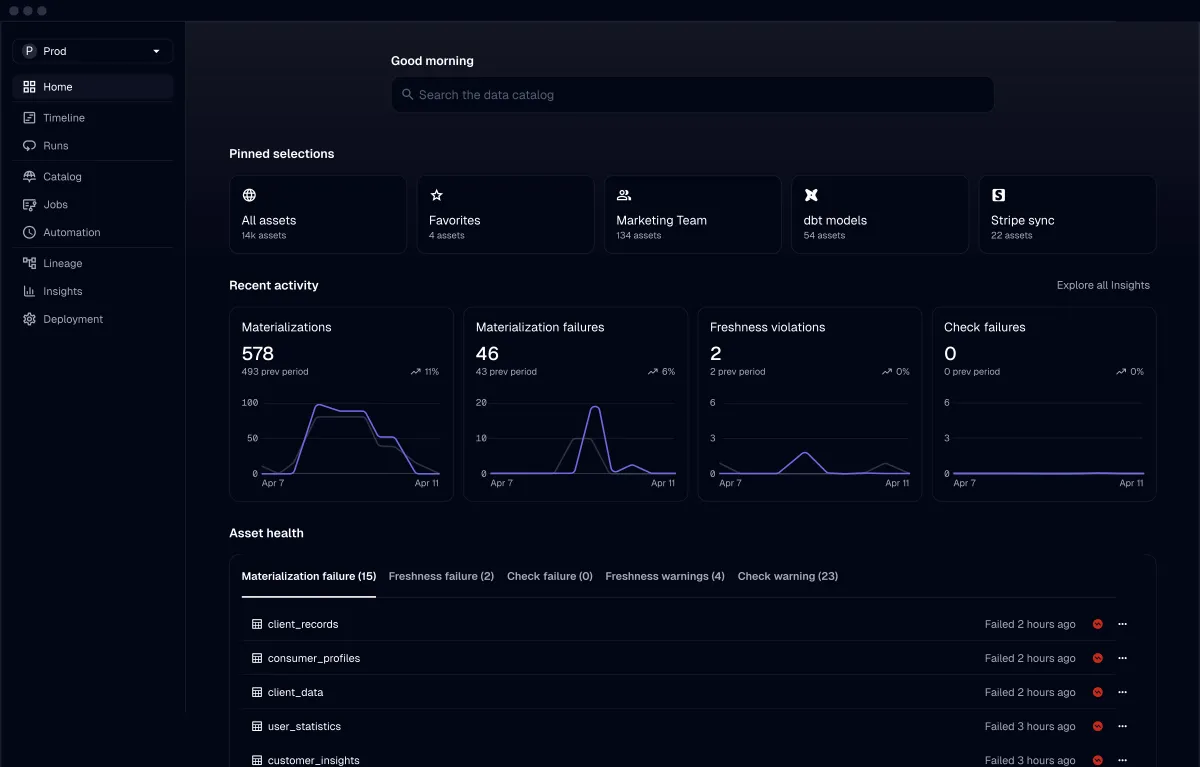
Dagster
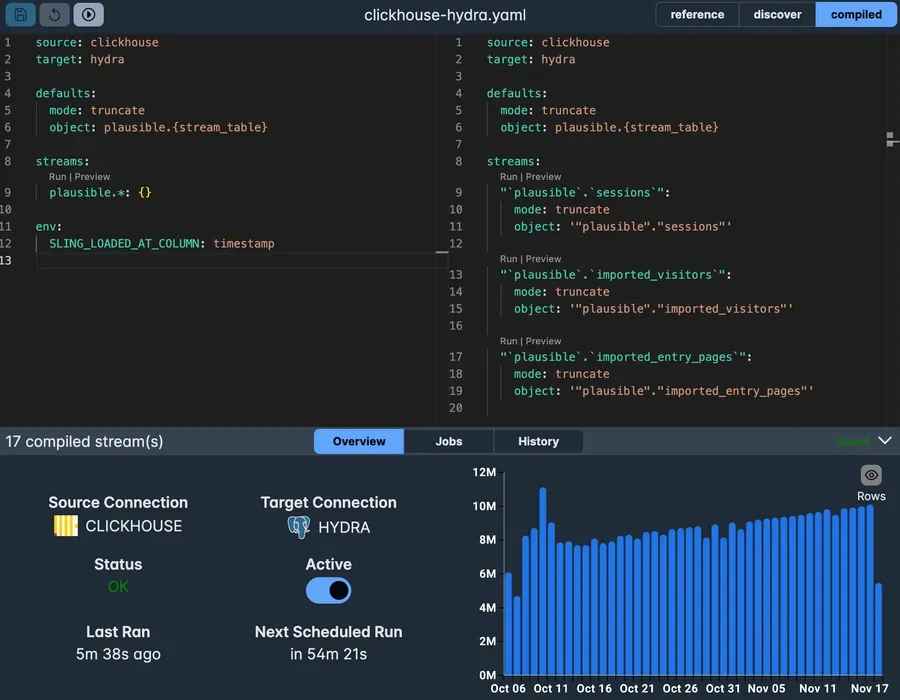
Sling
Feature Comparison
| Feature | Dagster | Sling |
|---|---|---|
| Data Movement & Integration | ||
| Database Replication | Orchestrates replication through integrations with Fivetran, Sling embedded ELT, and custom Python operators | Native streaming replication between PostgreSQL, MySQL, Oracle, Snowflake, BigQuery, Redshift with schema auto-detection |
| File Loading | Handles file-based assets through Python operators and integrations; supports Spark for large-scale file processing | Loads CSV, Parquet, JSON, and Excel files directly into warehouses with automatic schema detection and type conversion |
| Change Data Capture | Supports incremental materializations and partitioned assets for change-aware processing patterns | Reads database transaction logs for row-level CDC with inserts, updates, and deletes; available on Advanced plan |
| Orchestration & Workflow | ||
| Pipeline Definition | Declarative asset-based definitions in Python with automatic dependency resolution and DAG construction | YAML-based replication configurations with support for runtime variables, wildcard selection, and hooks |
| Scheduling & Automation | Built-in schedules, sensors, and auto-materialize policies for event-driven and time-based pipeline execution | Job scheduling through the Platform UI with alerting for specific statuses; CLI supports cron-based scheduling |
| Load Modes | Supports full and incremental materializations through partitioning, with configurable staleness policies | Five built-in modes: full-refresh, truncate, incremental merge/append, snapshot with timestamps, and backfill |
| Observability & Monitoring | ||
| Data Lineage | First-class lineage graphs showing asset dependencies, upstream/downstream impacts, and cross-system data flow | Job execution history with row/byte transfer details, duration tracking, and status logging per stream |
| Alerting | Intelligent alerts in Slack with AI-powered debugging and impact analysis for data incidents | Email, Slack, and MS Teams alerting on Standard plan; schema deviation and data quality alerts on all plans |
| Health Monitoring | Real-time health metrics tracking freshness, performance, costs, and pipeline reliability with dashboards | Monitors volume, existence, freshness, and schema changes for database and file objects via YAML configuration |
| Developer Experience | ||
| Local Development | Full local development environment with unit testing, type checking, and CI integration for pipelines | CLI runs locally on any OS; Python SDK available for programmatic use with pip install sling |
| IDE & Editor | Dagster UI (Dagit) provides web-based DAG visualization, asset catalog, and run monitoring interface | Built-in web editor in Platform for live replication compilation, stream discovery, and data preview |
| Version Control | Branch deployments for CI/CD workflows with GitOps-native pipeline management and code review integration | Git integration on Advanced plan connecting projects to GitHub, GitLab, or Bitbucket repositories |
| Enterprise & Security | ||
| Authentication & Access | SSO with Google, GitHub, and SAML IdPs; RBAC and SCIM provisioning for enterprise identity management | User roles with granular permissions on Advanced plan; project-based workspace isolation for team access |
| Compliance | SOC 2 Type II certified and HIPAA aligned with audit logs, retention policies, and multi-tenant isolation | Audit logs on Advanced plan for tracking platform activities; self-hosted option for full data control |
| Deployment Options | Self-hosted on single server or Kubernetes; Dagster Cloud with hybrid bring-your-own-infrastructure in NA and EU | Self-hosted agent on Mac, Linux, or Windows; Platform self-hosting available on Advanced plan for private networks |
Data Movement & Integration
Database Replication
File Loading
Change Data Capture
Orchestration & Workflow
Pipeline Definition
Scheduling & Automation
Load Modes
Observability & Monitoring
Data Lineage
Alerting
Health Monitoring
Developer Experience
Local Development
IDE & Editor
Version Control
Enterprise & Security
Authentication & Access
Compliance
Deployment Options
How they fit together
Dagster and Sling serve different layers of the modern data stack. Dagster is a comprehensive data orchestration platform for managing complex multi-tool pipelines, while Sling is a focused ELT integration tool that excels at fast, efficient data replication between systems.
What each one handles
Use Dagster for:
Choose Dagster when your team needs a full orchestration platform to coordinate complex data workflows spanning multiple tools like dbt, Snowflake, Databricks, and Spark. Dagster excels when you need asset-level lineage tracking, dependency management across dozens of data assets, built-in testing and CI/CD for pipelines, and enterprise features like SOC 2 compliance and RBAC. Its asset-centric approach is ideal for teams managing production data platforms where understanding data flow and debugging failures quickly is critical to business operations.
Use Sling for:
Choose Sling when your primary need is fast, reliable data replication between databases, files, and cloud storage without the overhead of a full orchestration platform. Sling's Go-based streaming engine and YAML configuration get data moving in minutes, making it perfect for teams that need to sync production databases to analytics warehouses, load files into data warehouses, or extract data from REST APIs. The free CLI makes it accessible for individual developers, and the Platform pricing at $99/mo for Standard is straightforward for teams that need scheduling and parallel execution.
These roles reflect the available product evidence. Most teams run both; which one owns a given job depends on your stack and team.
Frequently Asked Questions
Can Dagster and Sling be used together?
Dagster and Sling integrate directly through Dagster's embedded ELT feature. Multiple Sling users have praised this integration, with one consultant noting it as a 'big vote of confidence' that Dagster incorporated Sling. This combination lets you use Sling's efficient Go-based streaming engine for data movement while Dagster handles orchestration, scheduling, lineage tracking, and dependency management across your broader data platform. You define Sling replications as Dagster assets, gaining full observability and automated scheduling through Dagster's control plane.
What are the main differences in pricing between Dagster and Sling?
Both tools offer free open-source options. Dagster's self-hosted version is free under Apache-2.0, while Dagster Cloud starts at $10/mo for Solo (7,500 credits, 1 user), $100/mo for Starter (30,000 credits, up to 3 users), and contact sales for Pro and Enterprise. All cloud plans include a 30-day free trial. Sling's CLI is permanently free under GPL-3.0. The Sling Platform offers Free, Standard at $99/mo ($91/mo yearly), and Advanced at $249/mo ($228/mo yearly). The key difference is that Dagster uses credit-based pricing while Sling charges flat monthly rates per plan tier.
Which tool is better for small teams just starting with data pipelines?
For small teams focused on moving data between systems, Sling is the faster path to production. Its CLI installs as a single binary, configurations are defined in simple YAML files, and the free tier covers basic replication needs without any cost. Sling's 9.2/10 user rating across 14 reviews reflects its ease of use. Dagster requires more upfront investment in learning its asset-centric paradigm and Python-based definitions, but provides a stronger foundation if you anticipate growing into complex multi-tool orchestration with dbt, ML pipelines, or cross-team data platform management.
How do Dagster and Sling compare in terms of open-source community and development activity?
Dagster has a sizable open-source community with 16,000+ GitHub stars compared to Sling's 839 stars. Dagster is written in Python and licensed under Apache-2.0, with its latest release at v1.13.1 and active development including frequent pushes. Sling is written in Go and licensed under GPL-3.0, with its latest release at v1.5.15. Both tools maintain active development schedules. Dagster's sizable community means a high number of third-party integrations, tutorials, and community support resources, while Sling's focused scope keeps its codebase lean and its feature set targeted at data integration use cases.