Decision comparison
Dagster vs Y42
Dagster is the stronger choice for engineering teams that need deep customization, open-source flexibility, and enterprise-grade observability. Y42 is better suited for data practitioners who want a turnkey managed platform that minimizes infrastructure work.
Direct comparison. These are reviewed substitutes bought for the same job, so the differences below are the ones that decide between them.
All 2 are workflow orchestrators.
Quick Comparison
| Decision factor | Dagster | Y42 |
|---|---|---|
| Best For | Engineering teams building complex asset-centric pipelines with full observability and custom integrations | Data practitioners who want a unified turnkey platform without managing infrastructure overhead |
| Pricing | Open-source self-hosted free (Apache-2.0), Solo Plan $10/mo, Starter Plan $100/mo, Starter $1200/mo, Pro and Enterprise Plan contact sales | Free plan available, Business plan $500/mo (2 spaces included, 3 users included), Enterprise plan custom |
| Deployment Model | Self-hosted on Kubernetes or single server, or fully managed Dagster Cloud with hybrid options | Fully managed cloud platform with browser-based UI and code IDE, no self-hosting option |
| Orchestration Approach | Asset-centric declarative orchestration with dependency graphs, partitioning, and versioning built in | Turnkey declarative orchestrator with native Git integration and branch environments for data workflows |
| Learning Curve | Steeper learning curve requiring Python proficiency and understanding of asset-based paradigms | Lower barrier to entry with browser-based UI, though SQL/dbt Core and Python knowledge still needed |
| Extensibility | Highly extensible with native integrations for Snowflake, BigQuery, dbt, Databricks, Spark, and Fivetran | Native Git and data warehouse integrations with SQL/dbt Core and Python asset support |
Dagster
- Best For:
- Engineering teams building complex asset-centric pipelines with full observability and custom integrations
- Pricing:
- Open-source self-hosted free (Apache-2.0), Solo Plan $10/mo, Starter Plan $100/mo, Starter $1200/mo, Pro and Enterprise Plan contact sales
- Deployment Model:
- Self-hosted on Kubernetes or single server, or fully managed Dagster Cloud with hybrid options
- Orchestration Approach:
- Asset-centric declarative orchestration with dependency graphs, partitioning, and versioning built in
- Learning Curve:
- Steeper learning curve requiring Python proficiency and understanding of asset-based paradigms
- Extensibility:
- Highly extensible with native integrations for Snowflake, BigQuery, dbt, Databricks, Spark, and Fivetran
Y42
- Best For:
- Data practitioners who want a unified turnkey platform without managing infrastructure overhead
- Pricing:
- Free plan available, Business plan $500/mo (2 spaces included, 3 users included), Enterprise plan custom
- Deployment Model:
- Fully managed cloud platform with browser-based UI and code IDE, no self-hosting option
- Orchestration Approach:
- Turnkey declarative orchestrator with native Git integration and branch environments for data workflows
- Learning Curve:
- Lower barrier to entry with browser-based UI, though SQL/dbt Core and Python knowledge still needed
- Extensibility:
- Native Git and data warehouse integrations with SQL/dbt Core and Python asset support
Public signals
Verified factual signals only. Bars appear only for like-for-like metrics with five weekly assessments for every tool; missing evidence stays explicit. These signals do not establish enterprise adoption, product quality, or total cost.
| Metric | Dagster | Y42 |
|---|---|---|
| Docker Hub pulls(Developer adoption) | 6.2M | Not available |
| GitHub commits, 90d(Product adoption) | 265 | Not available |
| GitHub stars(Product adoption) | 16,000+ | Not available |
| Search interest(Market interest) | 1 | Unavailable |
| Hacker News mentions, 90d(Community interest) | 3 | 0 |
| Product Hunt comments(Community interest) | 11 | Not available |
| Product Hunt rating(Community interest) | 5.0/5 | Not available |
| Product Hunt reviews(Community interest) | 1 | Not available |
| Product Hunt votes(Community interest) | 112 | Not available |
| PyPI weekly downloads(Product adoption) | 1.8M | Not available |
| Stack Overflow questions(Community interest) | 171 | Not available |
As of September 21, 2026 — updated weekly.
Health & risk evidence
Observed public-source checks for mapped package versions and repositories.
Dagster
September 21, 2026Package vulnerabilities
PyPI · dagster@1.13.23
0 vulnerabilities
across 1 package
Repository security score
github.com/dagster-io/dagster
5.1/10
Y42
Package vulnerabilities
Not available
Repository security score
Not available
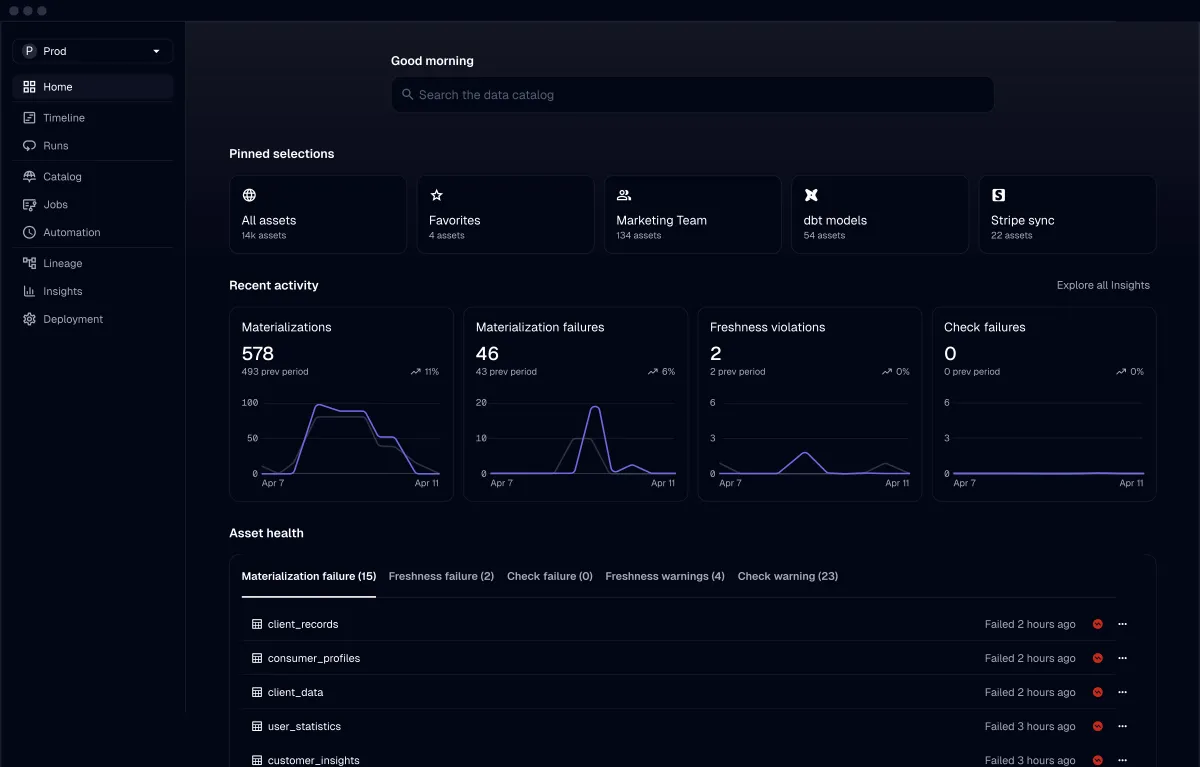
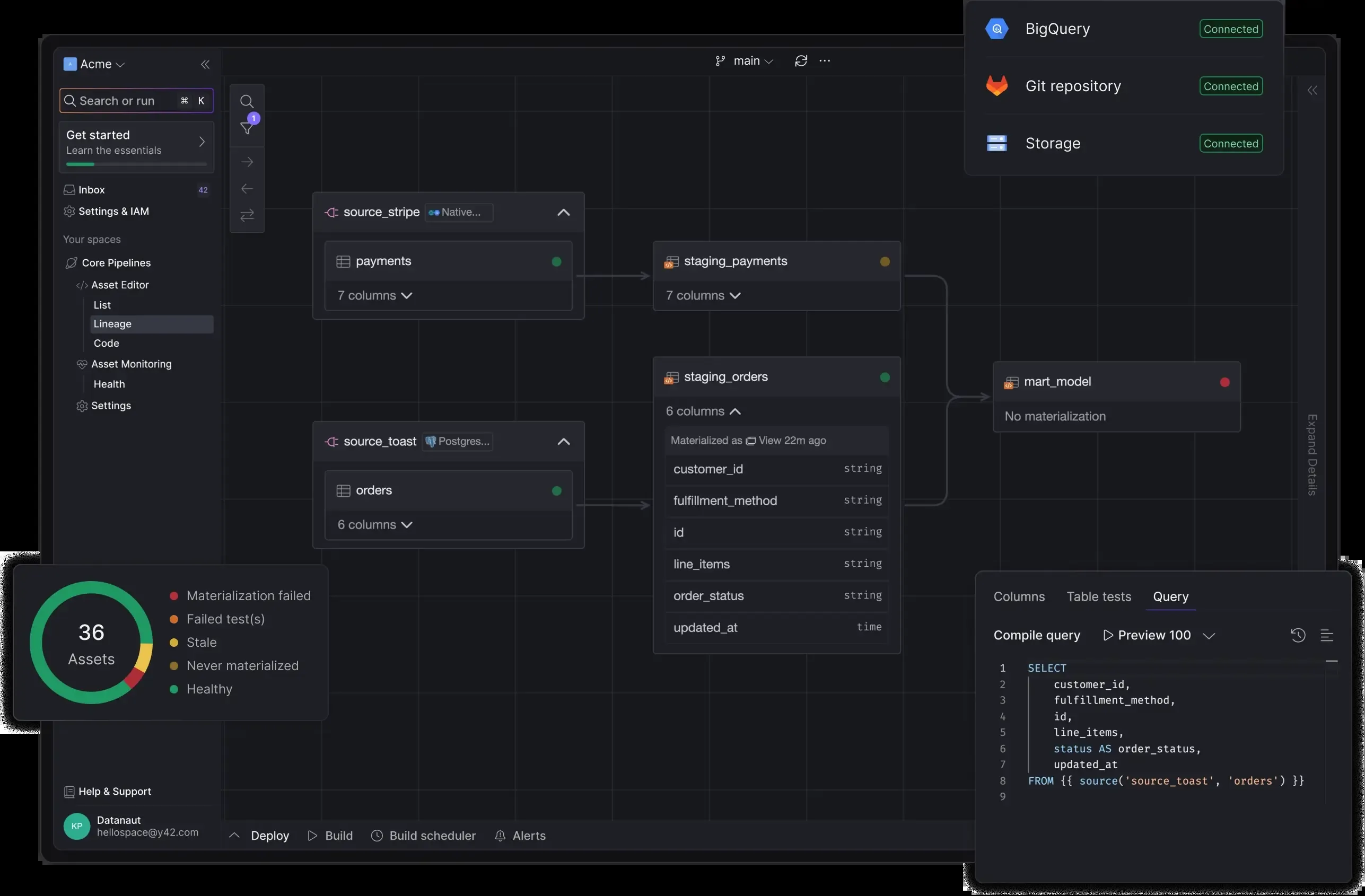
Interface Preview
Dagster
Y42
Feature Comparison
| Feature | Dagster | Y42 |
|---|---|---|
| Orchestration & Scheduling | ||
| Pipeline Orchestration | Asset-centric declarative orchestration with dependency management, partitioning, and incremental runs | Turnkey declarative orchestrator and scheduler with unified pipeline management interface |
| Scheduling | Built-in scheduler supporting cron-based, sensor-driven, and asset materialization triggers | Declarative scheduler integrated into the orchestration platform with automated pipeline runs |
| Version Control | Code-level version control via Git with branch deployments for CI/CD-native workflows | Native Git integration with branch environments for production deployment and pull requests for data |
| Data Quality & Observability | ||
| Data Quality | Built-in validation, automated testing, freshness checks, and partitioned asset checks embedded in code | Data quality assurance features available in Enterprise plan with built-in observability for pipelines |
| Lineage & Catalog | Integrated data catalog with auto-generated documentation, asset lineage graphs, and metadata tracking | Pipeline-level observability to monitor data flows and prevent errors across the platform |
| Monitoring & Alerting | Real-time health metrics, Slack alerting, AI-powered debugging, and cost tracking dashboards | Built-in observability to proactively prevent data pipeline errors and monitor flow reliability |
| Development Experience | ||
| Development Environment | Local development with unit testing, CI integration, and branch deployments for isolated testing | Browser-based UI and code IDE for developing pipelines directly in the platform without local setup |
| Language Support | Python-native framework with full programmatic control over pipeline definitions and asset logic | SQL/dbt Core and Python assets supported through the browser-based and code IDE interfaces |
| Collaboration | Multi-tenant instances with code isolation, RBAC, and shared asset catalogs across teams | Spaces-based collaboration with 2 spaces on Business plan, unlimited spaces on Enterprise |
| Integrations & Deployment | ||
| Data Warehouse Integrations | Native connectors for Snowflake, BigQuery, Databricks, and external system observability via Dagster Pipes | Native data warehouse integrations with SQL-based ingestion add-on using pre-built hosted connectors |
| dbt Integration | First-class dbt integration that orchestrates dbt models as Dagster assets with full lineage tracking | Native dbt Core support for SQL transformations within the unified orchestration platform |
| Deployment Options | Self-hosted on single server or Kubernetes, or Dagster Cloud with hybrid bring-your-own-infrastructure | Fully managed cloud platform only, with no self-hosted deployment option available |
| Security & Compliance | ||
| Authentication | SSO with Google, GitHub, and SAML IdPs, plus SCIM provisioning for automated user management | SSO using Okta, SCIM, and OAuth available on Enterprise plan for centralized identity management |
| Compliance | SOC 2 Type II certified and HIPAA aligned with independent audits and custom security questionnaires | Enterprise plan includes SLA and audit logging; specific compliance certifications not publicly listed |
| Audit & Access Control | RBAC with audit logs, retention policies, and unified view of all user actions across the platform | Audit logging available on Enterprise plan with role-based access through spaces and user management |
Orchestration & Scheduling
Pipeline Orchestration
Scheduling
Version Control
Data Quality & Observability
Data Quality
Lineage & Catalog
Monitoring & Alerting
Development Experience
Development Environment
Language Support
Collaboration
Integrations & Deployment
Data Warehouse Integrations
dbt Integration
Deployment Options
Security & Compliance
Authentication
Compliance
Audit & Access Control
Which to choose
Dagster is the stronger choice for engineering teams that need deep customization, open-source flexibility, and enterprise-grade observability. Y42 is better suited for data practitioners who want a turnkey managed platform that minimizes infrastructure work.
Best-fit scenarios
Choose Dagster if:
Choose Dagster if your team has strong Python skills and needs a highly extensible orchestration platform. Dagster excels at complex, multi-system pipelines where asset-centric orchestration provides clear lineage and dependency management. With 16,000+ GitHub stars and an Apache-2.0 license, it offers full transparency and an active open-source community. The self-hosted option gives complete control over infrastructure, while Dagster Cloud provides a managed experience with hybrid deployment. SOC 2 Type II and HIPAA compliance make it enterprise-ready.
Choose Y42 if:
Choose Y42 if your team prioritizes speed of deployment and wants to avoid managing orchestration infrastructure entirely. Y42 has a Browser-based UI and Code IDE. The native Git integration with branch environments supports safe iteration on production data. At $500/mo for the Business plan with 2 spaces and 3 users included, it provides a straightforward pricing model. Y42 scores 4.9 out of 5 on Capterra from 16 reviews, reflecting strong user satisfaction among its customer base.
These scenarios reflect the available product evidence. Your requirements, existing stack, and team expertise should guide the final decision.
Frequently Asked Questions
Is Dagster open source and can I self-host it?
Yes, Dagster is fully open source under the Apache-2.0 license with 15,348 GitHub stars. You can self-host Dagster on a single server or on Kubernetes with complete control over your infrastructure. The open-source version includes the core orchestration engine, asset framework, and all integrations. For teams that prefer a managed experience, Dagster Cloud offers hosted deployments with hybrid options where you bring your own infrastructure. The self-hosted path has no licensing fees, making it a cost-effective choice for teams with DevOps capacity.
How does Y42 pricing compare to Dagster for a small team?
Y42 offers a free plan for getting started and a Business plan at $500/mo that includes 2 spaces and 3 users with the browser-based UI, declarative orchestrator, and native Git integrations. Dagster provides its open-source version at zero cost for self-hosting, a Solo plan at $10/mo for personal projects, and a Starter plan at $100/mo for production pipelines with up to 3 users and RBAC. For a small team, Dagster Cloud is significantly cheaper at $100/mo compared to Y42 at $500/mo, though Y42 includes its turnkey infrastructure in that price while Dagster self-hosted requires you to manage your own servers.
Which platform has better dbt integration?
Both platforms integrate with dbt, but they take different approaches. Dagster treats dbt models as first-class assets within its orchestration graph, providing full lineage tracking and the ability to orchestrate dbt runs alongside Python transformations, API calls, and ML workflows in a unified dependency graph. Y42 supports SQL/dbt Core and Python assets natively within its browser-based IDE, offering a more streamlined experience for teams that primarily work with dbt transformations. Dagster provides deeper programmatic control over dbt orchestration, while Y42 offers a more accessible interface for dbt-centric workflows.
What enterprise security features do Dagster and Y42 offer?
Dagster provides SOC 2 Type II certification, HIPAA alignment, SSO with Google, GitHub, and SAML IdPs, SCIM provisioning, RBAC, multi-tenant instances with code isolation, audit logs with retention policies, and custom security questionnaires. Y42 offers SSO using Okta, SCIM, and OAuth on its Enterprise plan, along with audit logging and SLA guarantees. Dagster has a more comprehensive and publicly documented compliance posture, which matters for regulated industries like healthcare and finance. Y42 provides solid enterprise security features but does not publicly list specific compliance certifications beyond its Enterprise plan capabilities.