Decision comparison
ZenML vs Dagster
ZenML and Dagster serve different primary audiences. ZenML is purpose-built for ML and AI teams who need portable, reproducible pipelines across any infrastructure. Dagster excels as a general-purpose data orchestrator with superior observability, a built-in data catalog, and a lower managed-cloud entry point. The right choice depends on whether your workflows center on ML model lifecycle management or broader data asset orchestration.
Architecture choice. These take different approaches to the same problem. Read the table as a fit question rather than a feature race.
These are different kinds of product — ML Pipeline Framework and Workflow Orchestrator.
Quick Comparison
| Decision factor | ZenML | Dagster |
|---|---|---|
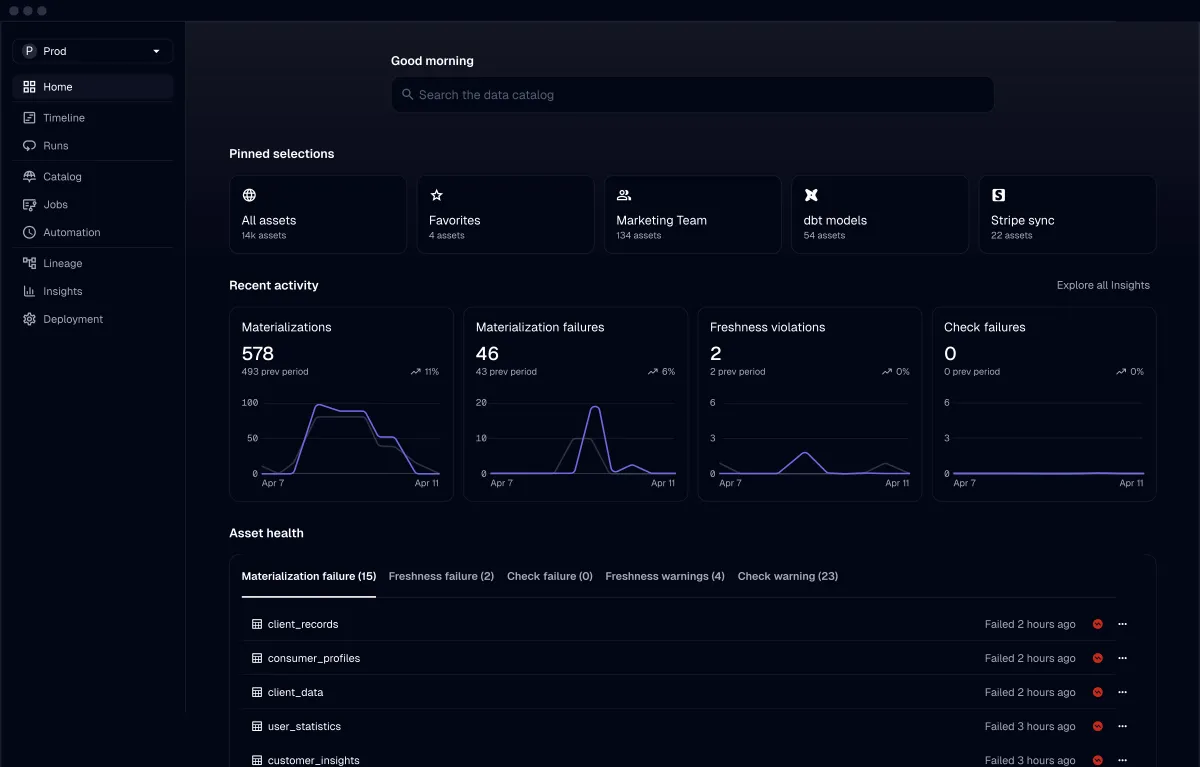
| Primary Focus | MLOps and LLMOps pipeline orchestration with pluggable stack components and artifact versioning | Asset-centric data orchestration with built-in lineage, observability, and catalog capabilities |
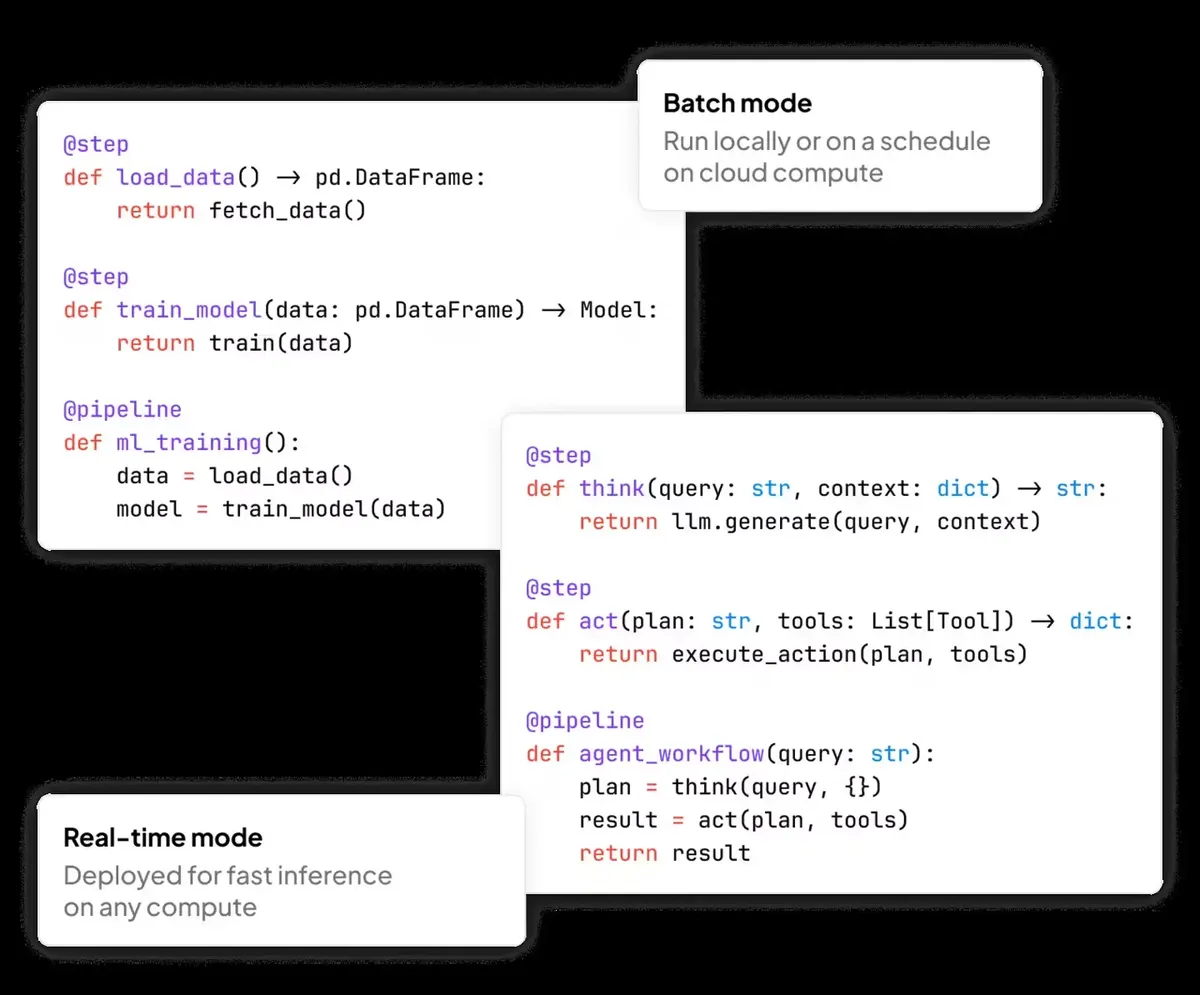
| Orchestration Model | Step-based pipelines with decorators that abstract away infrastructure and run on any orchestrator | Declarative asset-based DAGs that model data dependencies rather than task sequences |
| Pricing Entry Point | Open source (self-hosted) free, Starter $399/mo, Growth $999/mo, Scale $2,499/mo, Enterprise custom | Open-source self-hosted free (Apache-2.0), Solo Plan $10/mo, Starter Plan $100/mo, Starter $1200/mo, Pro and Enterprise Plan contact sales |
| Deployment Flexibility | Self-hosted open source or managed cloud with VPC deployment and full data sovereignty | Self-hosted open source, Dagster+ cloud, or hybrid with multi-region support across NA and EU |
| Community & Ecosystem | Growing MLOps community with 60+ integrations across ML and AI frameworks like LangChain | 16,000+ GitHub stars with deep integrations for Snowflake, dbt, Databricks, and Fivetran |
| Enterprise Readiness | SOC2 and ISO 27001 compliant with RBAC, SSO, audit logs, and on-prem options | SOC 2 Type II and HIPAA compliant with SSO, SCIM, RBAC, and multi-tenant instances |
ZenML
- Primary Focus:
- MLOps and LLMOps pipeline orchestration with pluggable stack components and artifact versioning
- Orchestration Model:
- Step-based pipelines with decorators that abstract away infrastructure and run on any orchestrator
- Pricing Entry Point:
- Open source (self-hosted) free, Starter $399/mo, Growth $999/mo, Scale $2,499/mo, Enterprise custom
- Deployment Flexibility:
- Self-hosted open source or managed cloud with VPC deployment and full data sovereignty
- Community & Ecosystem:
- Growing MLOps community with 60+ integrations across ML and AI frameworks like LangChain
- Enterprise Readiness:
- SOC2 and ISO 27001 compliant with RBAC, SSO, audit logs, and on-prem options
Dagster
- Primary Focus:
- Asset-centric data orchestration with built-in lineage, observability, and catalog capabilities
- Orchestration Model:
- Declarative asset-based DAGs that model data dependencies rather than task sequences
- Pricing Entry Point:
- Open-source self-hosted free (Apache-2.0), Solo Plan $10/mo, Starter Plan $100/mo, Starter $1200/mo, Pro and Enterprise Plan contact sales
- Deployment Flexibility:
- Self-hosted open source, Dagster+ cloud, or hybrid with multi-region support across NA and EU
- Community & Ecosystem:
- 16,000+ GitHub stars with deep integrations for Snowflake, dbt, Databricks, and Fivetran
- Enterprise Readiness:
- SOC 2 Type II and HIPAA compliant with SSO, SCIM, RBAC, and multi-tenant instances
Public signals
Verified factual signals only. Bars appear only for like-for-like metrics with five weekly assessments for every tool; missing evidence stays explicit. These signals do not establish enterprise adoption, product quality, or total cost.
| Metric | ZenML | Dagster |
|---|---|---|
| Docker Hub pulls(Product adoption) | 68.0k | Not available |
| GitHub commits, 90d(Ecosystem adoption) | 519 | Not available |
| GitHub stars(Ecosystem adoption) | 292 | Not available |
| Search interest(Market interest) | Unavailable | 1 |
| Hacker News mentions, 90d(Community interest) | 1 | 3 |
| Hugging Face downloads(Product adoption) | 1.1k | Not available |
| Hugging Face likes(Product adoption) | 28 | Not available |
| PyPI weekly downloads(Developer adoption) | 44.3k | Not available |
| Docker Hub pulls(Developer adoption) | Not available | 6.2M |
| GitHub commits, 90d(Product adoption) | Not available | 265 |
| GitHub stars(Product adoption) | Not available | 16,000+ |
| Product Hunt comments(Community interest) | Not available | 11 |
| Product Hunt rating(Community interest) | Not available | 5.0/5 |
| Product Hunt reviews(Community interest) | Not available | 1 |
| Product Hunt votes(Community interest) | Not available | 112 |
| PyPI weekly downloads(Product adoption) | Not available | 1.8M |
| Stack Overflow questions(Community interest) | Not available | 171 |
As of September 21, 2026 — updated weekly.
Health & risk evidence
Observed public-source checks for mapped package versions and repositories.
ZenML
September 21, 2026Package vulnerabilities
PyPI · zenml@0.96.4
0 vulnerabilities
across 1 package
Repository security score
Not available
Dagster
September 21, 2026Package vulnerabilities
PyPI · dagster@1.13.23
0 vulnerabilities
across 1 package
Repository security score
github.com/dagster-io/dagster
5.1/10
Interface Preview
ZenML
Dagster
Feature Comparison
| Feature | ZenML | Dagster |
|---|---|---|
| Pipeline Orchestration | ||
| DAG definition approach | Python decorators (@step, @pipeline) that convert functions into portable pipeline steps | Declarative asset definitions using @asset decorators with automatic dependency resolution |
| Scheduling and automation | Basic scheduling through connected orchestrators like Airflow and Kubeflow | Built-in schedules, sensors, and auto-materialization policies for reactive pipelines |
| Caching and optimization | Native smart caching that skips redundant steps and deduplicates expensive LLM calls | Incremental materialization with partition-aware caching and selective asset refreshes |
| Data Management | ||
| Artifact versioning | Full artifact and environment versioning with snapshots of code, packages, and container state | Asset versioning with partition-based tracking and metadata-driven lineage graphs |
| Data catalog and lineage | Pipeline-level lineage through the artifact store with metadata tracking per step | Integrated data catalog with auto-generated documentation, ownership, and cross-asset lineage |
| Data quality checks | Quality validation through integration with external tools like Great Expectations | Built-in asset checks, freshness policies, and automated data quality validation |
| ML and AI Capabilities | ||
| ML workflow support | Purpose-built for ML with model registries, experiment trackers, and model deployers | ML workflow support through integrations with training, experiment tracking, and data prep tools |
| LLM and GenAI support | Native LLMOps with LangChain, LlamaIndex, and OpenAI integrations for agent pipelines | AI workflow orchestration for model training and data preparation in GenAI applications |
| Model lifecycle management | Dedicated Model Control Plane for tracking model versions, stages, and deployment status | Model management through asset-based tracking with metadata and custom materialization |
| Infrastructure and Deployment | ||
| Cloud deployment options | Managed ZenML Pro with VPC deployment, or self-hosted on any Kubernetes cluster | Dagster+ cloud with serverless or hybrid modes, multi-region support across NA and EU |
| Infrastructure abstraction | Define hardware needs in Python; ZenML handles dockerization, GPU provisioning, and pod scaling | Dagster Pipes for running external compute jobs with first-class observability and metadata |
| Local development experience | Same @step code runs locally for debugging and in production on Kubernetes or Slurm | Full local development server with asset materialization, testing, and branch deployments |
| Governance and Security | ||
| Access control | Standard and custom RBAC roles with SSO support on Enterprise tier | SSO with Google, GitHub, and SAML IdPs, plus SCIM provisioning and RBAC |
| Compliance certifications | SOC2 and ISO 27001 certified with GDPR compliance and on-prem deployment option | SOC 2 Type II and HIPAA compliance with audit logs and data retention policies |
| Audit and observability | Execution traces, pipeline lineage visualization, and centralized API key management | Built-in audit logs, real-time health metrics, intelligent alerting, and cost tracking |
Pipeline Orchestration
DAG definition approach
Scheduling and automation
Caching and optimization
Data Management
Artifact versioning
Data catalog and lineage
Data quality checks
ML and AI Capabilities
ML workflow support
LLM and GenAI support
Model lifecycle management
Infrastructure and Deployment
Cloud deployment options
Infrastructure abstraction
Local development experience
Governance and Security
Access control
Compliance certifications
Audit and observability
Which approach fits
ZenML and Dagster serve different primary audiences. ZenML is purpose-built for ML and AI teams who need portable, reproducible pipelines across any infrastructure. Dagster excels as a general-purpose data orchestrator with superior observability, a built-in data catalog, and a lower managed-cloud entry point. The right choice depends on whether your workflows center on ML model lifecycle management or broader data asset orchestration.
When each approach fits
Choose ZenML if:
Choose ZenML if your team focuses primarily on machine learning and AI workflows and you need a framework that abstracts infrastructure complexity while keeping pipelines portable across orchestrators. ZenML is the stronger pick when your workflows involve training models, managing experiments, deploying ML services, or building LLM-powered agent pipelines. Its Model Control Plane, artifact versioning with full environment snapshots, and 60+ ML-focused integrations make it particularly well-suited for organizations that want to go from notebook prototypes to production ML systems without rewriting code. Teams already using Kubeflow, Airflow, or other orchestrators will appreciate that ZenML layers on top rather than replacing them.
Choose Dagster if:
Choose Dagster if your primary need is orchestrating data pipelines across your analytics stack, including ETL, dbt transformations, and warehouse management alongside ML workloads. Dagster stands out with its asset-centric paradigm that naturally models data dependencies, an integrated data catalog with auto-generated documentation, and built-in observability with real-time health metrics and intelligent alerting. Its managed cloud starts at just $10/mo, making it far more accessible for small teams and individual developers. With 15,000+ GitHub stars, extensive integrations with Snowflake, BigQuery, dbt, and Databricks, and features like Compass for AI-powered data exploration, Dagster is a mature choice for teams building comprehensive data platforms.
These scenarios reflect the available product evidence. Your requirements, existing stack, and team expertise should guide the final decision.
Frequently Asked Questions
Can ZenML and Dagster be used together in the same stack?
Yes, ZenML and Dagster can complement each other in certain architectures. ZenML is designed to work as a metadata and orchestration layer on top of existing tools, meaning you could use Dagster as one of your orchestration backends while ZenML handles ML-specific concerns like artifact versioning, model management, and experiment tracking. However, this combination adds complexity and is typically only justified when you have both a mature data engineering team running Dagster for analytics pipelines and a separate ML team that needs ZenML's specialized MLOps capabilities. For most organizations, choosing one platform that best fits your primary use case will be simpler and more maintainable.
Which platform has better support for production ML model deployment?
ZenML has a clear advantage for production ML model deployment. It provides a dedicated Model Control Plane that tracks model versions, stages, and deployment status across your entire lifecycle. ZenML integrates natively with model serving frameworks and registries, allowing you to manage the transition from experimentation to staging to production with built-in guardrails. Its artifact versioning snapshots the exact code, package versions, and container state for every pipeline step, making rollbacks straightforward when a deployment causes issues. Dagster can support ML deployment through its asset framework and custom integrations, but it treats ML as one of many workload types rather than a primary focus, so you will need to build more of the model management infrastructure yourself.
How do the open-source versions compare in terms of features and limitations?
Both platforms offer generous open-source editions under the Apache 2.0 license. ZenML's open-source version includes the full pipeline framework, all stack component integrations, artifact versioning, and local dashboard access. The paid Pro tiers add managed infrastructure, the Model Control Plane, advanced RBAC with custom roles, and enterprise security features like SSO and audit logs. Dagster's open-source version includes the complete orchestration engine, asset framework, data catalog, lineage graphs, scheduling, sensors, and the Dagit web UI. Dagster+ adds managed hosting, branch deployments, cost tracking, RBAC, SSO, and enterprise support. In practice, Dagster's open-source edition is slightly more feature-complete out of the box, especially regarding observability and the built-in data catalog.
Which platform scales better for large enterprise data and ML operations?
Both platforms are designed for enterprise scale, but they scale along different dimensions. Dagster excels at scaling data operations with features like multi-tenant instances, partition-aware scheduling that can manage thousands of data assets, cost tracking and insights, and a mature deployment model that supports multiple code locations and deployments. Its asset-based approach naturally handles complex dependency graphs across large data platforms. ZenML scales well for ML-intensive operations where you need to manage hundreds of concurrent training jobs, GPU provisioning across clusters, and complex model lifecycle management. ZenML's infrastructure abstraction handles dockerization and pod scaling automatically, and its Kubernetes and Slurm support enables large-scale distributed training. For pure data orchestration at scale, Dagster has the edge; for ML pipeline scale, ZenML is more specialized.