Decision comparison
Immuta vs Atlan
Immuta and Atlan solve fundamentally different problems in the modern data stack. Immuta excels at automated data access control and policy enforcement, while Atlan leads in data cataloging, metadata management, and building a context layer for AI. Most organizations need both capabilities, but your choice depends on whether data security or data discovery is your primary challenge.
Architecture choice. These take different approaches to the same problem. Read the table as a fit question rather than a feature race.
These are different kinds of product — Data Access Control and Data Catalog.
Quick Comparison
| Decision factor | Immuta | Atlan |
|---|---|---|
| Best For | Enterprise teams needing automated data access control and policy enforcement across cloud platforms | Data teams building a unified context layer for AI agents and cross-team collaboration |
| Core Strength | Automated data provisioning with policy-based access control enforced natively in cloud data platforms | Enterprise Data Graph unifying metadata from 80+ connectors into a living catalog |
| Pricing Model | Contact for pricing | Atlan publishes no pricing. atlan.com/pricing resolves to a talk-to-sales contact form, and no plan or edition names are published, so both the tier structure and the figures come from a quote. |
| Integrations | Native connectors for Databricks, Snowflake, BigQuery, Redshift, Starburst/Trino, and more | 80+ connectors spanning warehouses, BI tools, transformation layers, and business apps |
| AI Capabilities | Conversational AI for natural-language policy management and data access at scale | AI-native context pipeline that bootstraps descriptions, links terms, and serves MCP |
| Governance Approach | Policy-first with ABAC, RBAC, and purpose-based controls enforced at the data layer | Collaborative governance with human-in-the-loop certification and automated metadata enrichment |
Immuta
- Best For:
- Enterprise teams needing automated data access control and policy enforcement across cloud platforms
- Core Strength:
- Automated data provisioning with policy-based access control enforced natively in cloud data platforms
- Pricing Model:
- Contact for pricing
- Integrations:
- Native connectors for Databricks, Snowflake, BigQuery, Redshift, Starburst/Trino, and more
- AI Capabilities:
- Conversational AI for natural-language policy management and data access at scale
- Governance Approach:
- Policy-first with ABAC, RBAC, and purpose-based controls enforced at the data layer
Atlan
- Best For:
- Data teams building a unified context layer for AI agents and cross-team collaboration
- Core Strength:
- Enterprise Data Graph unifying metadata from 80+ connectors into a living catalog
- Pricing Model:
- Atlan publishes no pricing. atlan.com/pricing resolves to a talk-to-sales contact form, and no plan or edition names are published, so both the tier structure and the figures come from a quote.
- Integrations:
- 80+ connectors spanning warehouses, BI tools, transformation layers, and business apps
- AI Capabilities:
- AI-native context pipeline that bootstraps descriptions, links terms, and serves MCP
- Governance Approach:
- Collaborative governance with human-in-the-loop certification and automated metadata enrichment
Public signals
Verified factual signals only. Bars appear only for like-for-like metrics with five weekly assessments for every tool; missing evidence stays explicit. These signals do not establish enterprise adoption, product quality, or total cost.
| Metric | Immuta | Atlan |
|---|---|---|
| GitHub commits, 90d(Developer adoption) | 0 | 167 |
| GitHub stars(Developer adoption) | 0 | 22 |
| Search interest(Market interest) | 0 | 3 |
| Hacker News mentions, 90d(Community interest) | 0 | 0 |
| PyPI weekly downloads(Developer adoption) | Not available | 128.0k |
As of September 21, 2026 — updated weekly.
Health & risk evidence
Observed public-source checks for mapped package versions and repositories.
Immuta
Package vulnerabilities
Not available
Repository security score
Not available
Atlan
September 21, 2026Package vulnerabilities
PyPI · pyatlan@11.4.0
0 vulnerabilities
across 1 package
Repository security score
Not available
Interface Preview
Atlan
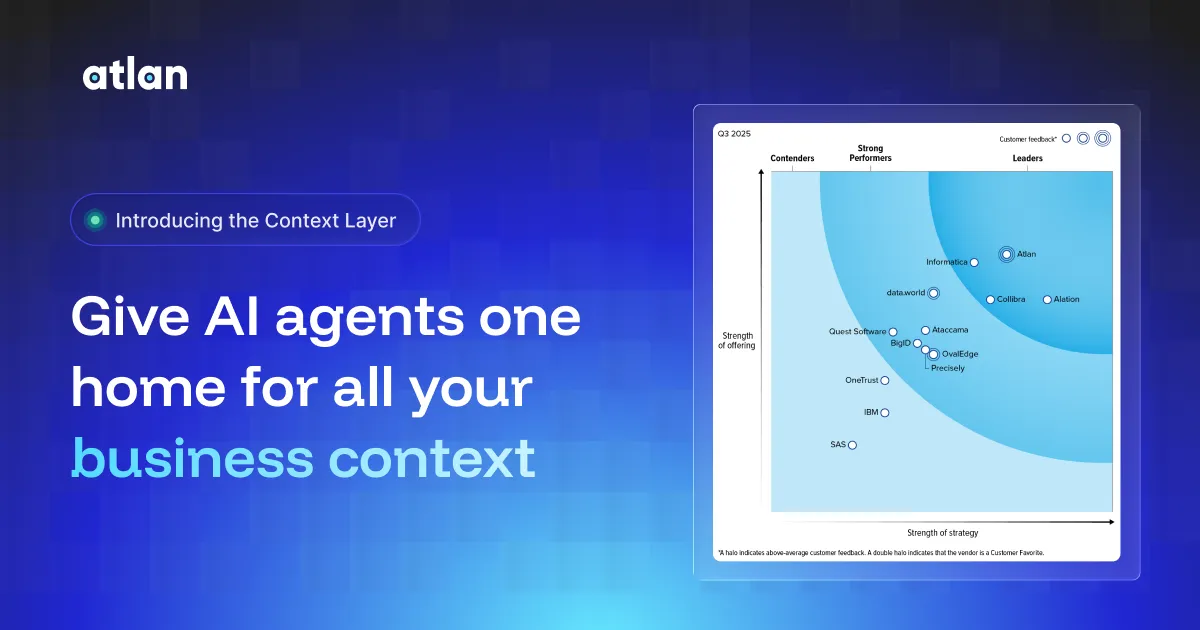
Feature Comparison
| Feature | Immuta | Atlan |
|---|---|---|
| Data Governance & Access Control | ||
| Policy-Based Access Control | Core strength with ABAC, RBAC, and purpose-based policies authored in plain language and enforced across all platforms | Role-based access via Personas and Purposes model with policy enforcement and compliance workflows |
| Dynamic Data Masking | Built-in dynamic masking applied automatically to sensitive data based on policy rules | Sensitive data classification and ownership identification through automated metadata tagging |
| Audit & Compliance | Unified Audit with structured logs, real-time monitoring, and automated compliance reporting across platforms | Governance workflows with data quality profiling and compliance support through lineage tracking |
| Data Discovery & Cataloging | ||
| Data Catalog | Data Marketplace for publishing, discovering, and requesting access to curated data products | Full-featured data catalog with AI-powered search, automated documentation, and 80+ connectors |
| Metadata Management | Metadata Registry that integrates with external sources and enriches data with centralized metadata | Active Metadata that is dynamic, continuously updated, and actionable across the Enterprise Data Graph |
| Data Lineage | Lineage visibility through audit trails and policy enforcement tracking across platforms | End-to-end visual lineage across Snowflake, dbt, Tableau, Salesforce, Fivetran, and more |
| AI & Automation | ||
| AI-Powered Features | Conversational AI enabling humans and agents to manage data access through natural language | AI agents that bootstrap context by generating descriptions, linking business terms, and surfacing questions |
| Workflow Automation | Automated provisioning with rapid approval workflows that route requests to the right approvers | Playbooks and auto-documentation that reduce repetitive tasks and ensure consistency |
| Agent Integration | Integrates with Gemini, Claude, ChatGPT, and Mistral for AI agent data access governance | MCP server and APIs that serve certified context to every downstream AI agent in your stack |
| Collaboration & Usability | ||
| Team Collaboration | Workflows for data users, stewards, and governors to negotiate and automate data access policies | Collaborative workspace where domain experts resolve conflicts, annotate edge cases, and certify assets |
| User Interface | Enterprise-focused interface designed for data engineers and security teams managing access policies | Clean, modern UI rated highly by users for intuitive navigation across technical and business personas |
| Business User Access | Data consumers can search and request access from a centralized marketplace with self-service workflows | Personalized homepages and curated asset views tailored to different user roles from engineers to analysts |
| Platform & Integration | ||
| Cloud Platform Support | Native integrations with Databricks, Snowflake, BigQuery, Starburst/Trino, Azure Synapse, AWS Redshift, and PostgreSQL | 80+ connectors spanning Snowflake, Databricks, BigQuery, Looker, Tableau, Postgres, and dbt |
| Identity & Security Integration | Connects with Active Directory, Okta, SailPoint, SAML, OpenID, LDAP, and HR systems like Workday | Role-based access control with Personas model and integrations for data security and governance |
| API & Extensibility | APIs for ecosystem integration with identity stores, catalogs, and business applications | Open APIs, SDK, and App Framework marketplace avoiding vendor lock-in with portable context |
Data Governance & Access Control
Policy-Based Access Control
Dynamic Data Masking
Audit & Compliance
Data Discovery & Cataloging
Data Catalog
Metadata Management
Data Lineage
AI & Automation
AI-Powered Features
Workflow Automation
Agent Integration
Collaboration & Usability
Team Collaboration
User Interface
Business User Access
Platform & Integration
Cloud Platform Support
Identity & Security Integration
API & Extensibility
Which approach fits
Immuta and Atlan solve fundamentally different problems in the modern data stack. Immuta excels at automated data access control and policy enforcement, while Atlan leads in data cataloging, metadata management, and building a context layer for AI. Most organizations need both capabilities, but your choice depends on whether data security or data discovery is your primary challenge.
When each approach fits
Choose Immuta if:
We recommend Immuta for enterprises where data access governance is the primary bottleneck. If your team spends significant time managing access tickets, writing platform-specific policies, or preparing for compliance audits, Immuta delivers measurable efficiency gains. Organizations with multi-cloud data platforms running on Databricks, Snowflake, or BigQuery will benefit most from its native policy enforcement that eliminates the need to copy or move data.
Choose Atlan if:
We recommend Atlan for data teams that need a collaborative metadata platform to power data discovery and AI readiness. If your organization struggles with fragmented metadata, inconsistent business definitions, or getting AI agents to understand your business context, Atlan provides the unified Enterprise Data Graph and context pipeline to solve these challenges. Its freemium pricing model and intuitive interface also make it a strong choice for teams that need rapid adoption across technical and non-technical users.
These scenarios reflect the available product evidence. Your requirements, existing stack, and team expertise should guide the final decision.
Frequently Asked Questions
Can Immuta and Atlan be used together?
Yes, Immuta and Atlan are complementary tools that many enterprises deploy side by side. Immuta lists Atlan as one of its catalog integration partners. Atlan handles metadata cataloging, data discovery, and business glossary management, while Immuta enforces access policies and dynamic masking at the data layer. Together they create a workflow where teams discover data assets in Atlan, then Immuta governs who can access that data and under what conditions. This combination gives organizations both visibility into their data estate and automated control over who can use it.
How do Immuta and Atlan compare on pricing?
Atlan publishes no pricing. Its pricing page resolves to a talk-to-sales contact form with no figures and no plan or edition names, so both the tier structure and the rates come from a quote. Ask for a quote scoped to your connector count and user roles, or the number will not be comparable with a competitor's published rate.
Which platform is better for AI agent governance?
Both platforms address AI governance but from different angles. Immuta focuses on securing data access for AI agents by enforcing controls at the data layer, supporting RAG-based GenAI applications, and integrating with models like Claude, ChatGPT, Gemini, and Mistral. Atlan takes a context-first approach, providing certified business context to AI agents through its MCP server, SQL APIs, and SDK so that agents can reason about your business data accurately. If your concern is preventing unauthorized data access by AI agents, Immuta is the stronger choice. If your concern is ensuring AI agents understand your business definitions and data relationships, Atlan is the better fit.
What do users say about each platform's ease of use?
Atlan receives consistently strong marks for its clean, modern user interface. Users at companies like Pfizer and Honeywell highlight its intuitive navigation and easy data extraction, with one team reporting 55 percent time savings through automation. However, users note the platform can feel overwhelming at times and that advanced workflows like mass-tagging have a learning curve. Immuta is designed primarily for data engineers and security teams, with a focus on plain-language policy authoring. While it streamlines access management with claims of 90 percent fewer tickets and 80 percent fewer policies, its interface is more enterprise-focused and less oriented toward casual business users.