Decision comparison
Marquez vs Monte Carlo
Marquez and Monte Carlo sit at opposite ends of the data reliability spectrum. Marquez is a focused, open-source metadata service that excels at one thing: collecting, storing, and visualizing data lineage through the OpenLineage standard. It gives engineering teams full control over their lineage infrastructure with zero licensing cost. Monte Carlo is a comprehensive commercial platform that covers the full data and AI observability lifecycle, from automated anomaly detection and incident management to AI agent monitoring. The choice between them depends on whether you need a lineage backbone you fully own and control, or an enterprise observability platform that handles monitoring, alerting, and resolution end to end.
Used together. These are normally used together rather than chosen between. The comparison explains what each one does in the stack.
These are different kinds of product — Data Catalog and Data Observability.
Quick Comparison
| Decision factor | Marquez | Monte Carlo |
|---|---|---|
| Primary Focus | Open-source metadata collection and data lineage visualization | Enterprise data and AI observability with automated anomaly detection and incident management |
| Deployment Model | Self-hosted; you run the metadata server in your own infrastructure | Fully managed SaaS with self-hosted storage options available in advanced tiers |
| AI/ML Capabilities | No built-in ML; provides raw lineage data that can feed downstream analysis tools | ML-driven anomaly detection, monitoring agents, and AI observability for production agents |
| Lineage Approach | OpenLineage-native endpoint that collects lineage from Airflow, Spark, Flink, dbt, and Dagster | End-to-end column-level lineage across warehouses, BI tools, ETL, and AI systems |
| Pricing Model | Free and open source | Monte Carlo publishes no amounts. Its tiers are Start, Scale, Enterprise and Business Critical, purchased as credits, and all are quote-only. Every tier includes agent, ML and data observability. |
| Best For | Engineering teams building custom lineage infrastructure with OpenLineage as the backbone | Enterprise teams needing full-stack data observability with automated monitoring and alerting |
Marquez
- Primary Focus:
- Open-source metadata collection and data lineage visualization
- Deployment Model:
- Self-hosted; you run the metadata server in your own infrastructure
- AI/ML Capabilities:
- No built-in ML; provides raw lineage data that can feed downstream analysis tools
- Lineage Approach:
- OpenLineage-native endpoint that collects lineage from Airflow, Spark, Flink, dbt, and Dagster
- Pricing Model:
- Free and open source
- Best For:
- Engineering teams building custom lineage infrastructure with OpenLineage as the backbone
Monte Carlo
- Primary Focus:
- Enterprise data and AI observability with automated anomaly detection and incident management
- Deployment Model:
- Fully managed SaaS with self-hosted storage options available in advanced tiers
- AI/ML Capabilities:
- ML-driven anomaly detection, monitoring agents, and AI observability for production agents
- Lineage Approach:
- End-to-end column-level lineage across warehouses, BI tools, ETL, and AI systems
- Pricing Model:
- Monte Carlo publishes no amounts. Its tiers are Start, Scale, Enterprise and Business Critical, purchased as credits, and all are quote-only. Every tier includes agent, ML and data observability.
- Best For:
- Enterprise teams needing full-stack data observability with automated monitoring and alerting
Public signals
Verified factual signals only. Bars appear only for like-for-like metrics with five weekly assessments for every tool; missing evidence stays explicit. These signals do not establish enterprise adoption, product quality, or total cost.
| Metric | Marquez | Monte Carlo |
|---|---|---|
| Docker Hub pulls(Product adoption) | 1.1M | Not available |
| GitHub commits, 90d(Product adoption) | 0 | Not available |
| GitHub stars(Product adoption) | 2,000+ | Not available |
| Search interest(Market interest) | Unavailable | 0 |
| PyPI weekly downloads(Developer adoption) | 84 | 41.2k |
| GitHub commits, 90d(Developer adoption) | Not available | 231 |
| GitHub stars(Developer adoption) | Not available | 2 |
| Hacker News mentions, 90d(Community interest) | Not available | 0 |
As of September 21, 2026 — updated weekly.
Health & risk evidence
Observed public-source checks for mapped package versions and repositories.
Marquez
September 21, 2026Package vulnerabilities
PyPI · marquez-python@0.50.0
0 vulnerabilities
across 1 package
Repository security score
github.com/MarquezProject/marquez
4.0/10
Monte Carlo
September 21, 2026Package vulnerabilities
PyPI · montecarlodata@0.175.0
0 vulnerabilities
across 1 package
Repository security score
Not available
Interface Preview
Monte Carlo
Feature Comparison
| Feature | Marquez | Monte Carlo |
|---|---|---|
| Data Lineage | ||
| Lineage Collection | OpenLineage-compatible endpoint for real-time metadata collection from running jobs | Automatic column-level lineage discovery across warehouses, BI tools, and ETL layers |
| Lineage Visualization | Web UI with unified visual graph showing job inputs, outputs, and interdependencies | Interactive lineage explorer with impact analysis and downstream dependency mapping |
| Cross-Platform Lineage | Supports Airflow, Spark, Flink, dbt, and Dagster through OpenLineage integrations | Deep integrations from ingestion through consumption including lakes, databases, BI, and AI systems |
| Monitoring & Observability | ||
| Anomaly Detection | Not a core capability; Marquez focuses on metadata collection, not monitoring | ML-driven anomaly detection with automatic baselines for freshness, volume, and schema |
| Incident Management | Not offered; users build their own alerting on top of the lineage API | Full incident management with intelligent alerting, granular routing, and root cause analysis |
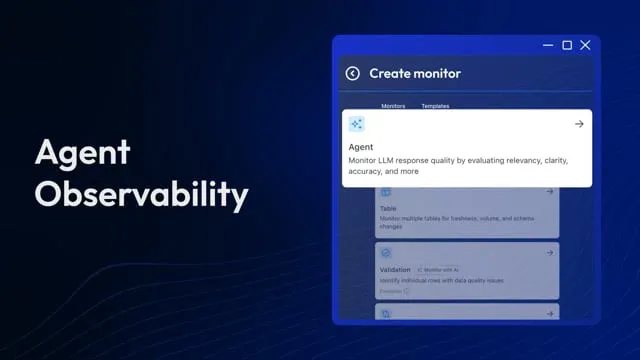
| AI/Agent Observability | Not available; focused exclusively on data pipeline metadata | Monitors AI agent inputs and outputs from data source through agent production environment |
| Automation & Intelligence | ||
| Automated Coverage | Manual setup; lineage data flows automatically once OpenLineage integrations are configured | Out-of-the-box monitoring with AI-powered coverage recommendations and auto-scaling |
| Root Cause Analysis | Lineage API enables manual root cause tracing by traversing the dependency tree | Automated root cause analysis with enriched lineage data and contextual notifications |
| Monitoring Agents | Not available; Marquez is a metadata service, not an agentic platform | AI-powered monitoring agent that discovers and deploys optimal monitors in minutes |
| Deployment & Operations | ||
| Setup Complexity | Self-hosted Java service requiring infrastructure management and operational maintenance | SaaS platform that connects in seconds with guided or expert-led onboarding |
| API Access | Open Lineage API for querying metadata, automating backfills, and dependency traversal | REST APIs with tiered rate limits: 10K, 50K, or 100K API calls per day depending on plan |
| Security & Access Control | Basic access control; security depends on your own infrastructure configuration | SSO, SCIM, self-hosted storage, PII filtering, and audit logging in Scale tier and above |
| Ecosystem & Integration | ||
| Orchestrator Support | Native support for Airflow, Spark, Flink, dbt, and Dagster via OpenLineage community | Broad integration ecosystem spanning ingestion, transformation, warehousing, and consumption |
| Data Warehouse Integration | Indirect; captures lineage from orchestrators that interact with warehouses | Direct integrations with Snowflake, Databricks, BigQuery, and enterprise databases |
| Enterprise Ecosystem | Open-source community-driven; no vendor-managed enterprise integrations | Enterprise tier adds Oracle, SAP Hana, Teradata, Microsoft Fabric, ServiceNow, and data catalogs |
Data Lineage
Lineage Collection
Lineage Visualization
Cross-Platform Lineage
Monitoring & Observability
Anomaly Detection
Incident Management
AI/Agent Observability
Automation & Intelligence
Automated Coverage
Root Cause Analysis
Monitoring Agents
Deployment & Operations
Setup Complexity
API Access
Security & Access Control
Ecosystem & Integration
Orchestrator Support
Data Warehouse Integration
Enterprise Ecosystem
How they fit together
Marquez and Monte Carlo sit at opposite ends of the data reliability spectrum. Marquez is a focused, open-source metadata service that excels at one thing: collecting, storing, and visualizing data lineage through the OpenLineage standard. It gives engineering teams full control over their lineage infrastructure with zero licensing cost. Monte Carlo is a comprehensive commercial platform that covers the full data and AI observability lifecycle, from automated anomaly detection and incident management to AI agent monitoring. The choice between them depends on whether you need a lineage backbone you fully own and control, or an enterprise observability platform that handles monitoring, alerting, and resolution end to end.
What each one handles
Use Marquez for:
Choose Marquez if your primary need is open-standard data lineage collection and you have the engineering capacity to self-host. Marquez is the reference implementation of OpenLineage, giving you a vendor-neutral metadata service that integrates natively with Airflow, Spark, Flink, dbt, and Dagster. It is the right starting point for teams that want full ownership of their lineage data, need to enrich data catalogs or quality tools with lineage metadata via API, and prefer building on open-source foundations. The zero licensing cost makes it accessible for organizations of any size, though you will need to budget for infrastructure and operational maintenance.
Use Monte Carlo for:
Choose Monte Carlo if you need enterprise-grade data observability that goes beyond lineage into automated monitoring, ML-driven anomaly detection, and incident management. Monte Carlo is built for organizations where data downtime has measurable business impact and manual monitoring cannot keep pace with pipeline complexity. Its managed SaaS deployment, AI-powered monitoring agents, and deep integration ecosystem across warehouses, BI tools, and AI systems deliver value fast with minimal engineering overhead. Enterprises like Nasdaq, JetBlue, and Axios rely on Monte Carlo to scale data trust across thousands of data assets.
These roles reflect the available product evidence. Most teams run both; which one owns a given job depends on your stack and team.
Frequently Asked Questions
What is the main difference between Marquez and Monte Carlo?
Marquez is an open-source metadata service focused on collecting and visualizing data lineage. It serves as the reference implementation of OpenLineage, providing a centralized repository where teams track how data flows through pipelines and jobs. Monte Carlo is a commercial data observability platform that monitors data pipelines, detects anomalies using ML, and manages incidents across the full data and AI stack. Marquez tells you where your data comes from and where it goes; Monte Carlo tells you when something breaks and helps you fix it.
Can Marquez and Monte Carlo be used together?
Yes, and the combination makes sense for teams that want both open-standard lineage collection and enterprise-grade observability. Marquez captures granular lineage metadata through its OpenLineage endpoint from orchestrators like Airflow, Spark, and dbt. Monte Carlo provides the monitoring, alerting, and incident management layer on top. Using both gives you deep lineage visibility through Marquez and proactive anomaly detection through Monte Carlo, covering complementary parts of the data reliability stack.
Is Marquez production-ready for enterprise use?
Marquez is a mature open-source project under the Linux Foundation with over 2,000 GitHub stars, active development, and an Apache-2.0 license. It is production-ready for teams that have the engineering resources to self-host and operate a Java-based metadata service. However, it does not include enterprise features like SSO, managed SLAs, or commercial support. Teams without dedicated infrastructure engineering capacity may find the operational overhead significant compared to a managed solution.
How do the pricing models compare between Marquez and Monte Carlo?
Marquez is completely free under the Apache-2.0 open-source license. Your costs are limited to infrastructure for hosting and operating the service, plus engineering time for integration and maintenance. Monte Carlo uses a usage-based credit model with four tiers: Start (up to 10 users, 1,000 monitors), Scale (unlimited users, pay per monitor), Enterprise (multi-workspace, advanced integrations), and Business Critical (maximum availability). Monte Carlo does not publish specific dollar amounts, requiring a custom quote for pricing.
Which tool is better for tracking data lineage?
For pure lineage collection and storage, Marquez is purpose-built for the job. As the OpenLineage reference implementation, it provides a standardized, vendor-neutral way to capture lineage metadata from every major orchestrator. Monte Carlo also offers strong lineage capabilities with end-to-end column-level lineage and impact analysis, but lineage is one component of its broader observability platform. If lineage is your primary need and you want open standards, Marquez is the focused choice. If you need lineage combined with monitoring, alerting, and incident management in a single platform, Monte Carlo delivers that integrated experience.