Decision comparison
Atlan vs Marquez
Atlan and Marquez serve fundamentally different needs in the data stack. Atlan is a comprehensive data workspace that unifies catalog, governance, lineage, and AI-native context into a single commercial platform. Marquez is a focused, open-source lineage service built around the OpenLineage standard. Choose Atlan when you need a full metadata management platform with enterprise governance and AI features. Choose Marquez when your primary need is open-standard lineage collection and you have the engineering resources to self-host.
Direct comparison. These are reviewed substitutes bought for the same job, so the differences below are the ones that decide between them.
All 2 are data catalogs.
Quick Comparison
| Decision factor | Atlan | Marquez |
|---|---|---|
| Best For | Enterprise data teams needing a full catalog, governance, and AI context layer | Engineering teams focused on open-source data lineage tracking |
| Pricing | Atlan publishes no pricing. atlan.com/pricing resolves to a talk-to-sales contact form, and no plan or edition names are published, so both the tier structure and the figures come from a quote. | Free and open source |
| Deployment | Cloud-hosted SaaS | Self-hosted |
| Core Strength | Unified data catalog with 80+ connectors, active metadata, and AI-native governance | Real-time lineage collection via OpenLineage-compatible API |
| Learning Curve | Moderate — intuitive UI but advanced features require configuration | Moderate to steep — requires self-hosting and integration setup |
Atlan
- Best For:
- Enterprise data teams needing a full catalog, governance, and AI context layer
- Pricing:
- Atlan publishes no pricing. atlan.com/pricing resolves to a talk-to-sales contact form, and no plan or edition names are published, so both the tier structure and the figures come from a quote.
- Deployment:
- Cloud-hosted SaaS
- Core Strength:
- Unified data catalog with 80+ connectors, active metadata, and AI-native governance
- Learning Curve:
- Moderate — intuitive UI but advanced features require configuration
Marquez
- Best For:
- Engineering teams focused on open-source data lineage tracking
- Pricing:
- Free and open source
- Deployment:
- Self-hosted
- Core Strength:
- Real-time lineage collection via OpenLineage-compatible API
- Learning Curve:
- Moderate to steep — requires self-hosting and integration setup
Public signals
Verified factual signals only. Bars appear only for like-for-like metrics with five weekly assessments for every tool; missing evidence stays explicit. These signals do not establish enterprise adoption, product quality, or total cost.
| Metric | Atlan | Marquez |
|---|---|---|
| GitHub commits, 90d(Developer adoption) | 167 | Not available |
| GitHub stars(Developer adoption) | 22 | Not available |
| Search interest(Market interest) | 3 | Unavailable |
| Hacker News mentions, 90d(Community interest) | 0 | Not available |
| PyPI weekly downloads(Developer adoption) | 128.0k | 84 |
| Docker Hub pulls(Product adoption) | Not available | 1.1M |
| GitHub commits, 90d(Product adoption) | Not available | 0 |
| GitHub stars(Product adoption) | Not available | 2,000+ |
As of September 21, 2026 — updated weekly.
Health & risk evidence
Observed public-source checks for mapped package versions and repositories.
Atlan
September 21, 2026Package vulnerabilities
PyPI · pyatlan@11.4.0
0 vulnerabilities
across 1 package
Repository security score
Not available
Marquez
September 21, 2026Package vulnerabilities
PyPI · marquez-python@0.50.0
0 vulnerabilities
across 1 package
Repository security score
github.com/MarquezProject/marquez
4.0/10
Interface Preview
Atlan
Feature Comparison
| Feature | Atlan | Marquez |
|---|---|---|
| Data Catalog & Discovery | ||
| Centralized Data Catalog | Full catalog with search, discovery, and personalized homepages | Not a catalog — focuses on lineage metadata collection |
| Business Glossary | Centralized glossary with ownership and linkable terms | Not verified |
| Active Metadata | Dynamic, continuously updated metadata with automation | Collects metadata at runtime but does not enrich or automate |
| Data Lineage | ||
| End-to-End Lineage | Visual lineage across Snowflake, dbt, Tableau, Salesforce, and 80+ connectors | Lineage visualization via web UI for jobs and datasets |
| OpenLineage Support | Not natively OpenLineage — uses proprietary connectors | Reference implementation of OpenLineage standard |
| Pipeline Integrations | 80+ connectors including warehouses, BI tools, and business applications | Integrates with Apache Airflow, Spark, Flink, dbt, and Dagster via OpenLineage |
| Governance & Collaboration | ||
| Data Governance Workflows | Role-based access control, Personas and Purposes model, certification workflows | No built-in governance workflows |
| Team Collaboration | Built-in discussions, annotations, Jira and Slack integrations | No collaboration features — purely a metadata service |
| Data Quality Integration | Integrates with Great Expectations, Soda, Monte Carlo, and dbt tests | Lineage API can enrich external quality systems but no native quality checks |
| AI & Automation | ||
| AI-Powered Features | AI agents for description generation, term linkage, metrics generation, semantic views | No AI features |
| MCP / Agent Protocol Support | MCP server for serving context to AI agents across the stack | No agent protocol support |
| Automation Capabilities | Playbooks, auto-documentation, automated metadata enrichment | Lineage API supports automation of backfills and root cause analysis |
| Deployment & Ecosystem | ||
| Deployment Model | Cloud-hosted SaaS with enterprise security | Self-hosted — requires managing your own infrastructure |
| Open Source | Open APIs but proprietary platform | Fully open source under Apache-2.0 license (2,000+ GitHub stars) |
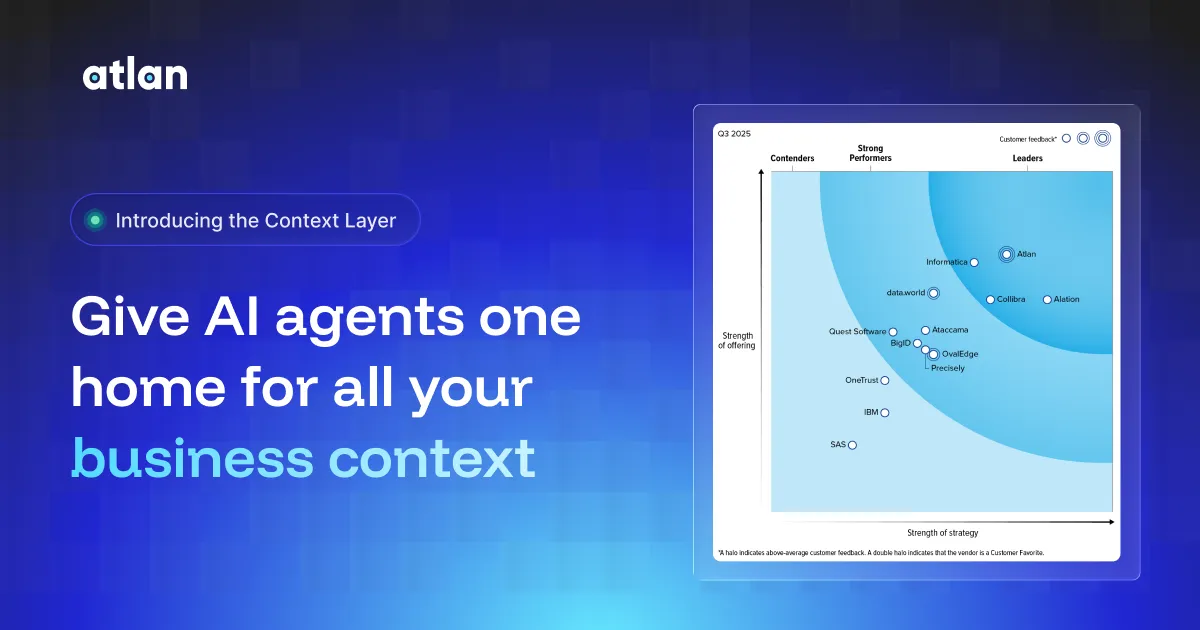
| Community & Support | Commercial support, 201-500 employees, Leader in Gartner MQ and Forrester Wave | Community-driven support via GitHub; part of the OpenLineage ecosystem |
Data Catalog & Discovery
Centralized Data Catalog
Business Glossary
Active Metadata
Data Lineage
End-to-End Lineage
OpenLineage Support
Pipeline Integrations
Governance & Collaboration
Data Governance Workflows
Team Collaboration
Data Quality Integration
AI & Automation
AI-Powered Features
MCP / Agent Protocol Support
Automation Capabilities
Deployment & Ecosystem
Deployment Model
Open Source
Community & Support
Which to choose
Atlan and Marquez serve fundamentally different needs in the data stack. Atlan is a comprehensive data workspace that unifies catalog, governance, lineage, and AI-native context into a single commercial platform. Marquez is a focused, open-source lineage service built around the OpenLineage standard. Choose Atlan when you need a full metadata management platform with enterprise governance and AI features. Choose Marquez when your primary need is open-standard lineage collection and you have the engineering resources to self-host.
Best-fit scenarios
Choose Atlan if:
Best for enterprise data teams that need a unified catalog, governance workflows, business glossary, and AI-powered automation in a managed SaaS platform with commercial support.
Choose Marquez if:
Best for engineering-driven teams that want free, open-source lineage tracking built on the OpenLineage standard, with native integrations for Airflow, Spark, Flink, dbt, and Dagster.
These scenarios reflect the available product evidence. Your requirements, existing stack, and team expertise should guide the final decision.
Frequently Asked Questions
Is Marquez a direct alternative to Atlan?
Not exactly. Marquez is a focused open-source lineage service, while Atlan is a full data workspace covering catalog, governance, collaboration, and AI. Marquez handles one piece of the puzzle — lineage collection and visualization — whereas Atlan addresses the broader metadata management lifecycle. Organizations sometimes use Marquez alongside a catalog platform rather than as a standalone replacement.
Can I use Marquez and Atlan together?
Yes. Since Marquez is the reference implementation of OpenLineage, teams can use it to collect lineage from Airflow, Spark, and dbt pipelines, then feed that metadata into a broader catalog like Atlan for discovery and governance. This hybrid approach gives you open-standard lineage collection with enterprise catalog features on top.
What does Atlan cost compared to Marquez?
Atlan publishes no pricing. Its pricing page resolves to a talk-to-sales contact form with no figures and no plan or edition names, so both the tier structure and the rates come from a quote. Ask for a quote scoped to your connector count and user roles, or the number will not be comparable with a competitor's published rate.
Which tool is better for data lineage specifically?
For pure lineage collection and visualization, Marquez is purpose-built. It is the reference implementation of the OpenLineage standard and integrates natively with Airflow, Spark, Flink, dbt, and Dagster. Atlan provides lineage as part of a broader platform with 80+ connectors and a visual lineage graph, but it does not natively implement the OpenLineage standard. Teams that prioritize open-standard lineage interoperability often lean toward Marquez.
How mature is Marquez compared to Atlan?
Marquez has 2,000+ GitHub stars and its latest release is version 0.50.0. It is actively maintained with code pushed as recently as April 2026. Atlan is a venture-backed company with 201-500 employees, recognized as a Leader in the 2025 Gartner Magic Quadrant for Metadata Management and the 2026 Gartner Magic Quadrant for Data & Analytics Governance. Both are actively developed, but Atlan has extensive commercial maturity and enterprise adoption.