Decision comparison
Monte Carlo vs Atlan
Monte Carlo and Atlan solve fundamentally different problems in the modern data stack. Monte Carlo is the go-to platform for data and AI observability, excelling at detecting, diagnosing, and resolving data incidents before they reach downstream consumers. Atlan is the leading context layer and data catalog, designed to make data discoverable, understandable, and governed across the entire organization. Many enterprise teams run both platforms together because they address complementary needs.
Architecture choice. These take different approaches to the same problem. Read the table as a fit question rather than a feature race.
These are different kinds of product — Data Observability and Data Catalog.
Quick Comparison
| Decision factor | Monte Carlo | Atlan |
|---|---|---|
| Primary Focus | Data and AI observability across the full pipeline | Data catalog and context layer for AI and analytics |
| Best For | Enterprise teams monitoring data quality at scale | Organizations building governed, discoverable data ecosystems |
| Pricing Model | Monte Carlo publishes no amounts. Its tiers are Start, Scale, Enterprise and Business Critical, purchased as credits, and all are quote-only. Every tier includes agent, ML and data observability. | Atlan publishes no pricing. atlan.com/pricing resolves to a talk-to-sales contact form, and no plan or edition names are published, so both the tier structure and the figures come from a quote. |
| Key Strength | ML-driven anomaly detection with automated root cause analysis | Enterprise Data Graph with 80+ connectors unifying metadata into a living context layer |
| Integration Depth | Deep integrations from ingestion to consumption across warehouses, BI, and ETL tools | 80+ connectors spanning warehouses, BI tools, business applications, and transformation layers |
| Learning Curve | Fast setup with out-of-the-box monitoring; advanced features need more time | Intuitive UI for basic use; advanced governance workflows require ramp-up |
Monte Carlo
- Primary Focus:
- Data and AI observability across the full pipeline
- Best For:
- Enterprise teams monitoring data quality at scale
- Pricing Model:
- Monte Carlo publishes no amounts. Its tiers are Start, Scale, Enterprise and Business Critical, purchased as credits, and all are quote-only. Every tier includes agent, ML and data observability.
- Key Strength:
- ML-driven anomaly detection with automated root cause analysis
- Integration Depth:
- Deep integrations from ingestion to consumption across warehouses, BI, and ETL tools
- Learning Curve:
- Fast setup with out-of-the-box monitoring; advanced features need more time
Atlan
- Primary Focus:
- Data catalog and context layer for AI and analytics
- Best For:
- Organizations building governed, discoverable data ecosystems
- Pricing Model:
- Atlan publishes no pricing. atlan.com/pricing resolves to a talk-to-sales contact form, and no plan or edition names are published, so both the tier structure and the figures come from a quote.
- Key Strength:
- Enterprise Data Graph with 80+ connectors unifying metadata into a living context layer
- Integration Depth:
- 80+ connectors spanning warehouses, BI tools, business applications, and transformation layers
- Learning Curve:
- Intuitive UI for basic use; advanced governance workflows require ramp-up
Public signals
Verified factual signals only. Bars appear only for like-for-like metrics with five weekly assessments for every tool; missing evidence stays explicit. These signals do not establish enterprise adoption, product quality, or total cost.
| Metric | Monte Carlo | Atlan |
|---|---|---|
| GitHub commits, 90d(Developer adoption) | 243 | 146 |
| GitHub stars(Developer adoption) | 2 | 22 |
| Search interest(Market interest) | 0 | 3 |
| Hacker News mentions, 90d(Community interest) | 0 | 0 |
| PyPI weekly downloads(Developer adoption) | 38.1k | 91.5k |
As of September 14, 2026 — updated weekly.
Health & risk evidence
Observed public-source checks for mapped package versions and repositories.
Monte Carlo
September 19, 2026Package vulnerabilities
PyPI · montecarlodata@0.175.0
0 vulnerabilities
across 1 package
Repository security score
Not available
Atlan
September 19, 2026Package vulnerabilities
PyPI · pyatlan@11.1.0
0 vulnerabilities
across 1 package
Repository security score
Not available
Interface Preview
Monte Carlo
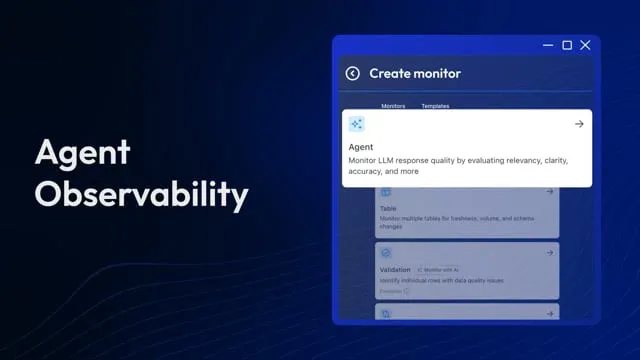
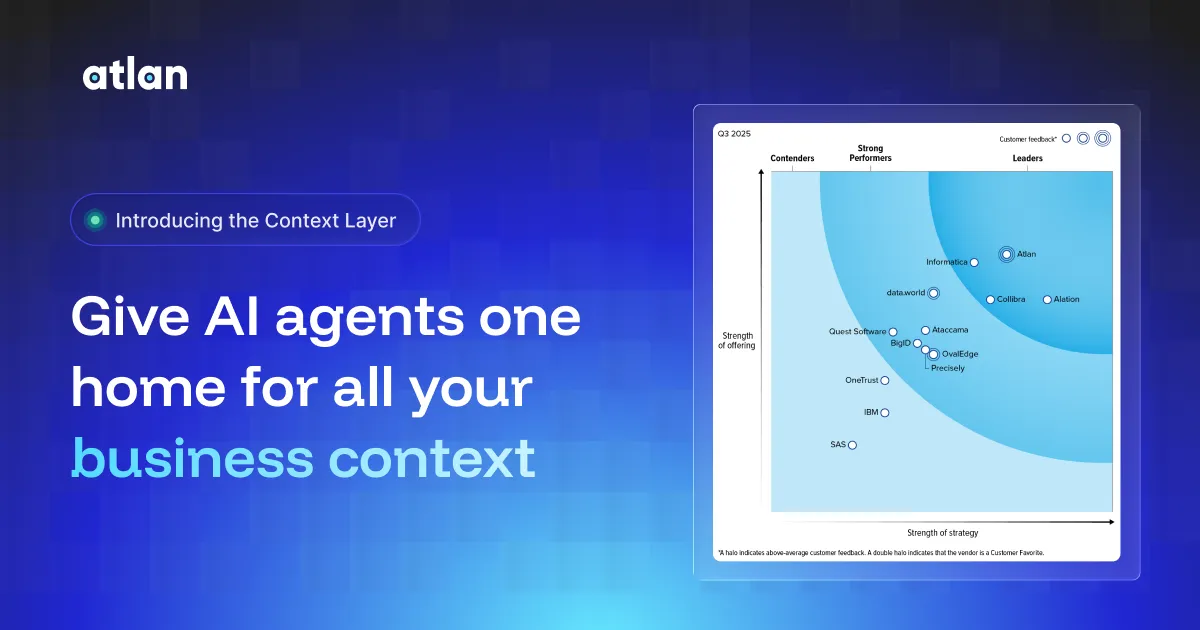
Atlan
Feature Comparison
| Feature | Monte Carlo | Atlan |
|---|---|---|
| Data Observability | ||
| ML-Driven Anomaly Detection | Core capability with automatic baseline monitoring | Not a primary feature; relies on external integrations |
| Automated Root Cause Analysis | Built-in with lineage-enriched context and alerting | Limited; focuses on lineage visibility rather than automated diagnosis |
| Incident Management | Full incident workflow with alerting, routing, and resolution tracking | Not a core function; collaboration features can support issue discussion |
| Data Catalog & Discovery | ||
| Metadata Cataloging | Limited; focused on observability metadata rather than full cataloging | Comprehensive automated cataloging with 18M+ assets supported at scale |
| Business Glossary | Not available as a standalone feature | Centralized, linkable glossary with ownership and certification workflows |
| Data Discovery & Search | Search scoped to monitored assets and incidents | AI-powered natural language search across the full data estate |
| Lineage & Impact Analysis | ||
| End-to-End Lineage | Column-level lineage across pipelines, warehouses, and BI layers | End-to-end lineage across Snowflake, dbt, Tableau, Looker, and more |
| Impact Analysis | Dashboard-level impact analysis tied to data incidents | Lineage-based impact assessment for governance and change management |
| Governance & Collaboration | ||
| Data Governance Workflows | SLA and coverage tools for pipeline reliability governance | Full governance with personas, purposes, certifications, and policy enforcement |
| Collaboration Features | Alert routing and team notifications for incident response | Rich collaboration workspace with annotation, certification, and conflict resolution |
| Access Controls | Role-based access with SSO and SCIM in Scale tier and above | Persona and Purpose-based access model with role-based controls |
| AI & Automation | ||
| AI Agents | Monitoring agents for automated coverage, troubleshooting, and root cause analysis | AI agents for auto-documentation, term linkage, metrics generation, and ontology creation |
| MCP Server / API Access | REST APIs and webhooks for integration and automation | MCP server, SQL APIs, and SDK for serving certified context to AI agents |
| Automation Capabilities | Auto-scaling monitors, YAML-based CI/CD deployment, programmatic monitor creation | Playbooks, auto-documentation, and automated metadata enrichment workflows |
Data Observability
ML-Driven Anomaly Detection
Automated Root Cause Analysis
Incident Management
Data Catalog & Discovery
Metadata Cataloging
Business Glossary
Data Discovery & Search
Lineage & Impact Analysis
End-to-End Lineage
Impact Analysis
Governance & Collaboration
Data Governance Workflows
Collaboration Features
Access Controls
AI & Automation
AI Agents
MCP Server / API Access
Automation Capabilities
Which approach fits
Monte Carlo and Atlan solve fundamentally different problems in the modern data stack. Monte Carlo is the go-to platform for data and AI observability, excelling at detecting, diagnosing, and resolving data incidents before they reach downstream consumers. Atlan is the leading context layer and data catalog, designed to make data discoverable, understandable, and governed across the entire organization. Many enterprise teams run both platforms together because they address complementary needs.
When each approach fits
Choose Monte Carlo if:
We recommend Monte Carlo for enterprise data and engineering teams that need to monitor data quality at scale across pipelines, warehouses, and AI systems. If your primary challenge is reducing data downtime, catching anomalies before stakeholders notice, and operationalizing incident response, Monte Carlo delivers unmatched depth. Its ML-driven anomaly detection, automated root cause analysis, and agent observability features make it the strongest choice for teams where data reliability directly impacts business outcomes. Organizations like Nasdaq, JetBlue, and Axios rely on Monte Carlo to keep mission-critical data flowing.
Choose Atlan if:
We recommend Atlan for organizations that need a unified data catalog and governance platform to make their data estate discoverable and trustworthy. If your challenge is that teams cannot find, understand, or trust the data they work with, Atlan solves that by unifying metadata from 80+ sources into a single Enterprise Data Graph. Its AI-native context pipeline, business glossary, and MCP server make it particularly compelling for teams preparing their data for AI consumption. Atlan is recognized as a Leader in both the Gartner Magic Quadrant for Metadata Management Solutions and Data & Analytics Governance, and 95% of its G2 users see the platform as a true partner.
These scenarios reflect the available product evidence. Your requirements, existing stack, and team expertise should guide the final decision.
Frequently Asked Questions
Can Monte Carlo and Atlan be used together?
Yes, and many enterprise teams do exactly that. Monte Carlo handles data observability, detecting anomalies and incidents in your pipelines and warehouses. Atlan handles data cataloging and governance, making data discoverable and understood across the organization. Atlan can even ingest data quality metrics from Monte Carlo to surface pipeline health alongside catalog metadata, giving teams a complete picture of both data reliability and data context.
Which platform is better for AI readiness?
It depends on the AI challenge you face. Monte Carlo focuses on ensuring the data inputs feeding AI systems are reliable and accurate, with dedicated agent observability for monitoring AI outputs in production. Atlan focuses on providing the semantic context layer that AI agents need to reason about your business, serving certified context through its MCP server. For comprehensive AI readiness, organizations benefit from both reliable data (Monte Carlo) and well-governed context (Atlan).
How do the pricing models differ between Monte Carlo and Atlan?
Monte Carlo uses a credit-based consumption model across four tiers (Start, Scale, Enterprise, Business Critical). You buy credits and consume them based on usage rates, with costs varying by tier. The Start tier supports up to 10 users with up to 1,000 monitors. Atlan uses a subscription-based model with per-user or per-workspace pricing. Both platforms require contacting sales for enterprise pricing, and neither publishes transparent list prices on their website.
Which tool offers better data lineage capabilities?
Both platforms provide strong lineage, but with different emphasis. Monte Carlo offers column-level lineage focused on tracing data incidents and understanding the blast radius of data quality issues across pipelines, warehouses, and BI dashboards. Atlan provides end-to-end lineage as part of its broader metadata graph, connecting lineage to governance workflows, business glossary terms, and data discovery. If lineage is primarily for incident response, Monte Carlo has the edge. If lineage is for governance and discovery, Atlan is stronger.
What integrations does each platform support?
Monte Carlo integrates deeply with the data and AI ecosystem from ingestion to consumption, including warehouses like Snowflake, Databricks, and BigQuery, plus BI tools, ETL pipelines, and agent frameworks like Langchain. The Enterprise tier adds Oracle, SAP Hana, Teradata, Microsoft Fabric, and ServiceNow. Atlan offers 80+ connectors spanning warehouses, BI tools, transformation layers, and business applications, building everything into its Enterprise Data Graph for unified metadata discovery.