Decision comparison
Soda vs Atlan
Soda and Atlan solve fundamentally different problems in the modern data stack. Soda is the stronger choice for teams whose primary challenge is catching, diagnosing, and fixing data quality issues at the pipeline level. Atlan wins when the priority is building a unified context layer for data discovery, governance, and AI agent enablement across the organization. Many mature data teams deploy both tools together, using Soda for quality enforcement and Atlan as the metadata and governance hub.
Used together. These are normally used together rather than chosen between. The comparison explains what each one does in the stack.
These are different kinds of product — Data Validation Framework and Data Catalog.
Quick Comparison
| Decision factor | Soda | Atlan |
|---|---|---|
| Primary Focus | Data quality testing and monitoring | Data catalog, governance, and metadata management |
| Best For | Data engineers enforcing quality checks across pipelines | Data teams needing unified discovery, lineage, and AI context |
| Pricing Model | Free tier at $0 per month, Team tier at $750 per month, with enterprise features available | Atlan publishes no pricing. atlan.com/pricing resolves to a talk-to-sales contact form, and no plan or edition names are published, so both the tier structure and the figures come from a quote. |
| Open Source Component | Yes (Python-based, 2,000+ GitHub stars) | No |
| AI Capabilities | AI-powered data contracts, record-level anomaly detection, AI automations | AI-native context pipeline, auto-documentation, semantic views, MCP server |
Soda
- Primary Focus:
- Data quality testing and monitoring
- Best For:
- Data engineers enforcing quality checks across pipelines
- Pricing Model:
- Free tier at $0 per month, Team tier at $750 per month, with enterprise features available
- Open Source Component:
- Yes (Python-based, 2,000+ GitHub stars)
- AI Capabilities:
- AI-powered data contracts, record-level anomaly detection, AI automations
Atlan
- Primary Focus:
- Data catalog, governance, and metadata management
- Best For:
- Data teams needing unified discovery, lineage, and AI context
- Pricing Model:
- Atlan publishes no pricing. atlan.com/pricing resolves to a talk-to-sales contact form, and no plan or edition names are published, so both the tier structure and the figures come from a quote.
- Open Source Component:
- No
- AI Capabilities:
- AI-native context pipeline, auto-documentation, semantic views, MCP server
Public signals
Verified factual signals only. Bars appear only for like-for-like metrics with five weekly assessments for every tool; missing evidence stays explicit. These signals do not establish enterprise adoption, product quality, or total cost.
| Metric | Soda | Atlan |
|---|---|---|
| GitHub commits, 90d(Product adoption) | 81 | Not available |
| GitHub stars(Product adoption) | 2,000+ | Not available |
| Search interest(Market interest) | 0 | 3 |
| PyPI weekly downloads(Product adoption) | 405.8k | Not available |
| GitHub commits, 90d(Developer adoption) | Not available | 167 |
| GitHub stars(Developer adoption) | Not available | 22 |
| Hacker News mentions, 90d(Community interest) | Not available | 0 |
| PyPI weekly downloads(Developer adoption) | Not available | 128.0k |
As of September 21, 2026 — updated weekly.
Health & risk evidence
Observed public-source checks for mapped package versions and repositories.
Soda
September 21, 2026Package vulnerabilities
PyPI · soda-core@4.24.0
0 vulnerabilities
across 1 package
Repository security score
Not available
Atlan
September 21, 2026Package vulnerabilities
PyPI · pyatlan@11.4.0
0 vulnerabilities
across 1 package
Repository security score
Not available
Interface Preview
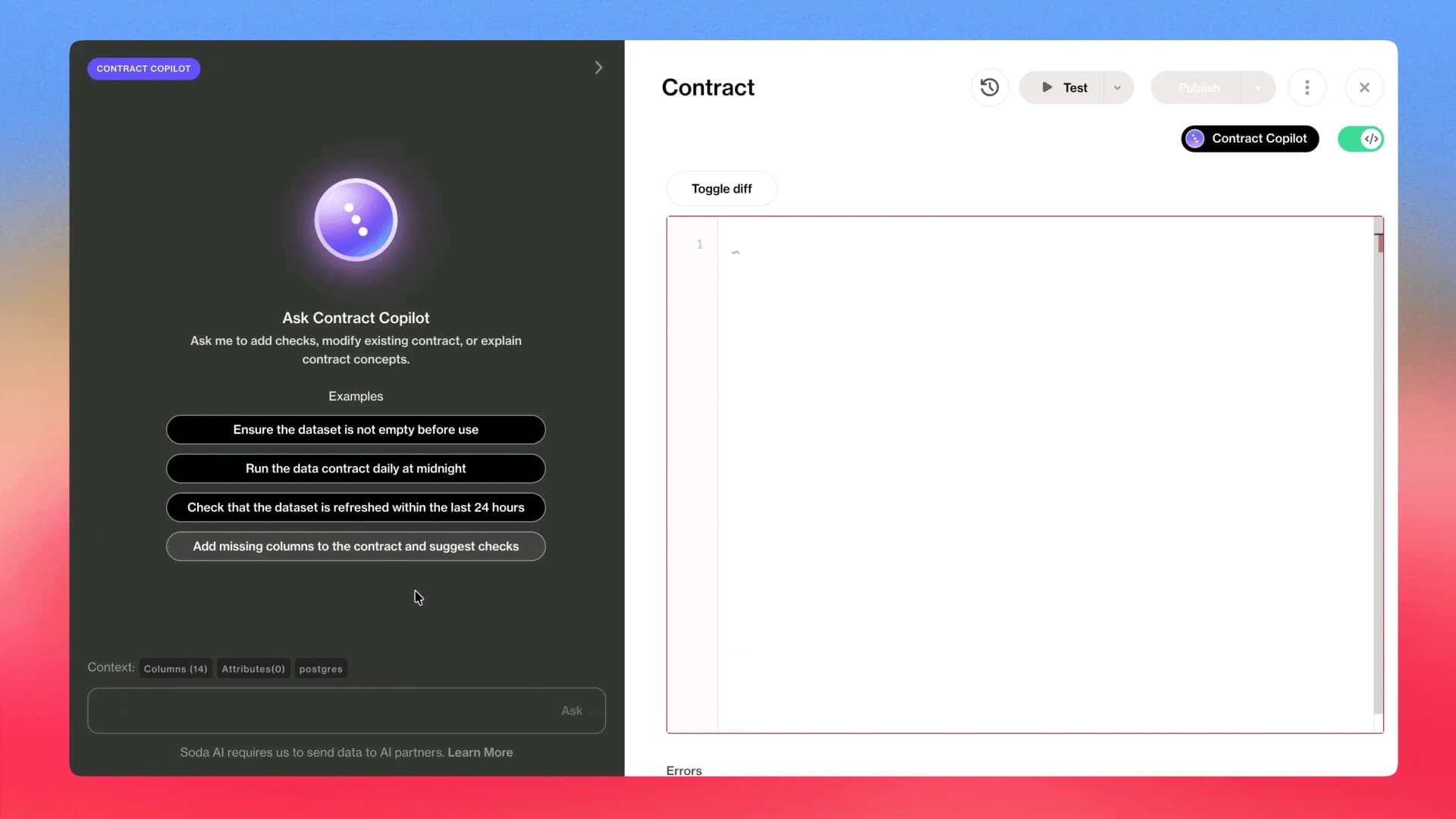
Soda
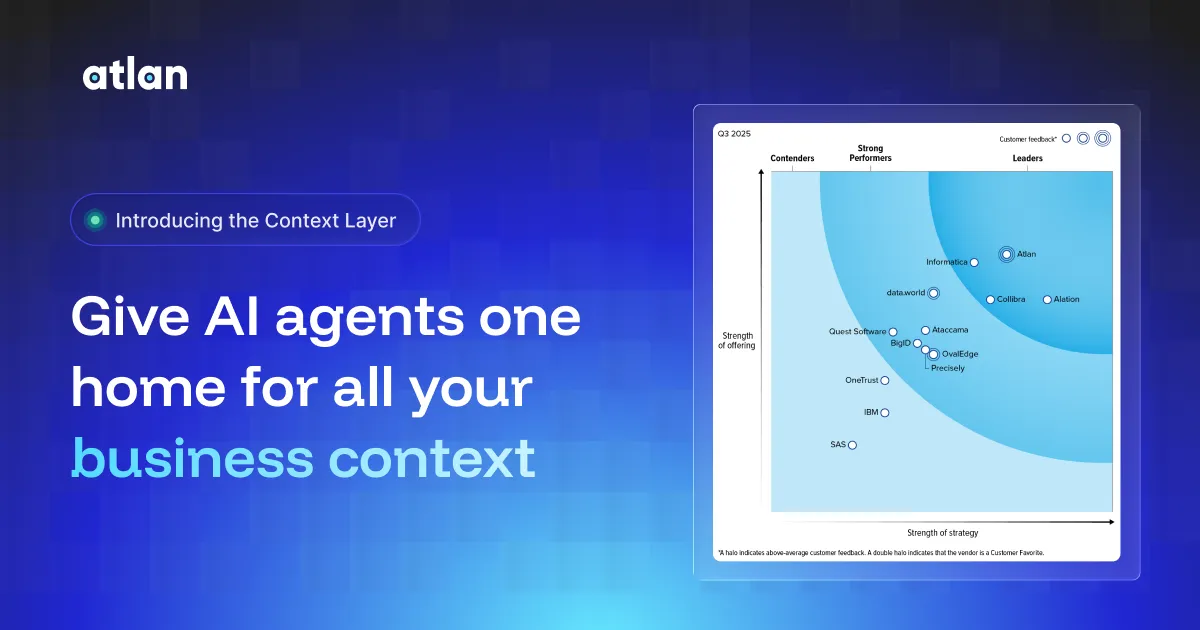
Atlan
Feature Comparison
| Feature | Soda | Atlan |
|---|---|---|
| Data Quality & Testing | ||
| Automated Data Quality Checks | Core strength with schema, freshness, and custom checks | Integrates external tools (Great Expectations, Soda, Monte Carlo) |
| Record-Level Anomaly Detection | Built-in with high-precision row-level detection | Not a native feature; relies on third-party integrations |
| Data Contracts | Full data contracts engine with AI-powered generation and collaborative workflows | Not offered; focuses on metadata governance rather than contract enforcement |
| Data Discovery & Catalog | ||
| Data Catalog | Not a core capability; focused on quality monitoring | Comprehensive catalog with 80+ connectors and Enterprise Data Graph |
| End-to-End Data Lineage | Limited to quality check traceability within pipelines | Full column-level lineage across warehouses, BI tools, and transformation layers |
| Business Glossary | Not verified | Centralized glossary with ownership, linkable terms, and AI-generated definitions |
| Collaboration & Governance | ||
| Team Collaboration Workflow | Engineers work in Git, business users in UI; versioned proposals and diffs | Annotation, certification, conflict resolution with domain expert involvement |
| Access Control & Permissions | Custom roles, RBAC, and audit logs (Team tier and above) | Personas and Purposes model with role-based access control |
| AI-Powered Automation | AI co-pilot for writing checks in plain English and generating data contracts | AI agents for auto-documentation, term linkage, metrics generation, and semantic views |
| Integration & Deployment | ||
| Data Platform Connectors | Supports major warehouses and data platforms; works with dbt and Snowflake | 80+ connectors spanning warehouses, BI tools, and business applications |
| API & Extensibility | Open-source Python library with CLI and API access | Open APIs, SDK, MCP server, and SQL interface for AI agent integration |
| Deployment Model | Data stays in your cloud; SaaS UI with agent-based architecture | Cloud-hosted SaaS with Metadata Lakehouse architecture |
| Analytics & Observability | ||
| Metrics Monitoring | Built-in with smart thresholds; scales to 1B rows in 64 seconds | Not a native capability; surfaces quality metrics from integrated tools |
| Root Cause Analytics | Diagnostics warehouse stores all failed records with complete traceability | Data lineage helps trace issues but no dedicated diagnostics store |
| Historical Analysis | Built-in backfilling and backtesting to analyze one year of historical data | Metadata change tracking over time but no historical data quality analysis |
Data Quality & Testing
Automated Data Quality Checks
Record-Level Anomaly Detection
Data Contracts
Data Discovery & Catalog
Data Catalog
End-to-End Data Lineage
Business Glossary
Collaboration & Governance
Team Collaboration Workflow
Access Control & Permissions
AI-Powered Automation
Integration & Deployment
Data Platform Connectors
API & Extensibility
Deployment Model
Analytics & Observability
Metrics Monitoring
Root Cause Analytics
Historical Analysis
How they fit together
Soda and Atlan solve fundamentally different problems in the modern data stack. Soda is the stronger choice for teams whose primary challenge is catching, diagnosing, and fixing data quality issues at the pipeline level. Atlan wins when the priority is building a unified context layer for data discovery, governance, and AI agent enablement across the organization. Many mature data teams deploy both tools together, using Soda for quality enforcement and Atlan as the metadata and governance hub.
What each one handles
Use Soda for:
Soda excels at the testing and monitoring layer, with peer-reviewed AI algorithms, record-level anomaly detection, and a data contracts engine that bridges engineering and business workflows.
Use Atlan for:
Atlan provides the broadest metadata coverage with 80+ connectors, an Enterprise Data Graph, AI-powered context pipeline, and industry recognition as a Gartner Magic Quadrant leader for Metadata Management.
These roles reflect the available product evidence. Most teams run both; which one owns a given job depends on your stack and team.
Frequently Asked Questions
Can Soda and Atlan be used together?
Yes. Atlan integrates with Soda as one of its data quality sources. Organizations can run Soda for quality checks and surface the results inside Atlan's catalog, giving business users visibility into data health alongside lineage and governance context.
Which tool is better for data governance?
Atlan is the stronger choice for comprehensive data governance. It provides a centralized business glossary, role-based access control through Personas and Purposes, certification workflows, and has been recognized as a leader in Gartner's Magic Quadrant for Data & Analytics Governance. Soda focuses specifically on data quality governance through data contracts and automated checks.
Does Soda have an open-source version?
Yes. Soda has an open-source Python library with over 2,000 stars on GitHub. The open-source component supports data quality checks and can be run as code in CI/CD pipelines. The commercial platform adds the AI-powered features, data contracts engine, no-code interface, and enterprise security features.
How does pricing compare between Soda and Atlan?
Atlan publishes no pricing. Its pricing page resolves to a talk-to-sales contact form with no figures and no plan or edition names, so both the tier structure and the rates come from a quote. Ask for a quote scoped to your connector count and user roles, or the number will not be comparable with a competitor's published rate.
Which tool provides better AI capabilities?
Both invest heavily in AI but in different areas. Soda focuses AI on data quality, with peer-reviewed algorithms published in NeurIPS, JAIR, and ACML, plus an AI co-pilot for generating data contracts. Atlan applies AI to metadata management, using AI agents to auto-generate documentation, link business terms, create semantic views, and power its MCP server for AI agent integration.