Decision comparison
Yellowfin vs Metabase
Yellowfin excels as a purpose-built embedded analytics platform with advanced data storytelling and automated analysis capabilities. Metabase wins on accessibility with its free open-source tier, fast deployment, and developer-friendly embedding SDK. The right choice depends on whether you prioritize polished embedded BI features or cost-effective self-service analytics.
Direct comparison. These are reviewed substitutes bought for the same job, so the differences below are the ones that decide between them.
All 2 are BI platforms.
Quick Comparison
| Decision factor | Yellowfin | Metabase |
|---|---|---|
| Ease of Use | Guided NLP-based analysis with automated insights and drag-and-drop dashboard builder for business users | Visual no-code query builder with point-and-click exploration designed for non-technical team members |
| Embedded Analytics | Purpose-built embedded BI platform with JavaScript API, multi-tenant architecture, and white-label options for SaaS products | React SDK and iframe-based embedding with white-labeling, dynamic styling, and interactive drill-through controls |
| Data Connectivity | Enterprise-grade connectors supporting major relational databases, cloud data warehouses, and OLAP cubes | Over 20 native database connectors including PostgreSQL, MySQL, Snowflake, BigQuery, and MongoDB for live queries |
| Deployment Options | Self-hosted on-premises deployment or private cloud installation with Docker and Kubernetes support available | Open-source self-hosted via Docker, fully managed Metabase Cloud, or air-gapped enterprise deployment options |
| Pricing Model | Yellowfin publishes no prices. Its pricing page names three quoted models for software vendors — Aligned Utility Model (price per unit), Revenue Share and Server Core — plus a flexible embedded-analytics model. Every model is quoted through a form; the page carries no dollar amount. | Community Edition is free, open-source and self-hosted, with unlimited users. Paid Metabase Cloud plans start with Starter at $100/month, or $90/month billed annually, including the first 5 users, then $6 per user/month. Pro is $575/month, or $517.50/month annually, including the first 10 users, then $12 per user/month. Enterprise is custom pricing starting at $20,000/year. Both paid plans offer a 14 days free trial. |
| Advanced Analytics | Automated analysis engine with signal detection, data storytelling narratives, and assisted insight discovery built-in | Metabot AI for natural language SQL generation, automatic x-ray reports, and scheduled alert-based monitoring |
Yellowfin
- Ease of Use:
- Guided NLP-based analysis with automated insights and drag-and-drop dashboard builder for business users
- Embedded Analytics:
- Purpose-built embedded BI platform with JavaScript API, multi-tenant architecture, and white-label options for SaaS products
- Data Connectivity:
- Enterprise-grade connectors supporting major relational databases, cloud data warehouses, and OLAP cubes
- Deployment Options:
- Self-hosted on-premises deployment or private cloud installation with Docker and Kubernetes support available
- Pricing Model:
- Yellowfin publishes no prices. Its pricing page names three quoted models for software vendors — Aligned Utility Model (price per unit), Revenue Share and Server Core — plus a flexible embedded-analytics model. Every model is quoted through a form; the page carries no dollar amount.
- Advanced Analytics:
- Automated analysis engine with signal detection, data storytelling narratives, and assisted insight discovery built-in
Metabase
- Ease of Use:
- Visual no-code query builder with point-and-click exploration designed for non-technical team members
- Embedded Analytics:
- React SDK and iframe-based embedding with white-labeling, dynamic styling, and interactive drill-through controls
- Data Connectivity:
- Over 20 native database connectors including PostgreSQL, MySQL, Snowflake, BigQuery, and MongoDB for live queries
- Deployment Options:
- Open-source self-hosted via Docker, fully managed Metabase Cloud, or air-gapped enterprise deployment options
- Pricing Model:
- Community Edition is free, open-source and self-hosted, with unlimited users. Paid Metabase Cloud plans start with Starter at $100/month, or $90/month billed annually, including the first 5 users, then $6 per user/month. Pro is $575/month, or $517.50/month annually, including the first 10 users, then $12 per user/month. Enterprise is custom pricing starting at $20,000/year. Both paid plans offer a 14 days free trial.
- Advanced Analytics:
- Metabot AI for natural language SQL generation, automatic x-ray reports, and scheduled alert-based monitoring
Public signals
Verified factual signals only. Bars appear only for like-for-like metrics with five weekly assessments for every tool; missing evidence stays explicit. These signals do not establish enterprise adoption, product quality, or total cost.
| Metric | Yellowfin | Metabase |
|---|---|---|
| Docker Hub pulls(Product adoption) | 447.9k | 272.7M |
| GitHub commits, 90d(Developer adoption) | 2 | Not available |
| GitHub stars(Developer adoption) | 7 | Not available |
| Hacker News mentions, 90d(Community interest) | 0 | 12 |
| GitHub commits, 90d(Product adoption) | Not available | 2.0k |
| GitHub stars(Product adoption) | Not available | 49,000+ |
| npm weekly downloads(Developer adoption) | Not available | 36.8k |
| Product Hunt comments(Community interest) | Not available | 30 |
| Product Hunt rating(Community interest) | Not available | 4.9/5 |
| Product Hunt reviews(Community interest) | Not available | 24 |
| Product Hunt votes(Community interest) | Not available | 310 |
| Stack Overflow questions(Community interest) | Not available | 374 |
As of September 21, 2026 — updated weekly.
Health & risk evidence
Observed public-source checks for mapped package versions and repositories.
Yellowfin
Package vulnerabilities
Not available
Repository security score
Not available
Metabase
September 21, 2026Package vulnerabilities
npm · @metabase/embedding-sdk-react@0.63.1
0 vulnerabilities
across 1 package
Repository security score
github.com/metabase/metabase
7.1/10
Interface Preview
Metabase
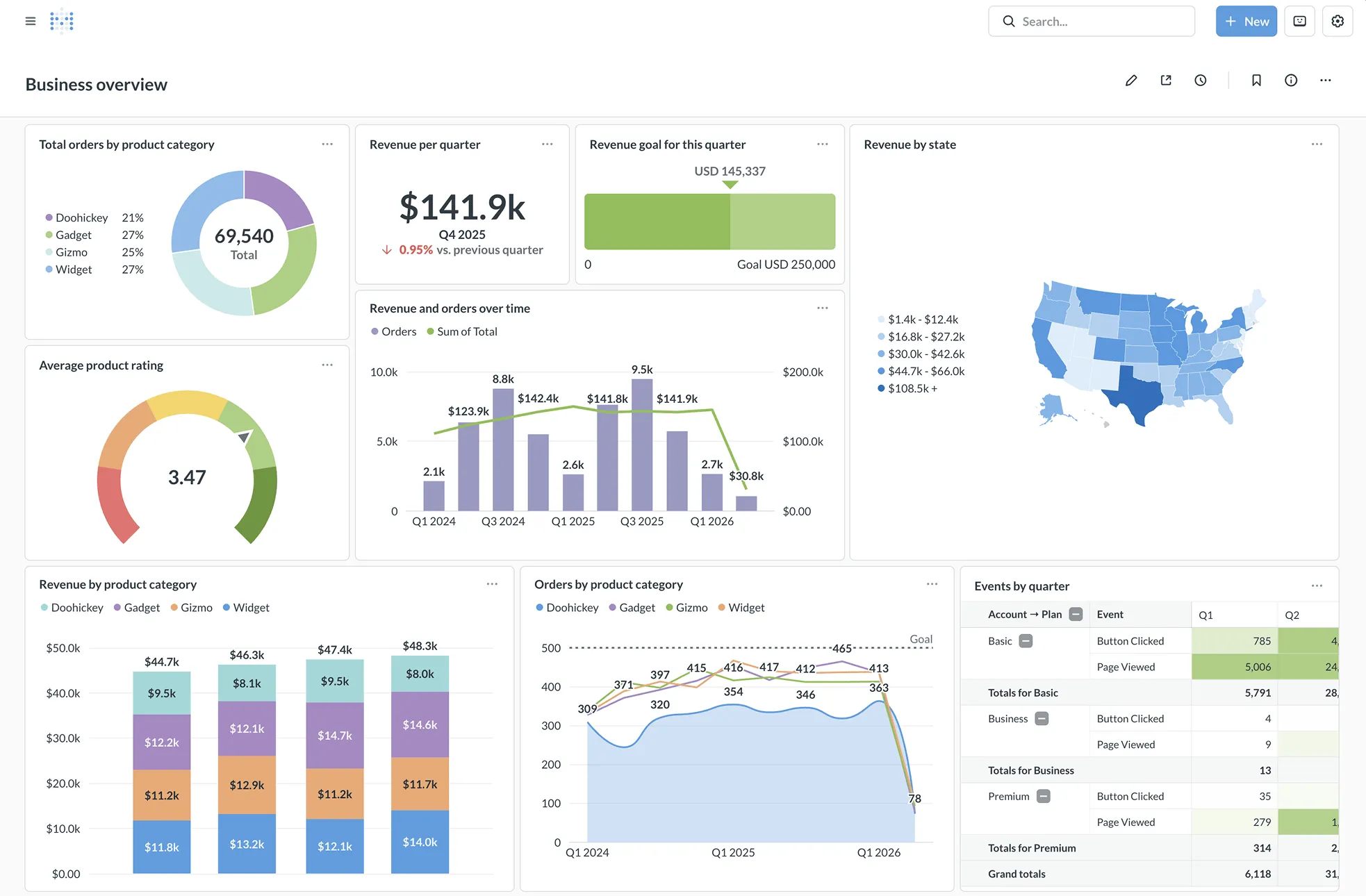
Feature Comparison
| Feature | Yellowfin | Metabase |
|---|---|---|
| Query & Exploration | ||
| Visual Query Builder | Drag-and-drop report builder with calculated fields and sub-queries | No-code visual query builder with template models and reusable metrics |
| SQL Editor | Integrated SQL runner with syntax highlighting and parameterized queries | Native SQL editor with variables, snippets, and auto-complete for power users |
| Natural Language Queries | Assisted Insights uses NLP to generate automated analysis narratives | Metabot AI generates SQL from plain-English questions via chat interface |
| Dashboard & Visualization | ||
| Dashboard Builder | Canvas-style dashboards with linked drill-downs and filter widgets | Grid-based dashboards with cross-filters and interactive drill-through menus |
| Data Storytelling | Built-in Stories feature combines charts, text, and images into presentation narratives | Dashboard documents with text cards and embedded descriptions for context |
| Scheduled Reporting | Broadcast scheduler delivers reports via email, FTP, and printer on custom schedules | Scheduled delivery via email and Slack with alert triggers for threshold monitoring |
| Embedding & Integration | ||
| White-Label Embedding | Full white-label JavaScript API with CSS theming for seamless SaaS product integration | White-label React SDK with dynamic styling and custom click behavior configuration |
| Multi-Tenant Support | Native multi-tenancy with organization-level isolation and row-level security filters | Multi-tenant data segregation with native one-database-per-tenant and row-level permissions |
| API Access | RESTful API and JavaScript API for programmatic report generation and management | REST API with API keys plus iframe and React SDK options for embedded deployment |
| Security & Governance | ||
| Authentication | LDAP and SAML SSO integration with role-based access control and IP filtering | SSO via SAML, LDAP, JWT, and Google with group mapping to Metabase roles |
| Data Permissions | Row-level and column-level security with content-level access controls per role | Granular table, row, and column-level permissions with database-managed row filtering |
| Compliance | Enterprise security certifications with audit logging and data governance controls | SOC1, SOC2, GDPR, and CCPA compliant with usage analytics and download tracking |
| Deployment & Administration | ||
| Self-Hosted Installation | WAR file or Docker container deployment on Windows, Linux, and macOS servers | Single Docker command deployment or JAR file with support for air-gapped environments |
| Cloud Hosting | No managed cloud offering; requires self-hosted infrastructure or partner hosting | Fully managed Metabase Cloud with automatic updates and free 14-day trial included |
| Environment Management | Promotion workflow moves content between development and production instances | Staging environments with config export for safe testing before production deployment |
Query & Exploration
Visual Query Builder
SQL Editor
Natural Language Queries
Dashboard & Visualization
Dashboard Builder
Data Storytelling
Scheduled Reporting
Embedding & Integration
White-Label Embedding
Multi-Tenant Support
API Access
Security & Governance
Authentication
Data Permissions
Compliance
Deployment & Administration
Self-Hosted Installation
Cloud Hosting
Environment Management
Which to choose
Yellowfin excels as a purpose-built embedded analytics platform with advanced data storytelling and automated analysis capabilities. Metabase wins on accessibility with its free open-source tier, fast deployment, and developer-friendly embedding SDK. The right choice depends on whether you prioritize polished embedded BI features or cost-effective self-service analytics.
Best-fit scenarios
Choose Yellowfin if:
Choose Yellowfin if your primary use case is embedding analytics into a commercial SaaS product where polished presentation, data storytelling, and automated insight discovery matter. Yellowfin's purpose-built embedded analytics platform provides a JavaScript API designed specifically for white-labeled integration into customer-facing applications. Its automated analysis engine proactively surfaces trends and anomalies, and the Stories feature enables compelling data narratives. Organizations building premium analytics offerings for their own customers, especially those needing multi-tenant isolation and broadcast reporting, will find Yellowfin's enterprise-grade capabilities worth the investment starting at $250/month.
Choose Metabase if:
Choose Metabase if you want to get self-service analytics running quickly without a large upfront commitment, especially if open-source flexibility matters to your team. Metabase's free self-hosted tier lets you deploy in minutes with a single Docker command, and its visual query builder empowers non-technical users to explore data independently. The React SDK and white-label embedding make it viable for customer-facing analytics at a fraction of Yellowfin's cost, with cloud plans starting at just $100/month. Startups and growing teams benefit from Metabase's 20+ database connectors, active open-source community with 47,000+ GitHub stars, and a pricing model that scales sensibly from pre-seed to enterprise.
These scenarios reflect the available product evidence. Your requirements, existing stack, and team expertise should guide the final decision.
Frequently Asked Questions
How does Yellowfin pricing compare to Metabase pricing?
Yellowfin uses commercial per-user licensing with the BI Suite starting at $50/user/month on annual billing. Their Starter plan begins at $250/month for 5 users, Professional at $750/month for 25 users, and Enterprise pricing is custom. Metabase offers a fundamentally different model with a free open-source self-hosted tier that has no user limits. Their cloud plans start at $100/month for the Starter tier and $575/month for Pro. Enterprise is custom pricing from $20,000 per year for self-hosted deployments. For a team of 10 users, Yellowfin costs $50/user/month totaling significant monthly spend, while Metabase self-hosted is free and cloud Starter is $100/month regardless of user count.
Can both Yellowfin and Metabase be embedded into SaaS applications?
Yes, both platforms support embedded analytics but take different approaches. Yellowfin was purpose-built for embedding and offers a comprehensive JavaScript API with full white-label capabilities, CSS theming, and multi-tenant architecture designed for ISVs. Its embedded analytics pricing is based on monthly active users rather than named users. Metabase provides embedding through both iframes for rapid deployment and a React SDK for more customized integration. Metabase's white-labeling removes branding across dashboards, scheduled reports, and PDF exports. Both support multi-tenant data segregation, but Yellowfin's embedding features are more mature for complex commercial SaaS products, while Metabase's SDK approach offers more developer flexibility at a lower cost starting at $100/month.
Is Metabase really free and how does its open-source version compare to paid plans?
Metabase's open-source edition is genuinely free with no user limits, no feature time-bombs, and full self-hosted deployment via a single Docker command. The open-source version includes the visual query builder, SQL editor, unlimited dashboards and charts, basic permissions, and 20+ database connectors. However, paid plans add significant enterprise features: the Starter plan at $100/month includes cloud hosting and Slack support; the Pro plan at $575/month adds self-hosted deployment options and advanced features; and Enterprise from $20,000/yearnth includes priority support, SAML SSO, row-level permissions, and environment management. Yellowfin publishes no prices and lists no free tier, so organizations exploring BI on a budget will find Metabase's open-source option compelling for initial evaluation.
Which tool provides better automated analytics and AI features?
Yellowfin and Metabase take distinct approaches to AI-powered analytics. Yellowfin's Assisted Insights engine automatically analyzes datasets to surface statistically significant trends, correlations, and anomalies without manual query building. Its Signal Detection continuously monitors data for changes and alerts users proactively. Yellowfin also offers unique data storytelling through its Stories feature, combining automated narratives with visualizations. Metabase introduced Metabot AI, which generates SQL queries from natural-language questions via a chat interface, making database exploration accessible to non-technical users. Metabase also provides automatic x-ray reports that analyze tables and generate dashboards instantly. Yellowfin's AI is more focused on proactive insight discovery, while Metabase's AI is designed for conversational data exploration. Both require paid plans for full AI capabilities.