Decision comparison
Wiz vs Orca Security
Choose Wiz when your primary requirement is a security graph that deeply connects code, identities, networks, cloud posture, logs, and runtime signals for attack-path reduction and code-level remediation. Choose Orca Security when rapid agentless onboarding, broad automated asset coverage, three reachability-analysis approaches, and AI-driven investigation workflows are the immediate priorities.
Direct comparison. These are reviewed substitutes bought for the same job, so the differences below are the ones that decide between them.
All 2 are cloud security platforms.
Quick Comparison
| Decision factor | Wiz | Orca Security |
|---|---|---|
| Best For | Enterprises needing code-to-cloud security graph context, attack-path reduction, and runtime detection across complex multi-cloud environments. | Teams prioritizing rapid agentless cloud onboarding, broad asset coverage, reachability-based vulnerability prioritization, and AI-assisted remediation workflows. |
| Architecture | Unified security graph connects code, cloud configuration, identities, network relationships, runtime telemetry, and cloud or SaaS logs. | Agentless SideScanning technology feeds a Unified Data Model spanning code, cloud assets, runtime, AI, and SDLC integrations. |
| Pricing Model | Enterprise-only pricing, custom quotes. Wiz publishes no rate and quotes every deal. Per-workload pricing model. No free tier or self-service plans. | Enterprise-only pricing, custom quotes based on cloud workload count. No free tier or self-service plans. Orca publishes no rate: orca.security/pricing is a 404 and every contract is quoted. |
| Ease of Use | Agentless cloud analysis centralizes risk context; optional eBPF Runtime Sensor adds runtime coverage where deeper detection is required. | Cloud accounts onboard in minutes, automatically discovering and monitoring newly added assets without manual update workflows. |
| Scalability | Per-workload enterprise licensing supports multiple clouds while graph correlation links application, identity, network, and runtime relationships. | Automatically monitors VMs, containers, storage, databases, and serverless applications as cloud accounts and assets expand. |
| Community/Support | Enterprise vendor support and demo-led sales model; Wiz states more than 50% of Fortune 100 use its platform. | Enterprise demo-led support model; its referenced GitHub repository has 14 stars and released version 1.120.0 in August 2026. |
Wiz
- Best For:
- Enterprises needing code-to-cloud security graph context, attack-path reduction, and runtime detection across complex multi-cloud environments.
- Architecture:
- Unified security graph connects code, cloud configuration, identities, network relationships, runtime telemetry, and cloud or SaaS logs.
- Pricing Model:
- Enterprise-only pricing, custom quotes. Wiz publishes no rate and quotes every deal. Per-workload pricing model. No free tier or self-service plans.
- Ease of Use:
- Agentless cloud analysis centralizes risk context; optional eBPF Runtime Sensor adds runtime coverage where deeper detection is required.
- Scalability:
- Per-workload enterprise licensing supports multiple clouds while graph correlation links application, identity, network, and runtime relationships.
- Community/Support:
- Enterprise vendor support and demo-led sales model; Wiz states more than 50% of Fortune 100 use its platform.
Orca Security
- Best For:
- Teams prioritizing rapid agentless cloud onboarding, broad asset coverage, reachability-based vulnerability prioritization, and AI-assisted remediation workflows.
- Architecture:
- Agentless SideScanning technology feeds a Unified Data Model spanning code, cloud assets, runtime, AI, and SDLC integrations.
- Pricing Model:
- Enterprise-only pricing, custom quotes based on cloud workload count. No free tier or self-service plans. Orca publishes no rate: orca.security/pricing is a 404 and every contract is quoted.
- Ease of Use:
- Cloud accounts onboard in minutes, automatically discovering and monitoring newly added assets without manual update workflows.
- Scalability:
- Automatically monitors VMs, containers, storage, databases, and serverless applications as cloud accounts and assets expand.
- Community/Support:
- Enterprise demo-led support model; its referenced GitHub repository has 14 stars and released version 1.120.0 in August 2026.
Public signals
Verified factual signals only. Bars appear only for like-for-like metrics with five weekly assessments for every tool; missing evidence stays explicit. These signals do not establish enterprise adoption, product quality, or total cost.
| Metric | Wiz | Orca Security |
|---|---|---|
| Search interest(Market interest) | 0 | 0 |
| Hacker News mentions, 90d(Community interest) | 0 | 0 |
| GitHub commits, 90d(Developer adoption) | Not available | 0 |
| GitHub stars(Developer adoption) | Not available | 14 |
As of September 14, 2026 — updated weekly.
Interface Preview
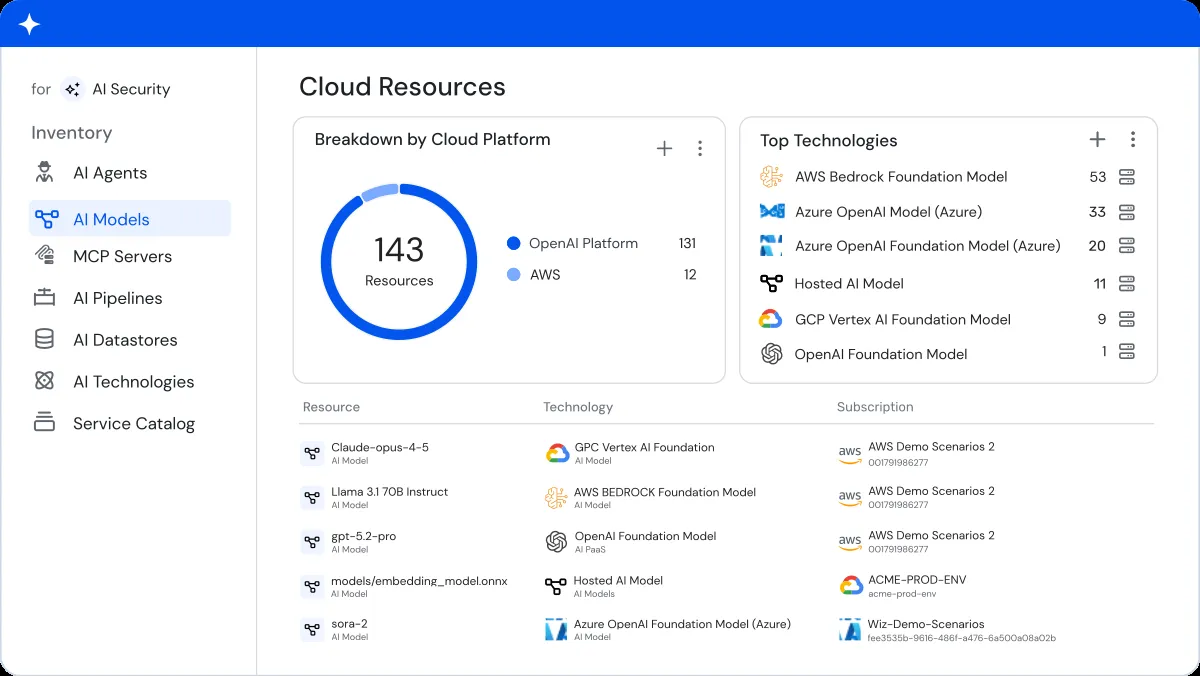
Wiz
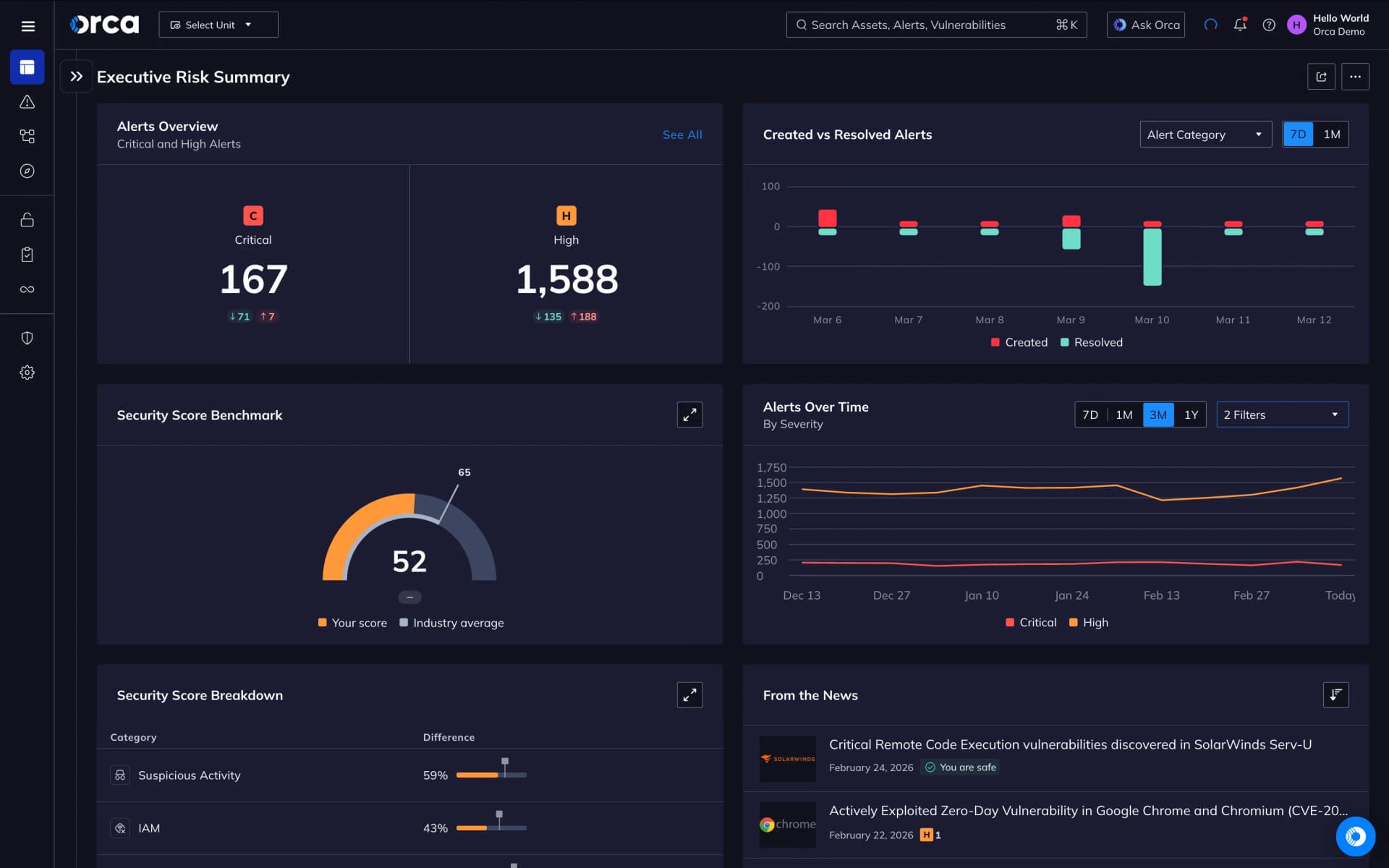
Orca Security
Feature Comparison
| Feature | Wiz | Orca Security |
|---|---|---|
| Attack Path and Exposure Analysis | ||
| External attack surface mapping | Maps externally reachable assets and models initial access paths. | Discovers cloud assets automatically through agentless SideScanning technology. |
| Internal movement context | Models lateral movement across code, identities, network, cloud, and runtime. | Surfaces high-impact attack paths using context-aware risk prioritization. |
| Vulnerability prioritization | Uses security graph context to prioritize risks and remediation. | Uses three types of reachability analysis to prioritize vulnerabilities. |
| Security Context and Coverage | ||
| Core data model | Security graph unifies code, cloud, runtime, identities, and network context. | Unified Data Model gathers comprehensive cloud-risk context for analysis. |
| Cloud asset coverage | Analyzes cloud configurations alongside identities, networks, code, and runtime. | Covers VMs, containers, buckets, databases, and serverless applications. |
| AI security context | Connects AI application code, cloud systems, runtime, models, data, and tools. | Extends visibility from code through cloud, runtime, and AI. |
| Remediation and Workflow Automation | ||
| Code remediation | Uses graph context and ownership mapping to fix risks in code. | Uses Orca AI to generate code fixes and action plans. |
| Risk ownership context | Maps ownership to route code fixes at scale. | Initiates workflows with comprehensive context baked into investigations. |
| AI-assisted operations | Applies unified security graph context to automated risk reduction. | Deploys AI agents to accelerate analysis and remediation planning. |
| Runtime Detection and Investigation | ||
| Runtime sensor | eBPF Runtime Sensor provides real-time threat detection and blocking. | Orca Sensor provides real-time threat detection within the platform. |
| Telemetry analysis | Combines cloud and SaaS logs with application and code context. | Orca AI acts on telemetry available throughout the Orca Platform. |
| Detection prioritization | Correlates runtime signals with graph context for threat response. | Prioritizes the small set of alerts with greatest business impact. |
| Deployment and Platform Operations | ||
| Initial onboarding | Uses cloud and code context for centralized security analysis. | Onboards cloud accounts in minutes for immediate platform coverage. |
| Asset change monitoring | Continuously connects cloud, code, identity, network, and runtime context. | Automatically detects and monitors newly added cloud assets. |
| SDLC integration | Connects code findings to cloud and runtime risk context. | Provides a unified cloud-native platform with SDLC integration. |
Attack Path and Exposure Analysis
External attack surface mapping
Internal movement context
Vulnerability prioritization
Security Context and Coverage
Core data model
Cloud asset coverage
AI security context
Remediation and Workflow Automation
Code remediation
Risk ownership context
AI-assisted operations
Runtime Detection and Investigation
Runtime sensor
Telemetry analysis
Detection prioritization
Deployment and Platform Operations
Initial onboarding
Asset change monitoring
SDLC integration
Which to choose
Choose Wiz when your primary requirement is a security graph that deeply connects code, identities, networks, cloud posture, logs, and runtime signals for attack-path reduction and code-level remediation. Choose Orca Security when rapid agentless onboarding, broad automated asset coverage, three reachability-analysis approaches, and AI-driven investigation workflows are the immediate priorities.
Best-fit scenarios
Choose Wiz if:
Choose Wiz for organizations that need to trace external entry points and internal lateral movement, then route graph-informed fixes to code owners. It is especially suited to mature multi-cloud programs that want runtime eBPF detection alongside cloud and SaaS log context.
Choose Orca Security if:
Choose Orca Security for teams seeking quick cloud-account onboarding and agentless visibility across VMs, containers, storage, databases, and serverless services. It is a strong fit when reachability-based vulnerability reduction and AI agents for investigations and action plans are central requirements.
These scenarios reflect the available product evidence. Your requirements, existing stack, and team expertise should guide the final decision.
Frequently Asked Questions
What is the main difference between Wiz and Orca Security?
Wiz centers its platform on a security graph that connects code, cloud configuration, identities, network relationships, runtime signals, and cloud or SaaS logs. Its supplied materials emphasize external initial-access paths, lateral-movement modeling, ownership-aware code fixes, and eBPF-based runtime detection. Orca Security emphasizes agentless SideScanning, a Unified Data Model, rapid onboarding, broad cloud-asset coverage, and three types of reachability analysis for vulnerability prioritization. Both address code, cloud, runtime, and AI security, but their stated operating emphasis differs.
Which is better for small teams?
For a small security team that needs to establish cloud visibility quickly, Orca Security may be the more direct operational fit because its materials state that cloud accounts can onboard in minutes and new assets are detected automatically without manual updates. Its context-aware engine also focuses attention on the highest-impact alerts. Wiz may suit a small but technically mature team that specifically needs graph-based correlation across code, cloud, identities, networks, runtime, and logs. Neither product offers a free tier or self-service plan in the provided pricing data.
Can I migrate from Wiz to Orca Security?
A transition is operationally possible, but the provided information does not describe a native Wiz-to-Orca migration utility, automatic finding transfer, or policy conversion. Plan the move as a parallel evaluation: connect the same cloud accounts, inventory assets, map Wiz policies and remediation workflows to Orca controls, compare prioritized attack paths and vulnerability findings, then validate alert routing and ownership processes. Historical findings, suppression rules, integrations, and reporting definitions should be reviewed separately because each platform uses a different contextual model.
What are the pricing differences?
Both products use enterprise-only, sales-quoted pricing rather than public self-service tiers or a free plan. Wiz licenses according to factors in the environment, including cloud usage and workloads; typical small-cloud deployments start around $30,000-$50,000 per year. Orca Security quotes based on cloud workload or asset count; typical contracts start around $36,000-$60,000 per year depending on cloud asset count. The final price for either product requires a vendor quote because coverage scope, cloud footprint, and workload volume affect the contract.