Decision comparison
Atlan vs Datafold
Atlan and Datafold address fundamentally different problems within the data quality ecosystem. Atlan is a metadata management and data cataloging platform that unifies governance, discovery, and AI context delivery across an organization's data estate. Datafold is a data engineering platform that automates data migrations, validates data quality in CI/CD pipelines, and optimizes compute costs. These tools complement each other rather than compete directly, and the right choice depends entirely on the problem you need to solve.
Used together. These are normally used together rather than chosen between. The comparison explains what each one does in the stack.
These are different kinds of product — Data Catalog and Data Validation Framework.
Quick Comparison
| Decision factor | Atlan | Datafold |
|---|---|---|
| Core Focus | AI-native context layer that unifies data catalog, governance, and collaboration into a single workspace powered by an Enterprise Data Graph with 80+ connectors | AI-powered data engineering platform specializing in automated data migrations, data quality testing, and cost optimization through intelligent workload routing |
| Pricing Model | Atlan publishes no pricing. atlan.com/pricing resolves to a talk-to-sales contact form, and no plan or edition names are published, so both the tier structure and the figures come from a quote. | Quote-based. Datafold publishes no prices; its pricing page directs buyers to contact sales. A quote is driven by data sources, data volume, and deployment model, with managed cloud and self-hosted options. The Migration Agent is sold at a fixed price per engagement. |
| Data Quality Approach | Integrates data quality metrics from external systems like Great Expectations, Soda, dbt tests, and Monte Carlo; surfaces quality issues on asset pages and toggles asset status automatically | Value-level validation using Data Diff compares data across all rows and columns at any scale; automated CI/CD testing prevents bad data deploys; real-time anomaly detection using ML models |
| AI Capabilities | AI-native context pipeline bootstraps descriptions, links business terms, and generates semantic views from query history and pipeline code; serves certified context via MCP server, SQL, and APIs | AI-powered Migration Agent performs code translation, SQL dialect conversion, and deep refactoring via the Data Knowledge Graph; AI coding agents connect to context layer through MCP |
| Migration Support | Not a core capability; Atlan focuses on metadata management, data cataloging, and governance rather than data platform migration services | Core differentiator with guaranteed-outcome migrations at fixed price and timeline; supports any source to any target including GUI-first ETL and BI; delivers 100% object migration with automated validation |
| Deployment Model | Cloud-native SaaS platform with Iceberg-native Metadata Lakehouse architecture, knowledge graph, vector storage, and analytics purpose-built for AI workloads | Single-tenant VPC deployment in AWS, GCP, or Azure ensures data stays within security perimeter; SOC 2 and HIPAA compliant; governed LLM inference uses customer-approved endpoints |
Atlan
- Core Focus:
- AI-native context layer that unifies data catalog, governance, and collaboration into a single workspace powered by an Enterprise Data Graph with 80+ connectors
- Pricing Model:
- Atlan publishes no pricing. atlan.com/pricing resolves to a talk-to-sales contact form, and no plan or edition names are published, so both the tier structure and the figures come from a quote.
- Data Quality Approach:
- Integrates data quality metrics from external systems like Great Expectations, Soda, dbt tests, and Monte Carlo; surfaces quality issues on asset pages and toggles asset status automatically
- AI Capabilities:
- AI-native context pipeline bootstraps descriptions, links business terms, and generates semantic views from query history and pipeline code; serves certified context via MCP server, SQL, and APIs
- Migration Support:
- Not a core capability; Atlan focuses on metadata management, data cataloging, and governance rather than data platform migration services
- Deployment Model:
- Cloud-native SaaS platform with Iceberg-native Metadata Lakehouse architecture, knowledge graph, vector storage, and analytics purpose-built for AI workloads
Datafold
- Core Focus:
- AI-powered data engineering platform specializing in automated data migrations, data quality testing, and cost optimization through intelligent workload routing
- Pricing Model:
- Quote-based. Datafold publishes no prices; its pricing page directs buyers to contact sales. A quote is driven by data sources, data volume, and deployment model, with managed cloud and self-hosted options. The Migration Agent is sold at a fixed price per engagement.
- Data Quality Approach:
- Value-level validation using Data Diff compares data across all rows and columns at any scale; automated CI/CD testing prevents bad data deploys; real-time anomaly detection using ML models
- AI Capabilities:
- AI-powered Migration Agent performs code translation, SQL dialect conversion, and deep refactoring via the Data Knowledge Graph; AI coding agents connect to context layer through MCP
- Migration Support:
- Core differentiator with guaranteed-outcome migrations at fixed price and timeline; supports any source to any target including GUI-first ETL and BI; delivers 100% object migration with automated validation
- Deployment Model:
- Single-tenant VPC deployment in AWS, GCP, or Azure ensures data stays within security perimeter; SOC 2 and HIPAA compliant; governed LLM inference uses customer-approved endpoints
Public signals
Verified factual signals only. Bars appear only for like-for-like metrics with five weekly assessments for every tool; missing evidence stays explicit. These signals do not establish enterprise adoption, product quality, or total cost.
| Metric | Atlan | Datafold |
|---|---|---|
| GitHub commits, 90d(Developer adoption) | 167 | Not available |
| GitHub stars(Developer adoption) | 22 | Not available |
| Search interest(Market interest) | 3 | Unavailable |
| Hacker News mentions, 90d(Community interest) | 0 | Not available |
| PyPI weekly downloads(Developer adoption) | 128.0k | 12.1k |
| Product Hunt comments(Community interest) | Not available | 7 |
| Product Hunt reviews(Community interest) | Not available | 0 |
| Product Hunt votes(Community interest) | Not available | 17 |
As of September 21, 2026 — updated weekly.
Health & risk evidence
Observed public-source checks for mapped package versions and repositories.
Atlan
September 21, 2026Package vulnerabilities
PyPI · pyatlan@11.4.0
0 vulnerabilities
across 1 package
Repository security score
Not available
Datafold
September 21, 2026Package vulnerabilities
PyPI · datafold-sdk@0.4.1
0 vulnerabilities
across 1 package
Repository security score
Not available
Interface Preview
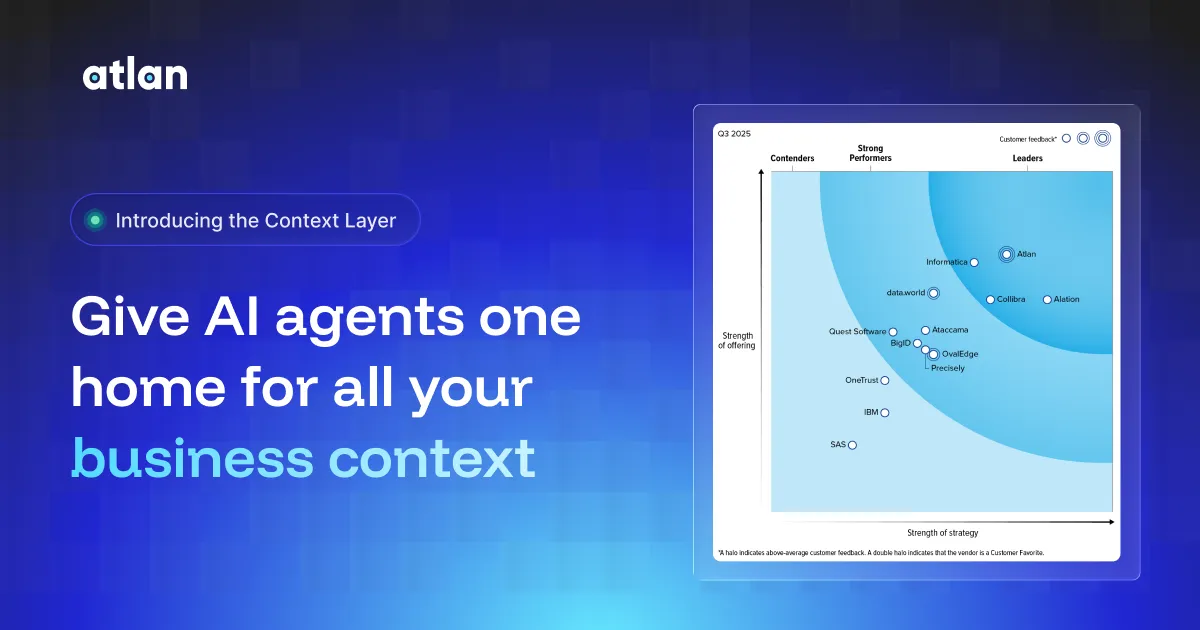
Atlan
Datafold
Feature Comparison
| Feature | Atlan | Datafold |
|---|---|---|
| Metadata and Governance | ||
| Data Catalog | Modern data workspace combining catalog, governance, and collaboration. | Not verified |
| End-to-End Lineage | Provides robust visual lineage across complex data ecosystems. | Not verified |
| Business Glossary | Centralized linkable glossary with assigned ownership for definitions. | Not verified |
| Data Migration | ||
| AI-Powered Code Translation | Not verified | AI-powered code translation combined with automated data validation. |
| Universal Source-Target Support | Not verified | Supports any legacy source to any modern target. |
| Value-Level Validation | Not verified | Validates every migrated dataset and automatically fixes discrepancies. |
| AI and Context | ||
| Enterprise Data Graph | Unifies business-system context through 80-plus data estate connectors. | Uses a Data Knowledge Graph for pipeline understanding. |
| Certified Context Flows | Delivers production-ready context through SQL, APIs, and MCP. | Not verified |
| Continuous Migration Monitoring | Not verified | Continuously monitors legacy-to-target data during UAT and cutover. |
| Delivery and Pricing | ||
| Pricing Model | Free tier, Pro and Team monthly plans, Enterprise custom. | Quoted per deployment; no published rate card. |
| Outcome-Based Delivery | Not verified | Fixed price, guaranteed timeline, and contractually ensured migration quality. |
| Migration Speed and Cost Claim | Not verified | Claims migrations are up to six times faster and cheaper. |
Metadata and Governance
Data Catalog
End-to-End Lineage
Business Glossary
Data Migration
AI-Powered Code Translation
Universal Source-Target Support
Value-Level Validation
AI and Context
Enterprise Data Graph
Certified Context Flows
Continuous Migration Monitoring
Delivery and Pricing
Pricing Model
Outcome-Based Delivery
Migration Speed and Cost Claim
How they fit together
Atlan and Datafold address fundamentally different problems within the data quality ecosystem. Atlan is a metadata management and data cataloging platform that unifies governance, discovery, and AI context delivery across an organization's data estate. Datafold is a data engineering platform that automates data migrations, validates data quality in CI/CD pipelines, and optimizes compute costs. These tools complement each other rather than compete directly, and the right choice depends entirely on the problem you need to solve.
What each one handles
These roles reflect the available product evidence. Most teams run both; which one owns a given job depends on your stack and team.
Frequently Asked Questions
Can Atlan and Datafold be used together in the same data stack?
Atlan and Datafold serve complementary roles and can work together effectively. Atlan handles metadata management, data cataloging, and governance across the organization, while Datafold handles data quality validation, migrations, and compute optimization at the engineering level. Atlan integrates quality metrics from external systems, so organizations could surface Datafold's data quality results within Atlan's catalog. Both tools also support MCP server integrations, enabling AI coding agents to access context from both platforms. Using them together gives data teams comprehensive coverage from metadata governance through to production data validation.
How do the pricing models of Atlan and Datafold compare?
Atlan publishes no pricing. Its pricing page resolves to a talk-to-sales contact form with no figures and no plan or edition names, so both the tier structure and the rates come from a quote. Ask for a quote scoped to your connector count and user roles, or the number will not be comparable with a competitor's published rate.
What data quality capabilities does each platform provide?
Atlan approaches data quality by aggregating metrics from external quality tools. It integrates with Great Expectations, Soda, dbt tests, and Monte Carlo, surfacing quality issues on asset pages and toggling asset status when problems arise. The platform serves as a visibility layer for quality across the data estate. Datafold approaches data quality through direct validation. Its Data Diff tool compares data at the value level across all rows and columns at any scale, and integrates into CI/CD pipelines to prevent bad deploys. It also provides real-time anomaly detection using ML models that monitor row counts, freshness, and custom metrics, along with schema change alerts. Datafold's quality tools are exposed via MCP so AI coding agents can validate their own work.
Which platform is better suited for data migration projects?
Datafold is purpose-built for data migration and offers this as a core capability. Its AI-powered Migration Agent handles code translation, SQL dialect conversion, and deep refactoring through the Data Knowledge Graph. Migrations are delivered as a guaranteed outcome with fixed price and contractual timelines, covering 100% of objects in scope. Customers have migrated thousands of tables across platforms like Redshift to Snowflake with 100% data parity and significant time savings. Atlan does not provide migration capabilities. Its 80+ connectors are designed for metadata ingestion rather than data platform migration. Organizations undertaking a major data platform migration would need Datafold or a similar migration tool, and could use Atlan alongside it to manage metadata governance during and after the migration.