Decision comparison
Datafold vs Soda
Datafold excels at data platform migrations with AI-powered code translation and guaranteed delivery, while Soda leads in continuous data quality monitoring with peer-reviewed AI algorithms and collaborative data contracts for ongoing operations.
Direct comparison. These are reviewed substitutes bought for the same job, so the differences below are the ones that decide between them.
All 2 are data validation frameworks.
Quick Comparison
| Decision factor | Datafold | Soda |
|---|---|---|
| Best For | Data platform migrations with automated code translation, value-level validation, and guaranteed delivery timelines | Continuous data quality monitoring with AI-powered anomaly detection and collaborative data contracts |
| Pricing | Quote-based. Datafold publishes no prices; its pricing page directs buyers to contact sales. A quote is driven by data sources, data volume, and deployment model, with managed cloud and self-hosted options. The Migration Agent is sold at a fixed price per engagement. | Free tier at $0 per month, Team tier at $750 per month, with enterprise features available |
| Data Quality Approach | Value-level data diffing that compares every row and column across sources for migration validation | Automated checks with record-level anomaly detection, metrics monitoring, and built-in backfilling for historical analysis |
| AI Capabilities | AI-powered SQL dialect translation via Migration Agent plus Data Knowledge Graph for coding agent context | Peer-reviewed AI research published in NeurIPS, JAIR, and ACML powering anomaly detection and data contracts |
| Open Source | Open-source Data Diff tool on GitHub with 2,988 stars, MIT license, written in Python | Open-source Soda Core on GitHub with 2,000+ stars, Python-based, actively maintained with v4.7.0 release |
| Deployment Options | Cloud-hosted SaaS or self-hosted single-tenant VPC deployment on AWS, GCP, or Azure | Cloud-hosted SaaS with private deployment option; data stays in your cloud environment |
Datafold
- Best For:
- Data platform migrations with automated code translation, value-level validation, and guaranteed delivery timelines
- Pricing:
- Quote-based. Datafold publishes no prices; its pricing page directs buyers to contact sales. A quote is driven by data sources, data volume, and deployment model, with managed cloud and self-hosted options. The Migration Agent is sold at a fixed price per engagement.
- Data Quality Approach:
- Value-level data diffing that compares every row and column across sources for migration validation
- AI Capabilities:
- AI-powered SQL dialect translation via Migration Agent plus Data Knowledge Graph for coding agent context
- Open Source:
- Open-source Data Diff tool on GitHub with 2,988 stars, MIT license, written in Python
- Deployment Options:
- Cloud-hosted SaaS or self-hosted single-tenant VPC deployment on AWS, GCP, or Azure
Soda
- Best For:
- Continuous data quality monitoring with AI-powered anomaly detection and collaborative data contracts
- Pricing:
- Free tier at $0 per month, Team tier at $750 per month, with enterprise features available
- Data Quality Approach:
- Automated checks with record-level anomaly detection, metrics monitoring, and built-in backfilling for historical analysis
- AI Capabilities:
- Peer-reviewed AI research published in NeurIPS, JAIR, and ACML powering anomaly detection and data contracts
- Open Source:
- Open-source Soda Core on GitHub with 2,000+ stars, Python-based, actively maintained with v4.7.0 release
- Deployment Options:
- Cloud-hosted SaaS with private deployment option; data stays in your cloud environment
Public signals
Verified factual signals only. Bars appear only for like-for-like metrics with five weekly assessments for every tool; missing evidence stays explicit. These signals do not establish enterprise adoption, product quality, or total cost.
| Metric | Datafold | Soda |
|---|---|---|
| Search interest(Market interest) | Unavailable | 0 |
| Product Hunt comments(Community interest) | 7 | Not available |
| Product Hunt reviews(Community interest) | 0 | Not available |
| Product Hunt votes(Community interest) | 17 | Not available |
| PyPI weekly downloads(Developer adoption) | 12.1k | Not available |
| GitHub commits, 90d(Product adoption) | Not available | 81 |
| GitHub stars(Product adoption) | Not available | 2,000+ |
| PyPI weekly downloads(Product adoption) | Not available | 405.8k |
As of September 21, 2026 — updated weekly.
Health & risk evidence
Observed public-source checks for mapped package versions and repositories.
Datafold
September 21, 2026Package vulnerabilities
PyPI · datafold-sdk@0.4.1
0 vulnerabilities
across 1 package
Repository security score
Not available
Soda
September 21, 2026Package vulnerabilities
PyPI · soda-core@4.24.0
0 vulnerabilities
across 1 package
Repository security score
Not available
Interface Preview
Datafold
Soda
Feature Comparison
| Feature | Datafold | Soda |
|---|---|---|
| Data Quality Checks | ||
| Automated Validation | Value-level data diffing compares every row and column across source and target databases at any scale | Automated data quality checks with schema validation, freshness monitoring, and custom business rule enforcement |
| Anomaly Detection | Real-time anomaly detection using ML models for row counts, freshness, and custom metrics | Record-level anomaly detection with algorithms that beat Facebook Prophet with 70% fewer false positives |
| Historical Analysis | Column-level lineage mapping for migration complexity assessment and impact analysis | Built-in backfilling and backtesting that instantly analyzes historical data to reveal patterns and trends |
| AI and Automation | ||
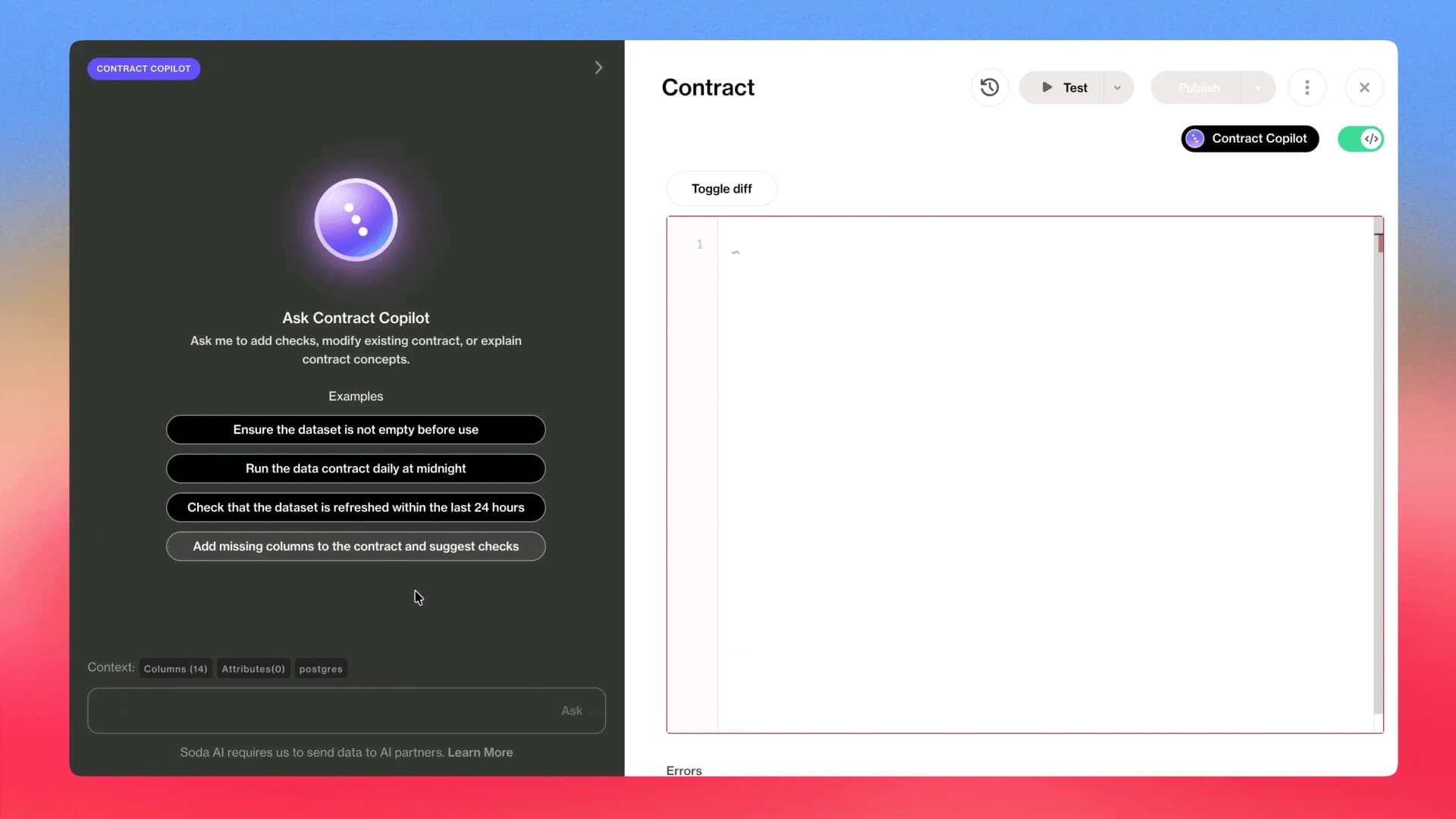
| AI-Powered Features | AI-powered SQL dialect conversion and code translation via the Migration Agent for automated data migrations | AI co-pilot creates full data contracts with one click; writes checks from plain English descriptions |
| Data Contracts | Data Knowledge Graph serves lineage, business logic, and ontology context via MCP for coding agents | Collaborative data contracts with version control, proposals, diffs, and AI-powered automated generation |
| CI/CD Integration | Integrates with CI/CD pipelines to prevent bad deploys by identifying value-level data differences | Engineers run checks as code in Git while business users manage them through a no-code UI interface |
| Migration and Observability | ||
| Data Migration | Full-service migration with AI code translation, guaranteed timelines, and 100% object coverage delivered end-to-end | Focuses on ongoing data quality rather than migration; monitors thousands of tables with interactive visualizations |
| Data Observability | Schema change detection with immediate alerts and real-time monitoring against business rules | Monitors thousands of tables in seconds with smart adaptive thresholds and interactive drill-down visualizations |
| Root Cause Analysis | Data Diff and monitors exposed via MCP so coding agents can debug production issues and reconcile data | Diagnostics warehouse stores all failed records for auditing; complete traceability with every log captured |
| Collaboration | ||
| Team Workflows | Data Knowledge Graph provides context layer for team collaboration on migrations and code reviews | Engineers work in Git, business users in the UI with one shared workflow and versioned change proposals |
| Governance | SOC 2 and HIPAA compliance with governed LLM inference through your approved security endpoints | Governance by design with auditability, permission control, audit logs, custom roles, and RBAC built in |
| Bad Data Remediation | Discrepancies automatically fixed by the migration agent; unfixable issues documented and explained | Automatically isolates, manages, and fixes bad data at source in your environment with AI remediation coming soon |
| Platform and Ecosystem | ||
| Open Source Component | Data Diff open-source tool with 2,988 GitHub stars compares tables within or across databases using Python | Soda Core open-source with 2,000+ GitHub stars serves as the data contracts engine for the modern data stack |
| Database Support | Universal source-target support including Snowflake, Databricks, PostgreSQL, MySQL, Oracle, and Trino | Connects to modern data platforms with focus on Snowflake, Databricks, and Unity Catalog environments |
| Security Architecture | Single-tenant VPC deployment ensures data never leaves your security perimeter; SOC 2 Type 2 certified | Security by design with data staying in your cloud; private deployment with SSO and enterprise compliance |
Data Quality Checks
Automated Validation
Anomaly Detection
Historical Analysis
AI and Automation
AI-Powered Features
Data Contracts
CI/CD Integration
Migration and Observability
Data Migration
Data Observability
Root Cause Analysis
Collaboration
Team Workflows
Governance
Bad Data Remediation
Platform and Ecosystem
Open Source Component
Database Support
Security Architecture
Which to choose
Datafold excels at data platform migrations with AI-powered code translation and guaranteed delivery, while Soda leads in continuous data quality monitoring with peer-reviewed AI algorithms and collaborative data contracts for ongoing operations.
Best-fit scenarios
Choose Datafold if:
We recommend Datafold for teams planning or executing data platform migrations. Its AI-powered Migration Agent delivers guaranteed-outcome migrations with fixed pricing and contractual timelines, having migrated 5,000+ tables for customers like Faire 6 months ahead of schedule. The value-level Data Diff validation ensures 100% data parity across source and target systems. Datafold also provides cost optimization through its SQL Proxy intelligent workload routing. Choose Datafold when migration speed and accuracy are your top priorities.
Choose Soda if:
We recommend Soda for teams focused on ongoing data quality monitoring and governance at scale. Soda 4.0 unites business and engineering teams through collaborative data contracts with a shared workflow where engineers work in Git and business users operate through a no-code interface. Its anomaly detection algorithms beat Facebook Prophet with 70% fewer false positives and scale to 1 billion rows in 64 seconds. The free tier at $0/month makes it accessible for small projects, while the Team tier at $750/month serves growing data engineering teams.
These scenarios reflect the available product evidence. Your requirements, existing stack, and team expertise should guide the final decision.
Frequently Asked Questions
What is the main difference between Datafold and Soda?
Datafold specializes in data platform migrations, using AI-powered code translation to convert SQL dialects and validate data parity at the value level across source and target databases. Soda focuses on continuous data quality monitoring with automated checks, anomaly detection, and collaborative data contracts that unite business and engineering teams. While both platforms address data quality, Datafold is migration-first and Soda is monitoring-first. Datafold delivers migrations as a managed service with guaranteed timelines, whereas Soda provides an ongoing platform for detecting, explaining, and resolving data quality issues as they appear in production.
Which tool is more affordable for small teams?
Soda is more accessible for small teams with its free tier at $0/month that includes pipeline testing, metrics observability, and alerting integrations with unlimited users. The Team tier costs $750/month for data engineering teams needing collaborative data contracts, a no-code interface, and advanced AI features. Datafold does not offer a publicly listed free tier for its commercial platform, though its open-source Data Diff tool is freely available. Datafold publishes no prices and quotes each deployment, making Soda the more predictable option for teams starting out with data quality.
Do Datafold and Soda have open-source components?
Both platforms maintain popular open-source projects on GitHub written in Python. Datafold offers Data Diff, an open-source tool with 2,988 GitHub stars under the MIT license that compares tables within or across databases supporting Snowflake, Databricks, PostgreSQL, MySQL, Oracle, and Trino. Soda maintains Soda Core with 2,335 GitHub stars, serving as a data contracts engine for the modern data stack with support for data quality checks, monitoring, and validation. Soda Core is actively maintained with its latest release v4.7.0 shipped in April 2026, while Data Diff's last release was v0.11.1 in February 2024.
Can Datafold and Soda be deployed in private cloud environments?
Both platforms support private deployment options for organizations with strict security requirements. Datafold offers single-tenant VPC deployment on AWS, GCP, or Azure, ensuring your data never leaves your security perimeter. It is SOC 2 Type 2 certified and HIPAA compliant, with governed LLM inference through your approved security endpoints. Soda provides private deployment with security by design, keeping data in your cloud environment under your full control. Soda Enterprise includes SSO, custom roles, RBAC, and audit logs. Both platforms are built for enterprise security, though Datafold emphasizes its VPC isolation model while Soda emphasizes its governance-by-design architecture.