Decision comparison
Elementary vs Marquez
Elementary and Marquez serve fundamentally different roles in the modern data stack. Elementary is a full-featured data observability platform built for dbt teams who need automated monitoring, anomaly detection, and incident management. Marquez is a focused metadata and lineage service designed for platform teams who need centralized tracking of data dependencies across diverse pipeline technologies.
Architecture choice. These take different approaches to the same problem. Read the table as a fit question rather than a feature race.
These are different kinds of product — Data Observability and Data Catalog.
Quick Comparison
| Decision factor | Elementary | Marquez |
|---|---|---|
| Best For | Data teams using dbt who need automated data quality monitoring and anomaly detection | Platform teams building centralized metadata and lineage tracking across multiple pipelines |
| Core Strength | dbt-native observability with automated monitors for freshness, volume, and schema changes | OpenLineage-compatible metadata service for collecting and visualizing data lineage at scale |
| Deployment Model | Cloud-hosted SaaS with tiered plans, plus an open-source dbt package for self-hosting | Fully open-source and self-hosted with no commercial cloud offering available |
| Pricing | Elementary publishes no amounts. Its open-source dbt package is free and self-hosted. Elementary Cloud is priced by seats and environments: Scale covers up to 10 editor seats and 1K tables, Enterprise up to 20 editor and 40 viewer seats and 3K tables, and Unlimited removes the seat caps; extra tables are charged per additional 1K. A free trial covers the Essentials feature set. Every paid tier is quote-only. | Free and open source |
| Learning Curve | Low for dbt users since configuration lives in code alongside existing dbt projects | Moderate to steep as it requires infrastructure setup and OpenLineage integration work |
| Integration Depth | End-to-end stack coverage including BI tools, warehouses, and alerting channels | Works with Airflow, Spark, Flink, dbt, and Dagster through OpenLineage integrations |
Elementary
- Best For:
- Data teams using dbt who need automated data quality monitoring and anomaly detection
- Core Strength:
- dbt-native observability with automated monitors for freshness, volume, and schema changes
- Deployment Model:
- Cloud-hosted SaaS with tiered plans, plus an open-source dbt package for self-hosting
- Pricing:
- Elementary publishes no amounts. Its open-source dbt package is free and self-hosted. Elementary Cloud is priced by seats and environments: Scale covers up to 10 editor seats and 1K tables, Enterprise up to 20 editor and 40 viewer seats and 3K tables, and Unlimited removes the seat caps; extra tables are charged per additional 1K. A free trial covers the Essentials feature set. Every paid tier is quote-only.
- Learning Curve:
- Low for dbt users since configuration lives in code alongside existing dbt projects
- Integration Depth:
- End-to-end stack coverage including BI tools, warehouses, and alerting channels
Marquez
- Best For:
- Platform teams building centralized metadata and lineage tracking across multiple pipelines
- Core Strength:
- OpenLineage-compatible metadata service for collecting and visualizing data lineage at scale
- Deployment Model:
- Fully open-source and self-hosted with no commercial cloud offering available
- Pricing:
- Free and open source
- Learning Curve:
- Moderate to steep as it requires infrastructure setup and OpenLineage integration work
- Integration Depth:
- Works with Airflow, Spark, Flink, dbt, and Dagster through OpenLineage integrations
Public signals
Verified factual signals only. Bars appear only for like-for-like metrics with five weekly assessments for every tool; missing evidence stays explicit. These signals do not establish enterprise adoption, product quality, or total cost.
| Metric | Elementary | Marquez |
|---|---|---|
| GitHub commits, 90d(Product adoption) | 19 | 0 |
| GitHub stars(Product adoption) | 2,000+ | 2,000+ |
| PyPI weekly downloads(Product adoption) | 215.3k | Not available |
| Docker Hub pulls(Product adoption) | Not available | 1.1M |
| PyPI weekly downloads(Developer adoption) | Not available | 84 |
As of September 21, 2026 — updated weekly.
Health & risk evidence
Observed public-source checks for mapped package versions and repositories.
Elementary
September 21, 2026Package vulnerabilities
PyPI · elementary-data@0.26.0
0 vulnerabilities
across 1 package
Repository security score
github.com/elementary-data/elementary
7.4/10
Marquez
September 21, 2026Package vulnerabilities
PyPI · marquez-python@0.50.0
0 vulnerabilities
across 1 package
Repository security score
github.com/MarquezProject/marquez
4.0/10
Interface Preview
Elementary
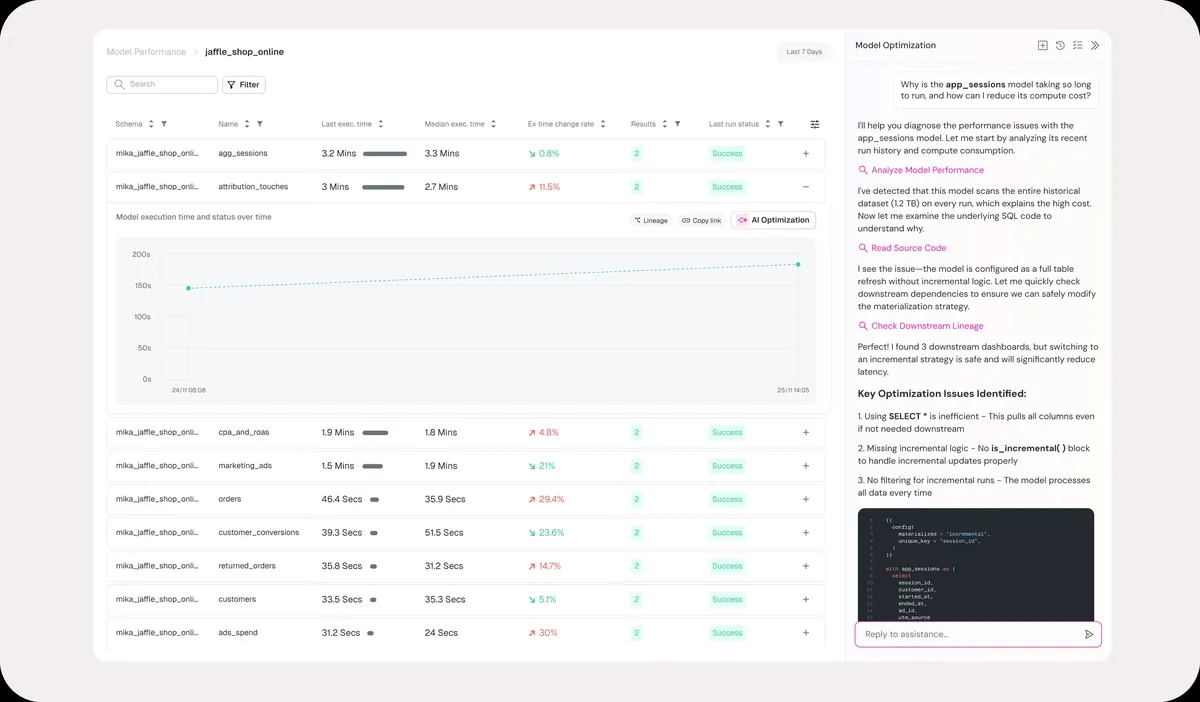
Feature Comparison
| Feature | Elementary | Marquez |
|---|---|---|
| Data Quality Monitoring | ||
| Automated Anomaly Detection | Built-in ML-based monitors for freshness, volume, nullness, distribution, and completeness | Not available; Marquez focuses on metadata and lineage rather than data quality checks |
| Schema Change Detection | Automated out-of-the-box monitors that detect schema changes across production tables | Tracks dataset schema as metadata but does not alert on unexpected schema changes |
| Data Quality Tests | Supports dbt tests, dbt-expectations, dbt-utils, and custom Elementary tests in one platform | No built-in testing framework; relies on external tools for data quality validation |
| Lineage and Metadata | ||
| Column-Level Lineage | End-to-end column-level lineage from code to BI tools, enriched with test results | Dataset-level lineage with job-to-dataset dependency tracking via OpenLineage events |
| Metadata Collection | Collects metadata from dbt artifacts, warehouses, and BI tools through its context engine | Centralized metadata service with real-time OpenLineage-compatible collection endpoint |
| Lineage Visualization | Interactive DAG view showing incidents and test failures across the full pipeline | Unified visual graph showing complex interdependencies across the entire data ecosystem |
| Alerting and Incident Management | ||
| Alert Routing | Routes alerts to Slack, Teams, Opsgenie, and PagerDuty based on ownership and severity | No built-in alerting system; requires external tooling for notifications |
| Incident Management | Groups related failures into managed incidents with context-aware notifications | Not available; Marquez stores metadata but does not manage operational incidents |
| Health Scoring | Data health scores across domains, teams, and assets measuring core quality dimensions | No health scoring; provides raw metadata and lineage without quality assessments |
| Developer Experience | ||
| Configuration as Code | All configurations managed in dbt code with version control, code review, and CI/CD support | Configuration through API and deployment manifests; no native code-first workflow |
| API Access | MCP Server interface exposing lineage, metadata, and health data to AI tools | Flexible Lineage API for querying metadata and automating tasks like backfills |
| Open Source Community | 2,000+ GitHub stars with Apache 2.0 license and active dbt community adoption | 2,000+ GitHub stars with Apache 2.0 license as the OpenLineage reference implementation |
| Platform and Integrations | ||
| Warehouse Support | Snowflake, BigQuery, Redshift, Databricks, and Postgres through native dbt integration | Warehouse-agnostic through OpenLineage; does not connect directly to warehouses |
| Orchestrator Support | Primarily dbt-native; works with any orchestrator that runs dbt jobs | Native integrations with Apache Airflow, Spark, Flink, dbt, and Dagster |
| BI Tool Integration | Direct integrations with Tableau, Looker, and other BI tools for end-to-end lineage | No direct BI integrations; BI metadata must be pushed via OpenLineage adapters |
Data Quality Monitoring
Automated Anomaly Detection
Schema Change Detection
Data Quality Tests
Lineage and Metadata
Column-Level Lineage
Metadata Collection
Lineage Visualization
Alerting and Incident Management
Alert Routing
Incident Management
Health Scoring
Developer Experience
Configuration as Code
API Access
Open Source Community
Platform and Integrations
Warehouse Support
Orchestrator Support
BI Tool Integration
Which approach fits
Elementary and Marquez serve fundamentally different roles in the modern data stack. Elementary is a full-featured data observability platform built for dbt teams who need automated monitoring, anomaly detection, and incident management. Marquez is a focused metadata and lineage service designed for platform teams who need centralized tracking of data dependencies across diverse pipeline technologies.
When each approach fits
Choose Elementary if:
We recommend Elementary for data and analytics engineering teams already using dbt who need comprehensive data observability in a single platform. Elementary excels when your priority is catching data quality issues before they reach downstream consumers. Its automated monitors, anomaly detection, and incident management provide a complete quality workflow. The dbt-native design means you can configure everything in code alongside your existing transformations, making onboarding fast and reducing context switching.
Choose Marquez if:
We recommend Marquez for platform engineering teams building a centralized metadata layer across a heterogeneous data ecosystem. Marquez is the right choice when you run multiple orchestrators such as Airflow, Spark, and Flink and need a single source of truth for lineage data. As the OpenLineage reference implementation, it provides a standards-based foundation that avoids vendor lock-in. Because it is fully open source with no commercial tier, it suits organizations with strong infrastructure teams who can manage self-hosted deployments.
These scenarios reflect the available product evidence. Your requirements, existing stack, and team expertise should guide the final decision.
Frequently Asked Questions
Can Elementary and Marquez be used together in the same data stack?
Yes, Elementary and Marquez complement each other well in larger data ecosystems. Marquez serves as the centralized lineage and metadata backbone, collecting dependency information from all orchestrators and pipeline tools via OpenLineage. Elementary then layers on top specifically for dbt pipelines, providing the data quality monitoring, anomaly detection, and alerting that Marquez does not offer. Teams running this combination typically use Marquez to maintain a global view of data flow across the organization while relying on Elementary to enforce quality standards and catch issues within their dbt transformation layer.
Which tool is better for a team that primarily uses dbt for data transformations?
Elementary is the stronger choice for dbt-centric teams. It was built from the ground up as a dbt-native solution, meaning it installs as a dbt package and reads directly from dbt artifacts. All monitoring configuration lives in your dbt YAML files, so you manage observability the same way you manage transformations: through version-controlled code. Marquez can ingest dbt metadata through its OpenLineage integration, but it only captures lineage information. It does not provide the automated quality monitors, anomaly detection, or test result dashboards that Elementary offers out of the box.
What are the infrastructure requirements for self-hosting each tool?
Marquez requires you to deploy and maintain a Java-based metadata server along with a PostgreSQL database for storage. You also need to configure OpenLineage integrations in each orchestrator and pipeline tool that should report lineage data. Elementary has two deployment paths: the open-source dbt package runs entirely within your existing dbt infrastructure and data warehouse with no additional servers needed. The Elementary Cloud offering is a managed SaaS product that requires only installing the dbt package and connecting it to your Elementary account. For teams wanting minimal infrastructure overhead, Elementary Cloud or the lightweight dbt package both demand less operational effort than a full Marquez deployment.
How do Elementary and Marquez compare in terms of community adoption and long-term viability?
Both projects are well-established in the data engineering community. Elementary has over 2,000+ GitHub stars, is licensed under Apache 2.0, and has an active release cadence with its latest release in April 2026. It benefits from strong adoption within the dbt community and backing from a commercial entity that offers paid cloud plans. Marquez has over 2,000 GitHub stars, also uses the Apache 2.0 license, and serves as the reference implementation of the OpenLineage standard governed by the Linux Foundation. Its latest release was version 0.50.0 in October 2024. Both projects have solid community support, though Elementary sees more frequent releases while Marquez benefits from its role as the backbone of the broader OpenLineage ecosystem.