Decision comparison
Holistics vs Metabase
Choose Holistics when a data team needs a semantic-layer-centered workflow: define SQL business logic once, curate datasets, and let business users build governed reports. Choose Metabase when open-source deployment, visual querying plus native SQL, broad connectivity, and embedded analytics are primary requirements; it also starts at a substantially lower published monthly price.
Direct comparison. These are reviewed substitutes bought for the same job, so the differences below are the ones that decide between them.
All 2 are BI platforms.
Quick Comparison
| Decision factor | Holistics | Metabase |
|---|---|---|
| Best For | Data teams centralizing SQL-defined metrics and enabling governed self-service reporting for non-technical business users across shared datasets. | Teams needing open-source, self-hosted or cloud BI, no-code exploration, native SQL, and embeddable analytics for products. |
| Architecture | BI platform combining data modeling, transformations, a semantic layer, and visualizations, with centrally maintained business logic and granular access controls. | Open-source querying and visualization layer connecting 20+ data sources, deployable self-hosted or cloud, with embedded dashboard and React SDK options. |
| Pricing Model | Entry is $960/month, or $800/month billed annually. Standard is $1200/month, or $1000/month annually. Security Compliance Suite is $2400/month, or $2000/month annually. Each includes the first 10 users; additional users are $15/month ($12.5 annually), and $18/month ($15 annually) on Security Compliance Suite. Custom Plan and Embedded Analytics are quote-based. A free trial is available. | Community Edition is free, open-source and self-hosted, with unlimited users. Paid Metabase Cloud plans start with Starter at $100/month, or $90/month billed annually, including the first 5 users, then $6 per user/month. Pro is $575/month, or $517.50/month annually, including the first 10 users, then $12 per user/month. Enterprise is custom pricing starting at $20,000/year. Both paid plans offer a 14 days free trial. |
| Ease of Use | Business users explore curated datasets, build reports without SQL, and interact through filters, drill-downs, and time-period comparisons. | Visual query builder supports no-SQL reporting, while a SQL editor provides an escalation path for complex queries and joins. |
| Scalability | Central business-logic definitions update related reports automatically, reducing repeated SQL maintenance as datasets, metrics, and report consumers expand. | Result and model caching improve dashboard responsiveness; staging environments and exported configurations support safer multi-instance deployment workflows. |
| Community/Support | Enterprise-oriented vendor offering; repository reports 0 GitHub stars, Shell as primary language, and a v0.1.1 release dated 2026-02-03. | Open-source project with 49,117 GitHub stars; paid tiers include Slack, Teams, and email support, with priority Enterprise support. |
Holistics
- Best For:
- Data teams centralizing SQL-defined metrics and enabling governed self-service reporting for non-technical business users across shared datasets.
- Architecture:
- BI platform combining data modeling, transformations, a semantic layer, and visualizations, with centrally maintained business logic and granular access controls.
- Pricing Model:
- Entry is $960/month, or $800/month billed annually. Standard is $1200/month, or $1000/month annually. Security Compliance Suite is $2400/month, or $2000/month annually. Each includes the first 10 users; additional users are $15/month ($12.5 annually), and $18/month ($15 annually) on Security Compliance Suite. Custom Plan and Embedded Analytics are quote-based. A free trial is available.
- Ease of Use:
- Business users explore curated datasets, build reports without SQL, and interact through filters, drill-downs, and time-period comparisons.
- Scalability:
- Central business-logic definitions update related reports automatically, reducing repeated SQL maintenance as datasets, metrics, and report consumers expand.
- Community/Support:
- Enterprise-oriented vendor offering; repository reports 0 GitHub stars, Shell as primary language, and a v0.1.1 release dated 2026-02-03.
Metabase
- Best For:
- Teams needing open-source, self-hosted or cloud BI, no-code exploration, native SQL, and embeddable analytics for products.
- Architecture:
- Open-source querying and visualization layer connecting 20+ data sources, deployable self-hosted or cloud, with embedded dashboard and React SDK options.
- Pricing Model:
- Community Edition is free, open-source and self-hosted, with unlimited users. Paid Metabase Cloud plans start with Starter at $100/month, or $90/month billed annually, including the first 5 users, then $6 per user/month. Pro is $575/month, or $517.50/month annually, including the first 10 users, then $12 per user/month. Enterprise is custom pricing starting at $20,000/year. Both paid plans offer a 14 days free trial.
- Ease of Use:
- Visual query builder supports no-SQL reporting, while a SQL editor provides an escalation path for complex queries and joins.
- Scalability:
- Result and model caching improve dashboard responsiveness; staging environments and exported configurations support safer multi-instance deployment workflows.
- Community/Support:
- Open-source project with 49,117 GitHub stars; paid tiers include Slack, Teams, and email support, with priority Enterprise support.
Public signals
Verified factual signals only. Bars appear only for like-for-like metrics with five weekly assessments for every tool; missing evidence stays explicit. These signals do not establish enterprise adoption, product quality, or total cost.
| Metric | Holistics | Metabase |
|---|---|---|
| GitHub commits, 90d(Developer adoption) | 0 | Not available |
| GitHub stars(Developer adoption) | 1 | Not available |
| Search interest(Market interest) | 0 | Not available |
| Hacker News mentions, 90d(Community interest) | 0 | 12 |
| Product Hunt comments(Community interest) | 0 | 30 |
| Product Hunt rating(Community interest) | 5.0/5 | 4.9/5 |
| Product Hunt reviews(Community interest) | 1 | 24 |
| Product Hunt votes(Community interest) | 7 | 310 |
| Docker Hub pulls(Product adoption) | Not available | 272.7M |
| GitHub commits, 90d(Product adoption) | Not available | 2.0k |
| GitHub stars(Product adoption) | Not available | 49,000+ |
| npm weekly downloads(Developer adoption) | Not available | 36.8k |
| Stack Overflow questions(Community interest) | Not available | 374 |
As of September 21, 2026 — updated weekly.
Health & risk evidence
Observed public-source checks for mapped package versions and repositories.
Holistics
Package vulnerabilities
Not available
Repository security score
Not available
Metabase
September 21, 2026Package vulnerabilities
npm · @metabase/embedding-sdk-react@0.63.1
0 vulnerabilities
across 1 package
Repository security score
github.com/metabase/metabase
7.1/10
Interface Preview
Metabase
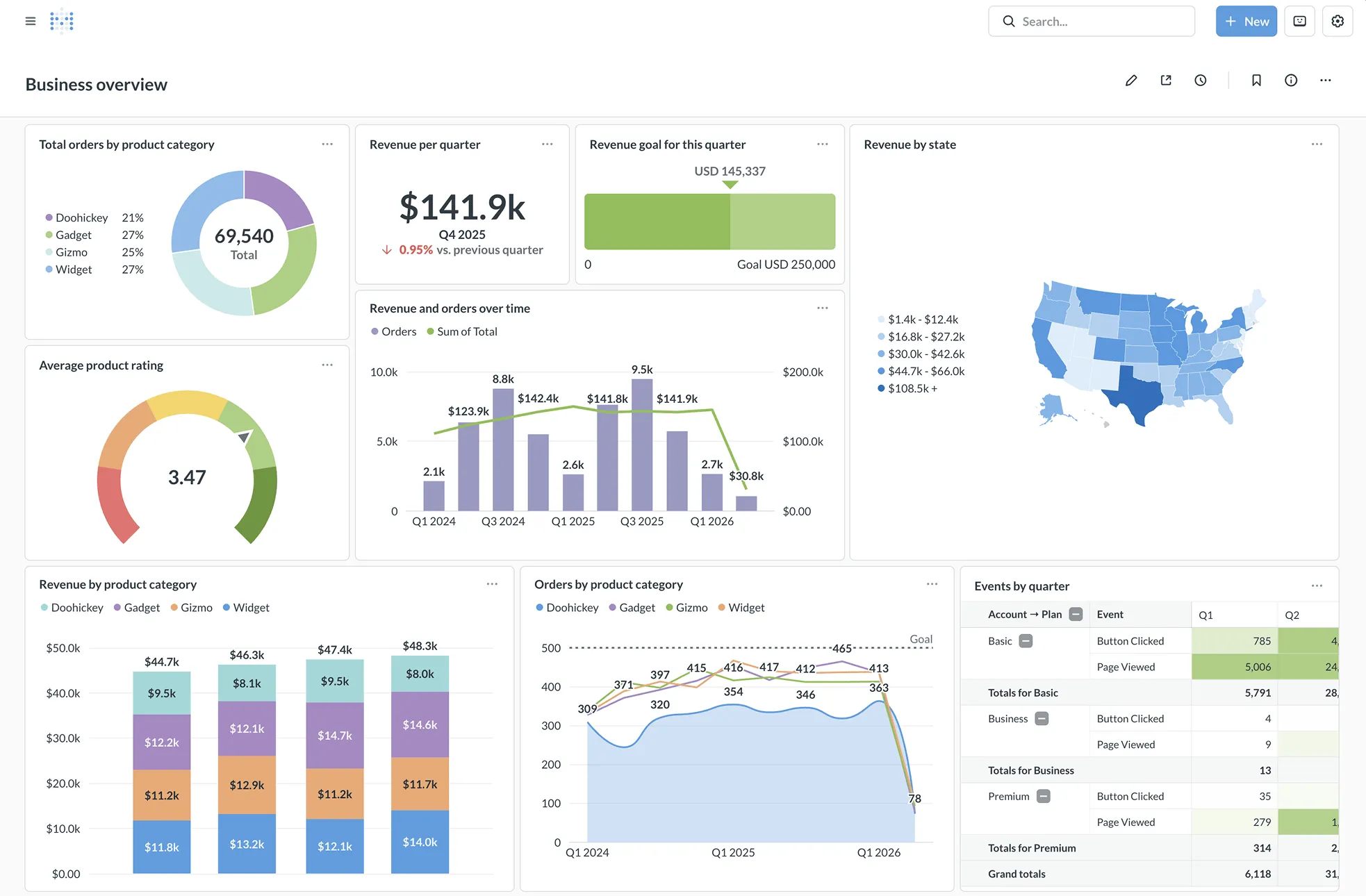
Feature Comparison
| Feature | Holistics | Metabase |
|---|---|---|
| Semantic Modeling and Metric Governance | ||
| Central business logic | Defines SQL business logic once and propagates changes across related reports. | Uses models, metrics, and verified items to standardize recurring questions. |
| Trusted reporting | Reuses centrally defined metrics to keep equivalent report values consistent. | Marks dashboards, models, metrics, and questions as official verified content. |
| Data preparation | Combines data modeling and transformation capabilities within the BI platform. | Provides querying, models, and caching; transformation functionality is not specified. |
| Self-Service Analysis | ||
| No-code exploration | Business users explore curated datasets and build reports without SQL. | Visual query builder creates questions and reports without writing SQL. |
| Advanced SQL | Data teams define reusable business metrics using SQL. | SQL editor supports raw queries, logic adjustments, and complex joins. |
| Dashboard interaction | Supports filtering, drill-down analysis, and comparisons across time periods. | Provides interactive dashboards and self-serve reporting for embedded product users. |
| Embedding and Distribution | ||
| Embedded analytics | Embedded analytics capabilities are not specified in the provided information. | Embeds dashboards and visualizations through iframes or a React SDK. |
| White-label customization | White-labeling capabilities are not specified in the provided information. | Supports white-labeling, dynamic styling, and configurable interactive controls. |
| Scheduled delivery | Sharing reports is described, but scheduled delivery is not specified. | Schedules reports to Slack or email and triggers real-time alerts. |
| Security and Administration | ||
| Fine-grained access control | Controls report, row-level, and column-level data sharing permissions. | Uses granular permissions and multi-tenant data segregation controls. |
| Identity integration | Identity-provider integrations are not specified in the provided information. | Integrates SAML, LDAP, JWT, and Google SSO with group mapping. |
| Usage governance | Centralized definitions reduce ad-hoc data-team report-change requests. | Tracks content usage, data access, user behavior, and downloads. |
| Deployment and Operations | ||
| Deployment options | Deployment options are not specified in the provided information. | Offers self-hosted and cloud deployment across paid plan options. |
| Data connectivity | Connectors and supported source count are not specified in provided data. | Connects to 20+ production databases and data warehouse sources. |
| Performance and release workflows | Operational caching and staging capabilities are not specified in provided data. | Uses result and model caching plus staging and configuration exports. |
Semantic Modeling and Metric Governance
Central business logic
Trusted reporting
Data preparation
Self-Service Analysis
No-code exploration
Advanced SQL
Dashboard interaction
Embedding and Distribution
Embedded analytics
White-label customization
Scheduled delivery
Security and Administration
Fine-grained access control
Identity integration
Usage governance
Deployment and Operations
Deployment options
Data connectivity
Performance and release workflows
Which to choose
Choose Holistics when a data team needs a semantic-layer-centered workflow: define SQL business logic once, curate datasets, and let business users build governed reports. Choose Metabase when open-source deployment, visual querying plus native SQL, broad connectivity, and embedded analytics are primary requirements; it also starts at a substantially lower published monthly price.
Best-fit scenarios
Choose Holistics if:
Choose Holistics for organizations willing to start at $1,200/month and prioritizing centrally managed SQL metrics, data transformations, row and column controls, and self-service reporting from curated datasets.
Choose Metabase if:
Choose Metabase for small product or data teams that need self-hosting or cloud deployment, a no-code query builder with SQL fallback, embedded dashboards, alerts, and connections to 20+ sources.
These scenarios reflect the available product evidence. Your requirements, existing stack, and team expertise should guide the final decision.
Frequently Asked Questions
What is the main difference between Holistics and Metabase?
Holistics is positioned around a data-team-managed semantic layer: teams define SQL business logic once, curate datasets, and distribute trusted self-service reporting to non-technical users. Metabase is an open-source BI and embedded analytics platform that emphasizes visual querying, native SQL, self-hosted or cloud deployment, and product embedding through iframes or a React SDK. Both support self-service analytics, but their provided feature sets emphasize different operating models.
Which is better for small teams?
Metabase is typically the more practical fit for a small team based on the published information. It offers an open-source self-hosted option, a Starter plan at $100/month, a visual query builder, native SQL, and 20+ data-source connections. Holistics starts at $1,200/month for its Entry plan and is better aligned with teams that already need centrally governed semantic modeling, reusable SQL logic, transformations, and detailed report-level access controls.
Can I migrate from Holistics to Metabase?
You can migrate reporting workloads, but it should be treated as a redesign rather than a direct one-to-one transfer. Recreate Holistics datasets, SQL-defined business logic, dashboards, access rules, and report interactions in Metabase using its models, metrics, collections, permissions, visual query builder, or SQL editor. Validate every key metric against the original reports, particularly where Holistics uses centrally defined logic, timezone handling, row-level controls, and built-in time-period comparisons.
What are the pricing differences?
Holistics publishes an Entry plan at $1,200/month and a Standard plan at $2,400/month, with free-trial, usage-based, and contact-sales signals. Metabase provides an open-source self-hosting option and publishes Starter at $100/month, Pro at $575/month, and Enterprise custom from $20,000/year; its pricing signals include per-seat, usage-based, enterprise, contact-sales, and free-trial options. The supplied data does not state the billing unit or qualification details for Metabase Enterprise's $20,000/year minimum, so confirm that directly with Metabase.