Decision comparison
Looker vs Metabase
Looker excels as an enterprise-grade semantic modeling platform for large organizations with dedicated data teams, while Metabase offers accessible, cost-effective analytics that startups and mid-size companies can deploy in minutes with minimal technical overhead.
Direct comparison. These are reviewed substitutes bought for the same job, so the differences below are the ones that decide between them.
All 2 are BI platforms.
Quick Comparison
| Decision factor | Looker | Metabase |
|---|---|---|
| Best For | Enterprise teams needing governed semantic layers and centralized metric definitions across large organizations | Startups and mid-size teams wanting fast, accessible analytics with minimal technical overhead required |
| Pricing | Looker (Google Cloud core) publishes no platform or per-user price. It offers three platform editions — Standard for organisations under 50 users, Enterprise, and Embed — each including one production instance, 10 Standard Users and 2 Developer Users, and each requiring a custom quote. Data-token overages beyond an instance's monthly allocation are published, at $3.00 per 1M input tokens and $20.00 per 1M output tokens. | Community Edition is free, open-source and self-hosted, with unlimited users. Paid Metabase Cloud plans start with Starter at $100/month, or $90/month billed annually, including the first 5 users, then $6 per user/month. Pro is $575/month, or $517.50/month annually, including the first 10 users, then $12 per user/month. Enterprise is custom pricing starting at $20,000/year. Both paid plans offer a 14 days free trial. |
| Ease of Use | Steeper learning curve requiring LookML expertise; powerful once mastered but not beginner-friendly for analysts | Intuitive no-code query builder designed for non-technical users; rated highly for simple UI experience |
| Data Modeling | LookML semantic modeling with Git version control; reusable metric definitions and governed data layer | Automatic data model discovery with Data Studio for curating semantic layers; less rigid than LookML |
| Deployment Options | Google Cloud hosted SaaS only; deep integration with BigQuery and Google Cloud Platform ecosystem | Self-hosted open source, cloud-hosted, or air-gapped deployments; Docker setup in minutes available |
| Embedded Analytics | Enterprise-grade embedding with white-labeling, robust APIs, SDKs, and extensive customization options | Production-grade embedding via iframes or React SDK; white-labeling and dynamic styling for SaaS apps |
Looker
- Best For:
- Enterprise teams needing governed semantic layers and centralized metric definitions across large organizations
- Pricing:
- Looker (Google Cloud core) publishes no platform or per-user price. It offers three platform editions — Standard for organisations under 50 users, Enterprise, and Embed — each including one production instance, 10 Standard Users and 2 Developer Users, and each requiring a custom quote. Data-token overages beyond an instance's monthly allocation are published, at $3.00 per 1M input tokens and $20.00 per 1M output tokens.
- Ease of Use:
- Steeper learning curve requiring LookML expertise; powerful once mastered but not beginner-friendly for analysts
- Data Modeling:
- LookML semantic modeling with Git version control; reusable metric definitions and governed data layer
- Deployment Options:
- Google Cloud hosted SaaS only; deep integration with BigQuery and Google Cloud Platform ecosystem
- Embedded Analytics:
- Enterprise-grade embedding with white-labeling, robust APIs, SDKs, and extensive customization options
Metabase
- Best For:
- Startups and mid-size teams wanting fast, accessible analytics with minimal technical overhead required
- Pricing:
- Community Edition is free, open-source and self-hosted, with unlimited users. Paid Metabase Cloud plans start with Starter at $100/month, or $90/month billed annually, including the first 5 users, then $6 per user/month. Pro is $575/month, or $517.50/month annually, including the first 10 users, then $12 per user/month. Enterprise is custom pricing starting at $20,000/year. Both paid plans offer a 14 days free trial.
- Ease of Use:
- Intuitive no-code query builder designed for non-technical users; rated highly for simple UI experience
- Data Modeling:
- Automatic data model discovery with Data Studio for curating semantic layers; less rigid than LookML
- Deployment Options:
- Self-hosted open source, cloud-hosted, or air-gapped deployments; Docker setup in minutes available
- Embedded Analytics:
- Production-grade embedding via iframes or React SDK; white-labeling and dynamic styling for SaaS apps
Public signals
Verified factual signals only. Bars appear only for like-for-like metrics with five weekly assessments for every tool; missing evidence stays explicit. These signals do not establish enterprise adoption, product quality, or total cost.
| Metric | Looker | Metabase |
|---|---|---|
| Search interest(Market interest) | 2 | Not available |
| Hacker News mentions, 90d(Community interest) | 2 | 12 |
| npm weekly downloads(Developer adoption) | 104.6k | 36.8k |
| Product Hunt comments(Community interest) | 5 | 30 |
| Product Hunt rating(Community interest) | Unavailable | 4.9/5 |
| Product Hunt reviews(Community interest) | 0 | 24 |
| Product Hunt votes(Community interest) | 83 | 310 |
| PyPI weekly downloads(Developer adoption) | 2.0M | Not available |
| Stack Overflow questions(Community interest) | 226 | 374 |
| Docker Hub pulls(Product adoption) | Not available | 272.7M |
| GitHub commits, 90d(Product adoption) | Not available | 2.0k |
| GitHub stars(Product adoption) | Not available | 49,000+ |
As of September 21, 2026 — updated weekly.
Health & risk evidence
Observed public-source checks for mapped package versions and repositories.
Looker
September 21, 2026Package vulnerabilities
npm · @looker/sdk@26.12.0 · PyPI · looker-sdk@26.12.0
0 vulnerabilities
across 2 packages
Repository security score
Not available
Metabase
September 21, 2026Package vulnerabilities
npm · @metabase/embedding-sdk-react@0.63.1
0 vulnerabilities
across 1 package
Repository security score
github.com/metabase/metabase
7.1/10
Interface Preview
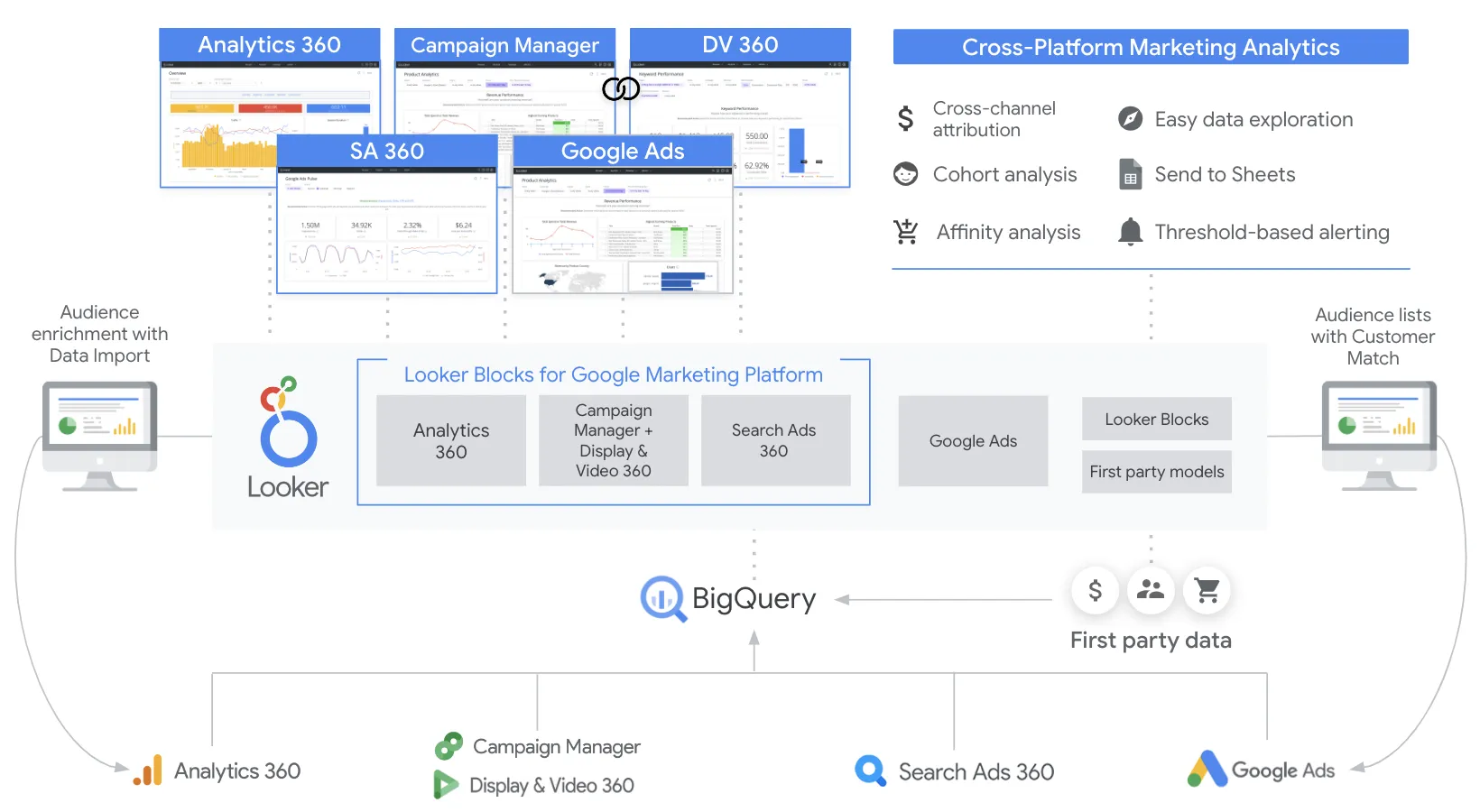
Looker
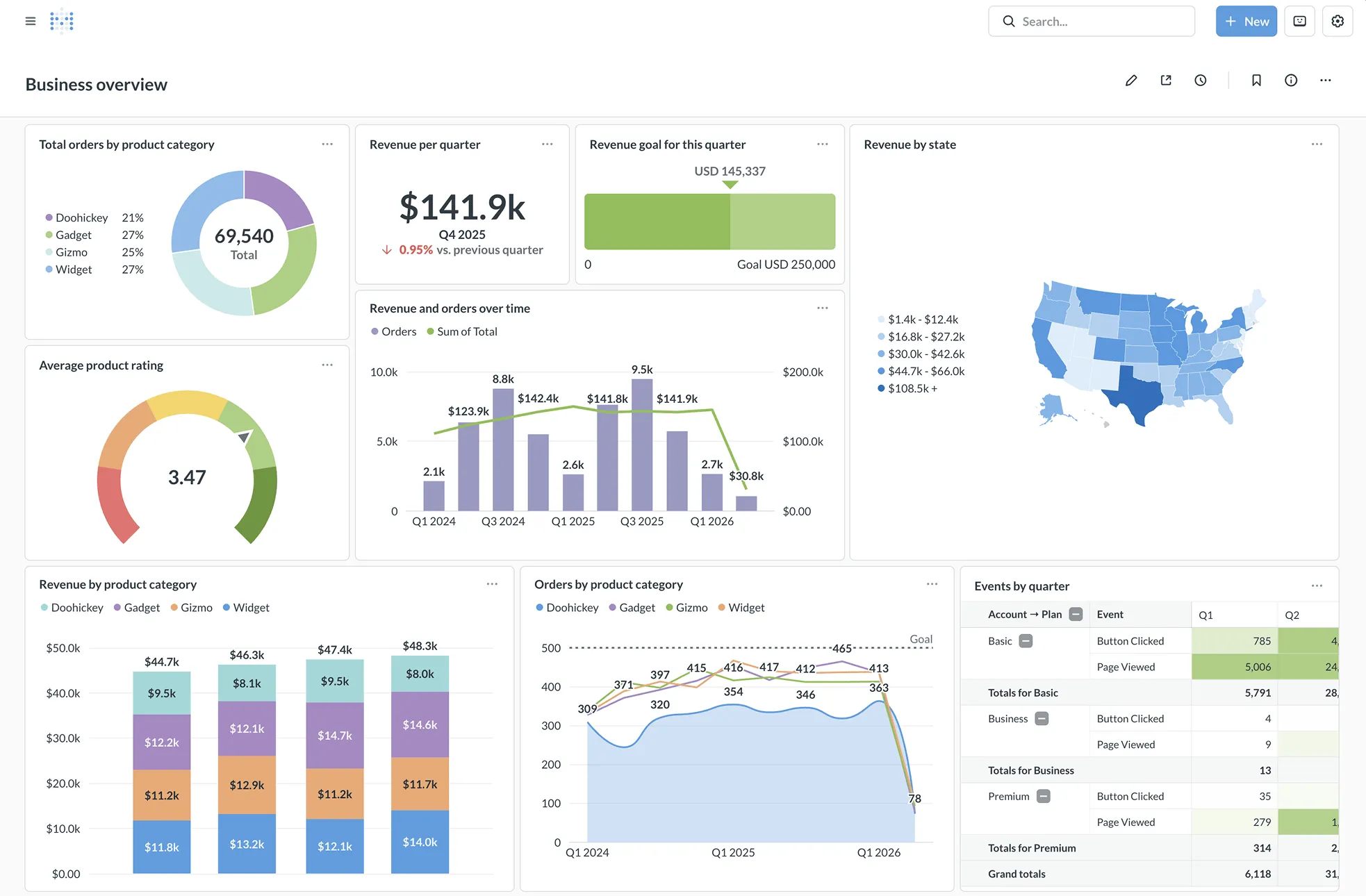
Metabase
Feature Comparison
| Feature | Looker | Metabase |
|---|---|---|
| Data Querying | ||
| Visual Query Builder | Explore interface built on governed LookML models with drill-down capabilities | Intuitive no-code query builder designed for non-technical users with drag-and-drop |
| SQL Editor | SQL Runner for ad hoc queries alongside LookML-governed Explores | Full native SQL editor with variable support and autocomplete |
| AI-Powered Querying | Conversational Analytics powered by Gemini for natural language data questions | Metabot AI for natural language SQL generation and chat-based data queries |
| Data Modeling | ||
| Semantic Layer | LookML provides a full semantic modeling language with reusable metrics and joins | Data Studio offers curated semantic layer with measures, segments, and SQL transforms |
| Version Control | Native Git integration for LookML models with branching and pull request workflows | Export and deploy configurations across staging and production environments |
| Data Caching | Direct query against warehouse with configurable caching policies per Explore | Built-in result and model caching with granular duration controls |
| Visualization & Dashboards | ||
| Dashboard Creation | Enterprise dashboards with real-time data, drill-downs, and Looker Studio for ad hoc reports | Unlimited dashboards and charts with cross-filtering and interactive drill-through menus |
| Alerts & Scheduling | Scheduled deliveries and alerts with configurable triggers and distribution lists | Scheduled delivery via email and Slack with real-time alert triggers for key metrics |
| Security & Governance | ||
| Access Control | Row-level and column-level security with enterprise audit features and SSO integration | Role-based permissions with row and column-level restrictions and SSO via SAML, LDAP, JWT |
| Multi-Tenant Support | Granular access controls configurable per user group with content management policies | Native one-database-per-tenant support and granular data segregation features |
| Compliance | Google Cloud security framework with enterprise-grade encryption and private networking | SOC1, SOC2, GDPR, CCPA compliant with encryption and role-based access control |
| Integration & Deployment | ||
| Data Sources | Connects to major cloud warehouses including BigQuery, Snowflake, Redshift, and Databricks | 20+ database connectors including PostgreSQL, MySQL, BigQuery, Snowflake, and MongoDB |
| API & Extensibility | Comprehensive REST APIs, SDKs, Looker Marketplace with Blocks and custom extensions | REST API with embedding SDK, React components, and open source extensibility |
| Embedded Analytics | Full white-label embedding with API-first architecture for custom data applications | Iframe and React SDK embedding with white-labeling, dynamic styling, and interactive controls |
Data Querying
Visual Query Builder
SQL Editor
AI-Powered Querying
Data Modeling
Semantic Layer
Version Control
Data Caching
Visualization & Dashboards
Dashboard Creation
Alerts & Scheduling
Security & Governance
Access Control
Multi-Tenant Support
Compliance
Integration & Deployment
Data Sources
API & Extensibility
Embedded Analytics
Which to choose
Looker excels as an enterprise-grade semantic modeling platform for large organizations with dedicated data teams, while Metabase offers accessible, cost-effective analytics that startups and mid-size companies can deploy in minutes with minimal technical overhead.
Best-fit scenarios
Choose Looker if:
Choose Looker if your organization has a dedicated data team that can invest in building and maintaining LookML models, you need a governed semantic layer that ensures consistent metrics across all departments, and you are already embedded in the Google Cloud ecosystem. Looker is ideal for enterprises requiring embedded analytics at scale, API-first architecture for custom data applications, and robust governance features including row-level security and audit logging. The platform excels when data consistency and centralized business logic are top priorities.
Choose Metabase if:
Choose Metabase if you need fast time-to-value with a tool your entire team can use without extensive training, you want the flexibility of self-hosting with an open-source option, or you are a startup watching your analytics budget. With 47,000+ GitHub stars and active community development, Metabase provides production-grade embedded analytics, a no-code query builder, and plans starting at $100 per month for cloud-hosted Starter. It is especially strong for teams that want to democratize data access without requiring SQL expertise from every user.
These scenarios reflect the available product evidence. Your requirements, existing stack, and team expertise should guide the final decision.
Frequently Asked Questions
Is Metabase really free to use?
Yes, Metabase offers a fully functional open-source edition that you can self-host at no cost using Docker or a JAR file. The open-source version includes the visual query builder, SQL editor, dashboards, charts, and connections to 20+ data sources. Paid plans start at $100 per month for the Starter cloud-hosted tier, which adds features like Slack delivery and Metabot AI. The Pro plan at $575 per month adds self-hosted options and advanced features, while Enterprise custom from $20,000/year per user per month includes priority support and advanced permissions.
How does Looker's LookML compare to traditional BI query tools?
LookML is a proprietary modeling language that defines data relationships, metrics, and business logic in version-controlled code rather than point-and-click interfaces. Unlike traditional BI tools where each analyst writes their own SQL, LookML centralizes definitions so every dashboard and report uses the same governed metrics. This eliminates discrepancies where different teams calculate revenue or churn differently. The trade-off is a steeper learning curve and the need for data engineers or analysts comfortable with code-based modeling, but it pays dividends at scale with consistent, reusable, and auditable data definitions.
Can Metabase handle enterprise-scale deployments?
Metabase is designed to scale from startup to enterprise. The Enterprise plan includes advanced features like native multi-tenant data segregation, database-managed row-level permissions, priority support, and SSO integration with SAML, LDAP, and JWT providers. Companies like Cal.com and Pathrise use Metabase in production. With over 90,000 companies trusting Metabase, the platform supports staging environments, config exports for multi-instance deployments, and usage analytics for tracking dashboard adoption. However, it lacks the depth of governed semantic modeling that Looker provides through LookML.
Which tool is better for embedded analytics in a SaaS product?
Both tools offer strong embedded analytics, but they serve different needs. Looker provides an API-first architecture with comprehensive SDKs, making it ideal for building deeply customized data applications and monetizing data products. Its white-labeling and Vertex AI integration enable advanced custom workflows. Metabase offers a simpler path with iframe embedding for speed and a React SDK for more control, plus white-labeling and dynamic styling. Metabase is typically faster to implement and more cost-effective for startups, while Looker offers more depth and governance for enterprise ISVs embedding analytics into their platforms.
How do Looker and Metabase compare on community and ecosystem support?
Metabase has a thriving open-source community with over 48,000 GitHub stars, active community forums, and regular releases including the recent v0.60.2. Its open-source nature means you can inspect the code, contribute features, and benefit from community-built integrations. Looker, as part of Google Cloud, benefits from enterprise-grade support, a curated Marketplace with Blocks and pre-built data models, certified partner integrations with services like Segment and Slack, and Google Cloud training paths. Looker has 457 reviews while Metabase has 66 reviews on major platforms, both maintaining an 8.4 out of 10 rating.