Decision comparison
Looker vs Sigma Computing
Looker excels as a governed semantic modeling platform for enterprise data teams that want centralized business logic via LookML, while Sigma Computing empowers business users with a familiar spreadsheet interface on live warehouse data. The right choice depends on whether your priority is developer-controlled data governance or broad self-service adoption by non-technical users.
Direct comparison. These are reviewed substitutes bought for the same job, so the differences below are the ones that decide between them.
All 2 are BI platforms.
Quick Comparison
| Decision factor | Looker | Sigma Computing |
|---|---|---|
| Best For | Enterprise teams needing governed semantic modeling with LookML and embedded analytics | Business users who want spreadsheet-style analytics on live warehouse data |
| Architecture | API-first platform with LookML semantic layer querying warehouses directly | Warehouse-native with spreadsheet UI that compiles actions into optimized SQL |
| Pricing Model | Looker (Google Cloud core) publishes no platform or per-user price. It offers three platform editions — Standard for organisations under 50 users, Enterprise, and Embed — each including one production instance, 10 Standard Users and 2 Developer Users, and each requiring a custom quote. Data-token overages beyond an instance's monthly allocation are published, at $3.00 per 1M input tokens and $20.00 per 1M output tokens. | Free tier (5 users), Pro $25/mo, Enterprise custom |
| Ease of Use | Powerful but steeper learning curve; requires LookML knowledge for modeling | Familiar spreadsheet interface accessible to non-technical users without SQL |
| Scalability | Enterprise-grade on Google Cloud with robust API coverage and embedding | Cloud-native with zero-copy query model and hybrid execution engine |
| Community/Support | Rated 8.4/10 across 457 reviews; Google Cloud support and documentation | Rated 8.2/10 across 297 reviews; recognized by Gartner and Forrester |
Looker
- Best For:
- Enterprise teams needing governed semantic modeling with LookML and embedded analytics
- Architecture:
- API-first platform with LookML semantic layer querying warehouses directly
- Pricing Model:
- Looker (Google Cloud core) publishes no platform or per-user price. It offers three platform editions — Standard for organisations under 50 users, Enterprise, and Embed — each including one production instance, 10 Standard Users and 2 Developer Users, and each requiring a custom quote. Data-token overages beyond an instance's monthly allocation are published, at $3.00 per 1M input tokens and $20.00 per 1M output tokens.
- Ease of Use:
- Powerful but steeper learning curve; requires LookML knowledge for modeling
- Scalability:
- Enterprise-grade on Google Cloud with robust API coverage and embedding
- Community/Support:
- Rated 8.4/10 across 457 reviews; Google Cloud support and documentation
Sigma Computing
- Best For:
- Business users who want spreadsheet-style analytics on live warehouse data
- Architecture:
- Warehouse-native with spreadsheet UI that compiles actions into optimized SQL
- Pricing Model:
- Free tier (5 users), Pro $25/mo, Enterprise custom
- Ease of Use:
- Familiar spreadsheet interface accessible to non-technical users without SQL
- Scalability:
- Cloud-native with zero-copy query model and hybrid execution engine
- Community/Support:
- Rated 8.2/10 across 297 reviews; recognized by Gartner and Forrester
Public signals
Verified factual signals only. Bars appear only for like-for-like metrics with five weekly assessments for every tool; missing evidence stays explicit. These signals do not establish enterprise adoption, product quality, or total cost.
| Metric | Looker | Sigma Computing |
|---|---|---|
| Search interest(Market interest) | 2 | 1 |
| Hacker News mentions, 90d(Community interest) | 2 | 0 |
| npm weekly downloads(Developer adoption) | 104.6k | 16.1k |
| Product Hunt comments(Community interest) | 5 | 1 |
| Product Hunt reviews(Community interest) | 0 | 0 |
| Product Hunt votes(Community interest) | 83 | 6 |
| PyPI weekly downloads(Developer adoption) | 2.0M | Not available |
| Stack Overflow questions(Community interest) | 226 | Not available |
| GitHub commits, 90d(Developer adoption) | Not available | 0 |
| GitHub stars(Developer adoption) | Not available | 6 |
As of September 21, 2026 — updated weekly.
Health & risk evidence
Observed public-source checks for mapped package versions and repositories.
Looker
September 21, 2026Package vulnerabilities
npm · @looker/sdk@26.12.0 · PyPI · looker-sdk@26.12.0
0 vulnerabilities
across 2 packages
Repository security score
Not available
Sigma Computing
September 21, 2026Package vulnerabilities
npm · @sigmacomputing/embed-sdk@0.7.1
0 vulnerabilities
across 1 package
Repository security score
Not available
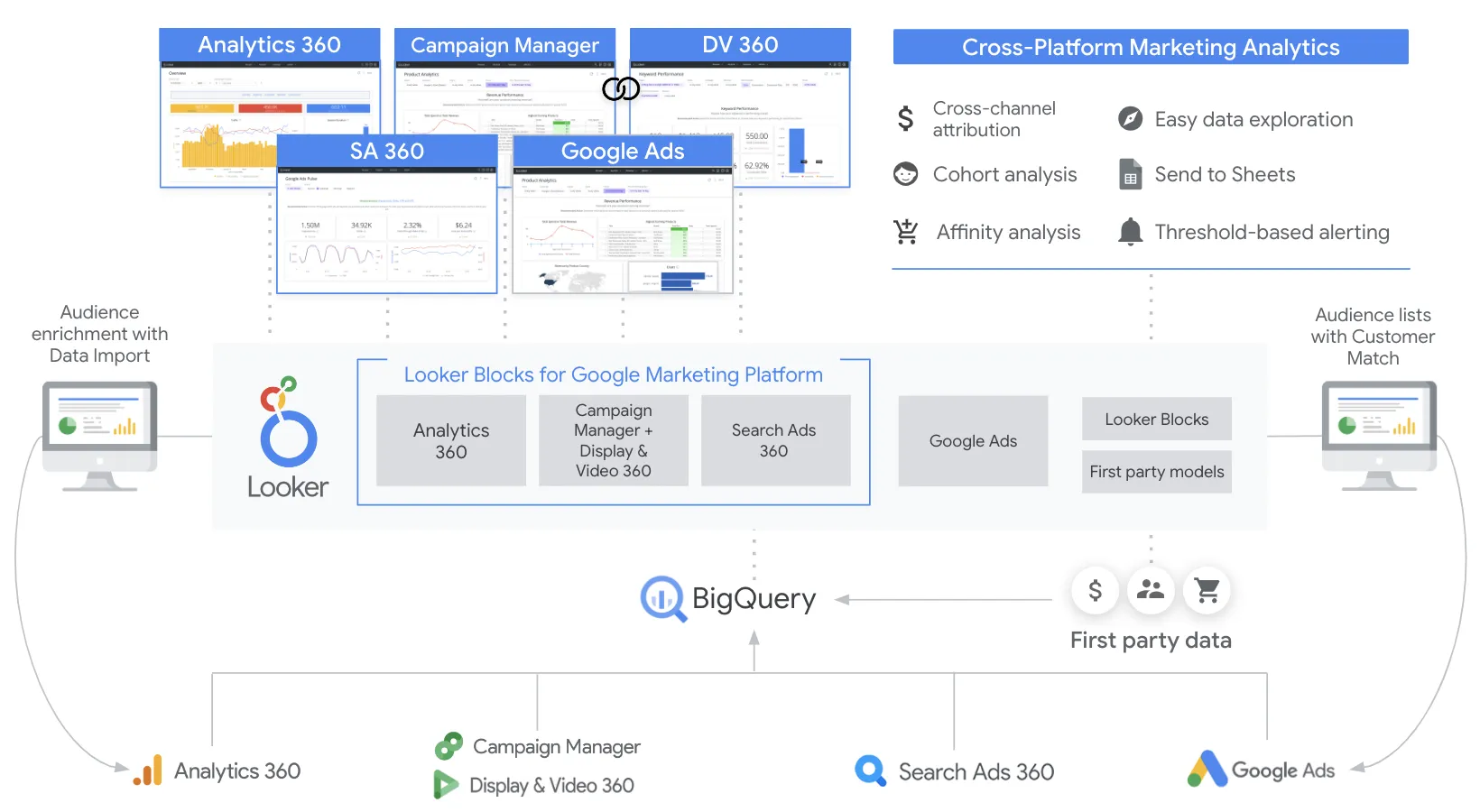
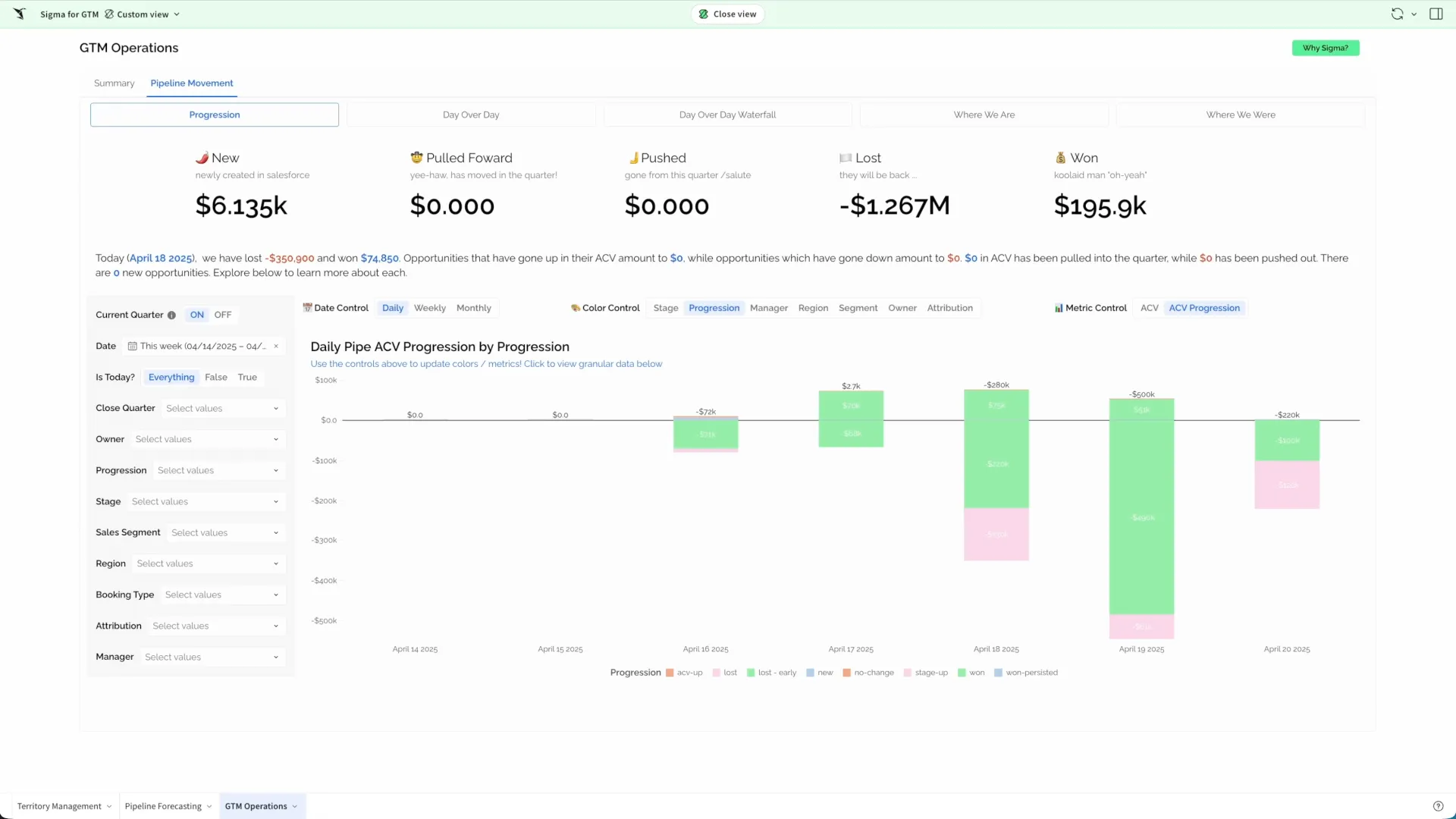
Interface Preview
Looker
Sigma Computing
Feature Comparison
| Feature | Looker | Sigma Computing |
|---|---|---|
| Data Modeling & Governance | ||
| Semantic Layer | LookML defines reusable metrics, joins, and derived tables | Data models with reusable tables, relationships, and metrics |
| Version Control | Git-integrated version-controlled LookML models | Workbook versioning with audit logs for changes |
| Row-Level Security | Row-level and column-level security with audit features | Warehouse-boundary governance with OAuth and role mapping |
| Data Access Control | Enterprise governance with permissions defined in LookML | Warehouse roles enforced at query time with audit logs |
| Data Exploration & Visualization | ||
| Self-Service Analytics | Explores and dashboards for governed self-service exploration | Spreadsheet UI with filters, pivots, and formulas on live data |
| Dashboard Creation | Real-time enterprise dashboards with drill-down capability | Interactive dashboards with natural language query support |
| Visualization Options | Built-in charts plus marketplace custom visualizations | Charts, graphs, and pixel-perfect paginated reports |
| AI-Powered Analytics | Conversational Analytics powered by Gemini for natural language | AI Builder with Explain Viz and Formula Assistant features |
| Integration & Connectivity | ||
| Warehouse Support | BigQuery, Redshift, Snowflake, Vertica, and more | Snowflake, Databricks, BigQuery, and Redshift supported |
| API & Extensibility | REST APIs, SDKs, and Looker Marketplace for extensions | React SDK, API access, and partner integrations available |
| Embedded Analytics | Robust white-label embedding with full API coverage | White-label embedded analytics with SSO and React SDK |
| Third-Party Integrations | Slack, Google Analytics, Segment, and Google Workspace | dbt Semantic Layer, catalog, monitoring, and reverse ETL tools |
| Query & Performance | ||
| Query Architecture | Direct query against warehouses with no data storage layer | Zero-copy model with hybrid browser-cache-warehouse execution |
| Caching Strategy | Warehouse-level caching with always-fresh query results | Multi-tier caching from browser to query ID to warehouse cache |
| Data Writeback | Read-only analytics platform without native writeback | Input Tables allow writeback to warehouse via INSERT/UPDATE/DELETE |
| Security & Compliance | ||
| Cloud Security | Google Cloud IAM SSO with private networking support | PrivateLink and Private Service Connect across AWS/Azure/GCP |
| Authentication | SSO via Google Cloud IAM with enterprise controls | OAuth with write access plus service account authentication |
| Compliance | Enterprise audit features within Google Cloud ecosystem | SOC 2 Type II, ISO 27001, GDPR/CCPA via Trust Center |
Data Modeling & Governance
Semantic Layer
Version Control
Row-Level Security
Data Access Control
Data Exploration & Visualization
Self-Service Analytics
Dashboard Creation
Visualization Options
AI-Powered Analytics
Integration & Connectivity
Warehouse Support
API & Extensibility
Embedded Analytics
Third-Party Integrations
Query & Performance
Query Architecture
Caching Strategy
Data Writeback
Security & Compliance
Cloud Security
Authentication
Compliance
Which to choose
Looker excels as a governed semantic modeling platform for enterprise data teams that want centralized business logic via LookML, while Sigma Computing empowers business users with a familiar spreadsheet interface on live warehouse data. The right choice depends on whether your priority is developer-controlled data governance or broad self-service adoption by non-technical users.
Best-fit scenarios
Choose Looker if:
You need a robust semantic modeling layer with LookML to centralize business logic and metrics across the organization
Choose Sigma Computing if:
Your business users need to explore and analyze warehouse data using a familiar spreadsheet interface without SQL knowledge
These scenarios reflect the available product evidence. Your requirements, existing stack, and team expertise should guide the final decision.
Frequently Asked Questions
What is the main difference between Looker and Sigma Computing?
Looker excels as a governed semantic modeling platform for enterprise data teams that want centralized business logic via LookML, while Sigma Computing empowers business users with a familiar spreadsheet interface on live warehouse data. The right choice depends on whether your priority is developer-controlled data governance or broad self-service adoption by non-technical users.
When should I choose Looker?
Choose Looker when you need a robust semantic modeling layer with LookML to centralize business logic and metrics across the organization, or when your team requires deep embedded analytics with full API coverage for SaaS products.
When should I choose Sigma Computing?
Choose Sigma Computing when your business users need to explore and analyze warehouse data using a familiar spreadsheet interface without SQL knowledge, or when you require data writeback with Input Tables for operational workflows like planning and forecasting.
How do Looker and Sigma Computing compare on pricing?
Looker: Annual commitment with custom enterprise pricing; contact sales required. Sigma Computing: Essentials from $300/mo; Professional and Enterprise tiers are custom-priced.
Do you need SQL knowledge to use Looker or Sigma Computing?
Sigma Computing is built for people who do not write SQL: its spreadsheet interface exposes filters, pivots and formulas over live warehouse data, so a business analyst can explore without writing a query. Looker separates the two roles — a modeler writes LookML to define metrics, joins and derived tables, and everyone else consumes governed Explores and dashboards built on that model. Sigma lowers the barrier for the consumer; Looker moves the SQL work upstream to a smaller, version-controlled team.