Decision comparison
Looker vs Apache Superset
Looker and Apache Superset both serve the business intelligence space but target different organizational needs and budgets. Looker is a fully managed enterprise platform built around LookML, a semantic modeling language that centralizes business logic and ensures every dashboard and API consumer sees consistent, governed metrics. It excels at embedded analytics, AI-powered conversational queries via Gemini, and deep Google Cloud integration. Apache Superset is a free, open-source alternative that delivers a rich visualization library with 40+ chart types, a powerful SQL Lab IDE, and the flexibility to connect to virtually any SQL database. Superset gives data teams full control over their BI stack at zero licensing cost, though it requires self-hosting and lacks native AI features and enterprise-grade embedding. The choice comes down to whether you need managed governance and embedded analytics or prefer an open, SQL-first platform you fully own.
Direct comparison. These are reviewed substitutes bought for the same job, so the differences below are the ones that decide between them.
All 2 are BI platforms.
Quick Comparison
| Decision factor | Looker | Apache Superset |
|---|---|---|
| Pricing Model | Looker (Google Cloud core) publishes no platform or per-user price. It offers three platform editions — Standard for organisations under 50 users, Enterprise, and Embed — each including one production instance, 10 Standard Users and 2 Developer Users, and each requiring a custom quote. Data-token overages beyond an instance's monthly allocation are published, at $3.00 per 1M input tokens and $20.00 per 1M output tokens. | Free and open-source under Apache License 2.0 |
| Semantic Layer | LookML provides a full semantic modeling language with version-controlled Git integration for reusable metrics, joins, and derived tables | Semantic layer with metrics and dimensions defined through the UI; virtual datasets for ad-hoc transformations |
| Visualization Library | Enterprise dashboards with real-time data, drill-down capabilities, and Looker Studio for ad hoc drag-and-drop reporting | 40+ pre-installed chart types with a plug-in architecture for building custom visualizations |
| Deployment Model | Fully managed SaaS on Google Cloud Platform with SSO, private networking, and unified Google Cloud IAM | Self-hosted; requires your own infrastructure for installation, configuration, and maintenance |
| SQL Exploration | Explores let business users query governed models without writing raw SQL; analysts can access underlying SQL when needed | SQL Lab IDE for writing and executing queries directly against connected databases with Jinja templating support |
| Best For | Enterprises requiring centralized data governance, embedded analytics in SaaS products, and tight Google Cloud integration | Data teams that want full control over their BI stack, strong SQL-first workflows, and zero licensing cost |
Looker
- Pricing Model:
- Looker (Google Cloud core) publishes no platform or per-user price. It offers three platform editions — Standard for organisations under 50 users, Enterprise, and Embed — each including one production instance, 10 Standard Users and 2 Developer Users, and each requiring a custom quote. Data-token overages beyond an instance's monthly allocation are published, at $3.00 per 1M input tokens and $20.00 per 1M output tokens.
- Semantic Layer:
- LookML provides a full semantic modeling language with version-controlled Git integration for reusable metrics, joins, and derived tables
- Visualization Library:
- Enterprise dashboards with real-time data, drill-down capabilities, and Looker Studio for ad hoc drag-and-drop reporting
- Deployment Model:
- Fully managed SaaS on Google Cloud Platform with SSO, private networking, and unified Google Cloud IAM
- SQL Exploration:
- Explores let business users query governed models without writing raw SQL; analysts can access underlying SQL when needed
- Best For:
- Enterprises requiring centralized data governance, embedded analytics in SaaS products, and tight Google Cloud integration
Apache Superset
- Pricing Model:
- Free and open-source under Apache License 2.0
- Semantic Layer:
- Semantic layer with metrics and dimensions defined through the UI; virtual datasets for ad-hoc transformations
- Visualization Library:
- 40+ pre-installed chart types with a plug-in architecture for building custom visualizations
- Deployment Model:
- Self-hosted; requires your own infrastructure for installation, configuration, and maintenance
- SQL Exploration:
- SQL Lab IDE for writing and executing queries directly against connected databases with Jinja templating support
- Best For:
- Data teams that want full control over their BI stack, strong SQL-first workflows, and zero licensing cost
Public signals
Verified factual signals only. Bars appear only for like-for-like metrics with five weekly assessments for every tool; missing evidence stays explicit. These signals do not establish enterprise adoption, product quality, or total cost.
| Metric | Looker | Apache Superset |
|---|---|---|
| Search interest(Market interest) | 2 | 0 |
| Hacker News mentions, 90d(Community interest) | 2 | 0 |
| npm weekly downloads(Developer adoption) | 104.6k | 13.8k |
| Product Hunt comments(Community interest) | 5 | 0 |
| Product Hunt reviews(Community interest) | 0 | 0 |
| Product Hunt votes(Community interest) | 83 | 69 |
| PyPI weekly downloads(Developer adoption) | 2.0M | Not available |
| Stack Overflow questions(Community interest) | 226 | 1.3k |
| Docker Hub pulls(Product adoption) | Not available | 605.5M |
| GitHub commits, 90d(Product adoption) | Not available | 2.3k |
| GitHub stars(Product adoption) | Not available | 74,000+ |
| PyPI weekly downloads(Product adoption) | Not available | 87.1k |
As of September 21, 2026 — updated weekly.
Health & risk evidence
Observed public-source checks for mapped package versions and repositories.
Looker
September 21, 2026Package vulnerabilities
npm · @looker/sdk@26.12.0 · PyPI · looker-sdk@26.12.0
0 vulnerabilities
across 2 packages
Repository security score
Not available
Apache Superset
September 21, 2026Package vulnerabilities
npm · @superset-ui/core@0.20.4 · PyPI · apache-superset@6.1.0
0 vulnerabilities
across 2 packages
Repository security score
github.com/apache/superset
5.4/10
Interface Preview
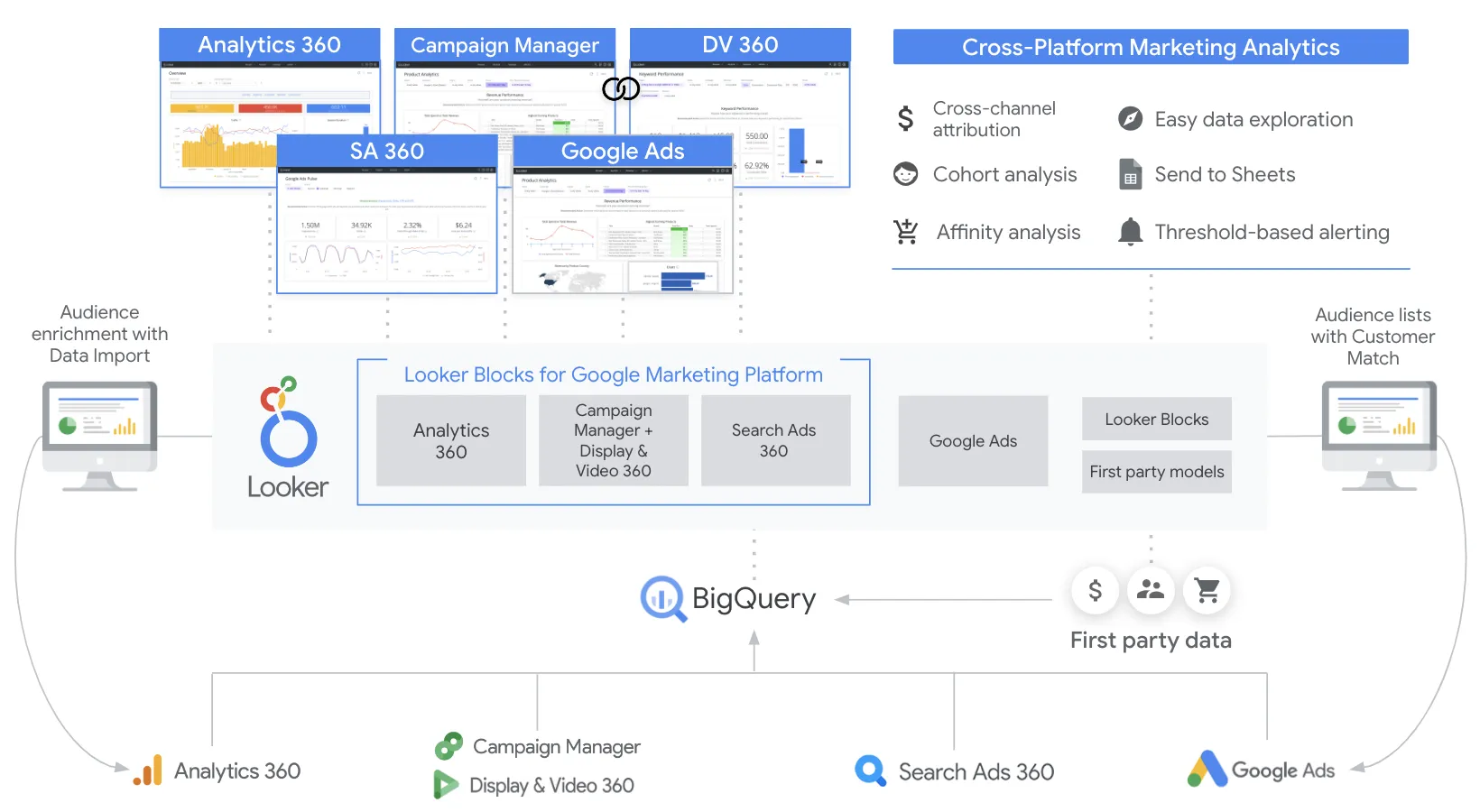
Looker
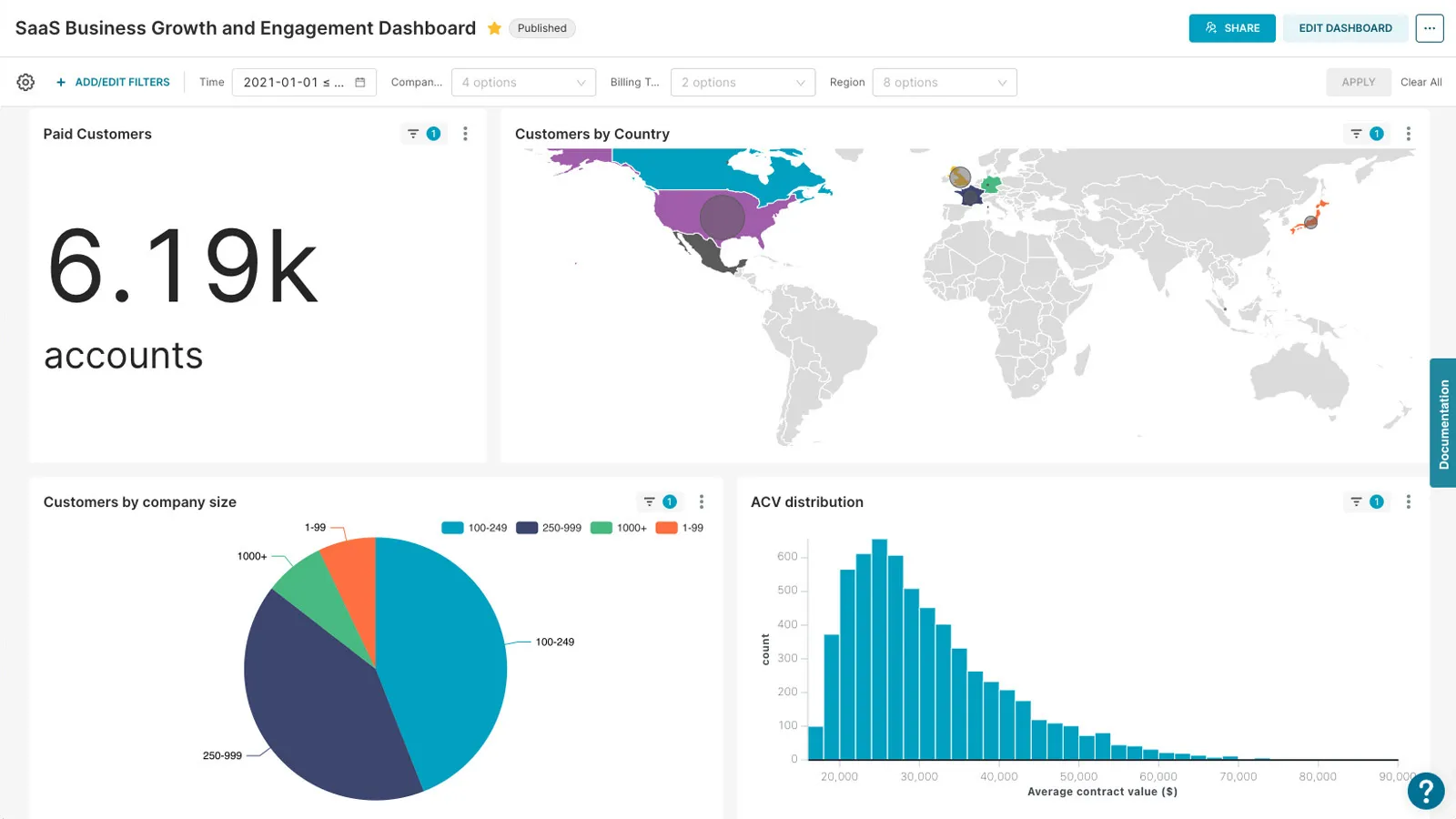
Apache Superset
Feature Comparison
| Feature | Looker | Apache Superset |
|---|---|---|
| Data Modeling & Governance | ||
| Semantic Layer | LookML provides a dedicated modeling language for defining reusable metrics, joins, permissions, and derived tables with Git-based version control | UI-based semantic layer with metrics and dimensions; virtual datasets for SQL-level transformations |
| Row-Level Security | Row-level and column-level security with enterprise audit features built into the platform | Role-based access control with row-level security available through configuration |
| Version Control | Native Git integration for LookML models enables branching, pull requests, and full version history | No built-in version control for dashboards or datasets; relies on external tools or API-based exports |
| Visualization & Dashboards | ||
| Chart Library | Enterprise dashboards with drill-down to row-level detail; Looker Studio adds 1,000+ data connectors and drag-and-drop canvas | 40+ pre-installed visualization types including geospatial charts; plug-in architecture for custom chart development |
| Dashboard Interactivity | Real-time dashboards with explore tiles, filter expansion, and drill-down into governed data models | Cross-filters, drill-to-detail, and drill-by features; CSS templates for brand customization |
| Embedded Analytics | Robust embedding and white-labeling options with REST APIs and SDKs for deep SaaS product integration | Dashboard embedding supported but lacks native multi-tenancy and white-labeling capabilities |
| Data Connectivity & Architecture | ||
| Database Support | Direct query against warehouses including BigQuery, Redshift, Snowflake, and Vertica with no data storage layer | Connects to any SQL-based database at petabyte scale including BigQuery, Redshift, Snowflake, MySQL, PostgreSQL, and more |
| Caching & Performance | Always-fresh results via direct warehouse queries; relies on warehouse-level caching and optimization | Built-in caching layer for faster dashboard and chart load times |
| API & Extensibility | API-first platform with REST APIs, SDKs, and a marketplace of pre-built Blocks, applications, and plug-ins | REST API for programmatic access; open-source codebase allows full modification and custom plug-in development |
| AI & Advanced Analytics | ||
| AI-Powered Features | Conversational Analytics powered by Gemini for natural-language data queries; Vertex AI integration for custom AI workflows | No built-in AI features; extensible through custom integrations and community plug-ins |
| Self-Service Analytics | Explores enable business users to ask questions on governed models without SQL knowledge | No-code chart builder for drag-and-drop exploration alongside the full SQL Lab IDE for power users |
| Collaboration Features | Scheduled reports, Slack integration, alert actions, and shared explores across teams | Dashboard sharing and role-based access; community-driven integrations for notifications |
| Deployment & Operations | ||
| Deployment Options | Fully managed SaaS on Google Cloud with SSO via Cloud IAM, private networking, and unified terms of service | Self-hosted on any infrastructure; Docker and Kubernetes deployment options available |
| Authentication & SSO | Google Cloud IAM SSO with enterprise identity provider integration | Extensible security model supporting OAuth, OpenID, LDAP, and custom authentication providers |
| Community & Ecosystem | Google Cloud ecosystem with Looker Marketplace offering Blocks, applications, and visualization plug-ins | 74,000+ GitHub stars, Apache Foundation governance, active Slack community, and regular releases (latest: 6.0.0) |
Data Modeling & Governance
Semantic Layer
Row-Level Security
Version Control
Visualization & Dashboards
Chart Library
Dashboard Interactivity
Embedded Analytics
Data Connectivity & Architecture
Database Support
Caching & Performance
API & Extensibility
AI & Advanced Analytics
AI-Powered Features
Self-Service Analytics
Collaboration Features
Deployment & Operations
Deployment Options
Authentication & SSO
Community & Ecosystem
Which to choose
Looker and Apache Superset both serve the business intelligence space but target different organizational needs and budgets. Looker is a fully managed enterprise platform built around LookML, a semantic modeling language that centralizes business logic and ensures every dashboard and API consumer sees consistent, governed metrics. It excels at embedded analytics, AI-powered conversational queries via Gemini, and deep Google Cloud integration. Apache Superset is a free, open-source alternative that delivers a rich visualization library with 40+ chart types, a powerful SQL Lab IDE, and the flexibility to connect to virtually any SQL database. Superset gives data teams full control over their BI stack at zero licensing cost, though it requires self-hosting and lacks native AI features and enterprise-grade embedding. The choice comes down to whether you need managed governance and embedded analytics or prefer an open, SQL-first platform you fully own.
Best-fit scenarios
Choose Looker if:
Choose Looker if your organization needs a governed semantic layer that enforces consistent metric definitions across teams and applications. Looker is the stronger pick for enterprises embedding analytics into customer-facing SaaS products, thanks to its robust white-labeling, REST APIs, and SDKs. Its Conversational Analytics feature powered by Gemini lets non-technical users query data in natural language, reducing the burden on data teams. Tight integration with BigQuery and the extensive Google Cloud ecosystem makes it especially compelling for companies already invested in that stack. The trade-off is cost: Looker requires an annual commitment with per-seat and usage-based pricing, and the LookML modeling layer demands dedicated developer resources to build and maintain.
Choose Apache Superset if:
Choose Apache Superset if you want a powerful BI platform with zero licensing cost and full ownership of your deployment. With 40+ visualization types, a plug-in architecture for custom charts, and SQL Lab for direct database exploration, Superset covers the core needs of data teams that are comfortable managing their own infrastructure. Its broad database support covers every major cloud warehouse and relational database. The 72,000+ GitHub stars and Apache Foundation backing ensure long-term community support and regular releases. The trade-off is operational overhead: you handle installation, upgrades, security patches, and scaling yourself, and there is no built-in AI assistant or enterprise-grade embedding with multi-tenancy.
These scenarios reflect the available product evidence. Your requirements, existing stack, and team expertise should guide the final decision.
Frequently Asked Questions
What is the main difference between Looker and Apache Superset?
Looker is a fully managed, paid enterprise BI platform built around LookML, a semantic modeling language that centralizes business logic and metric definitions in version-controlled code. Apache Superset is a free, open-source BI platform focused on SQL-first data exploration and visualization with 40+ chart types. Looker emphasizes governed, consistent analytics across teams and embedded applications, while Superset emphasizes flexibility, broad database connectivity, and zero licensing cost for data teams willing to self-host.
Can Apache Superset replace Looker for embedded analytics?
Superset supports basic dashboard embedding, but it lacks the native multi-tenancy, white-labeling, and deep SDK integration that Looker provides for embedding analytics into customer-facing SaaS products. If embedded analytics is a core requirement for your product, Looker's API-first architecture and dedicated embedding infrastructure are purpose-built for that use case. Superset can work for internal embedded dashboards, but scaling it for external customer-facing analytics requires significant custom engineering.
Is Apache Superset truly free, and what are the hidden costs?
Superset itself is free under the Apache License 2.0 with no licensing fees. The real costs come from infrastructure and operations: you need servers or cloud resources to host it, engineering time for installation and configuration, and ongoing effort for upgrades, security patches, and scaling. Organizations without dedicated DevOps resources should factor in these operational costs when comparing against a fully managed platform like Looker.
Which tool has better AI and natural language query features?
Looker has a clear advantage here with its Conversational Analytics feature powered by Google Gemini, which lets users ask data questions in natural language without BI expertise. Looker also integrates with Vertex AI for custom AI workflows and advanced analytics. Apache Superset does not include built-in AI features, though its open-source nature allows teams to build custom integrations with external AI services.
How do Looker and Apache Superset handle database connectivity?
Both tools support a wide range of databases. Looker directly queries warehouses like BigQuery, Snowflake, Redshift, and Vertica without storing data, ensuring always-fresh results. Superset connects to any SQL-based database including cloud-native engines at petabyte scale and adds a built-in caching layer for faster dashboard load times. Superset's broader out-of-the-box database driver support makes it slightly more flexible for heterogeneous database environments.