Decision comparison
Select Star vs Soda
Select Star and Soda address different layers of the data governance stack. Select Star excels at metadata discovery, automated cataloging, and cross-platform lineage for making data findable and understandable. Soda specializes in proactive data quality enforcement through automated checks, data contracts, and AI-powered anomaly detection. Many teams benefit from using both together -- Select Star to understand data flows and Soda to validate data integrity.
Used together. These are normally used together rather than chosen between. The comparison explains what each one does in the stack.
These are different kinds of product — Data Catalog and Data Validation Framework.
Quick Comparison
| Decision factor | Select Star | Soda |
|---|---|---|
| Primary Focus | Metadata context platform for data discovery, automated cataloging, column-level lineage, and semantic model generation for AI-ready data | AI-native data quality platform for automated detection, explanation, and resolution of data quality issues from table to record level |
| Data Quality Approach | Indirect data quality through lineage tracking, impact analysis, and data documentation that surfaces upstream issues and downstream dependencies | Direct data quality enforcement through data contracts, automated checks, record-level anomaly detection, and root cause analytics with diagnostics warehouse |
| AI Capabilities | MCP Server for Data integrating agents and LLMs with enterprise metadata, Ask AI for auto-documentation and answering data questions, semantic model generation for Snowflake Cortex Analyst | Peer-reviewed AI research published in NeurIPS, JAIR, and ACML, with algorithms claiming 70% fewer false positives than Facebook Prophet, scaling to 1B rows in 64 seconds |
| Deployment Model | Cloud-hosted SaaS with one-click integrations for Snowflake, BigQuery, Redshift, Tableau, Looker, dbt, and Salesforce with instant setup and zero maintenance | Hybrid model where data stays in your cloud, with both code-based and UI-based workflows for engineers and business users sharing one platform |
| Pricing | Free tier available. Starter plan at $300/user/month. Professional and Enterprise plans are quoted on request. | Free tier at $0 per month, Team tier at $750 per month, with enterprise features available |
| Community & Ecosystem | Closed-source commercial platform with SOC 2 compliance, enterprise customer base including Pitney Bowes, AlphaSense, Faire, Wallbox, and HDC Hyundai | Open-source core with 2,000+ GitHub stars, Python-based, latest release v4.7.0, active development with topics spanning data-contracts, dbt, and Snowflake integration |
Select Star
- Primary Focus:
- Metadata context platform for data discovery, automated cataloging, column-level lineage, and semantic model generation for AI-ready data
- Data Quality Approach:
- Indirect data quality through lineage tracking, impact analysis, and data documentation that surfaces upstream issues and downstream dependencies
- AI Capabilities:
- MCP Server for Data integrating agents and LLMs with enterprise metadata, Ask AI for auto-documentation and answering data questions, semantic model generation for Snowflake Cortex Analyst
- Deployment Model:
- Cloud-hosted SaaS with one-click integrations for Snowflake, BigQuery, Redshift, Tableau, Looker, dbt, and Salesforce with instant setup and zero maintenance
- Pricing:
- Free tier available. Starter plan at $300/user/month. Professional and Enterprise plans are quoted on request.
- Community & Ecosystem:
- Closed-source commercial platform with SOC 2 compliance, enterprise customer base including Pitney Bowes, AlphaSense, Faire, Wallbox, and HDC Hyundai
Soda
- Primary Focus:
- AI-native data quality platform for automated detection, explanation, and resolution of data quality issues from table to record level
- Data Quality Approach:
- Direct data quality enforcement through data contracts, automated checks, record-level anomaly detection, and root cause analytics with diagnostics warehouse
- AI Capabilities:
- Peer-reviewed AI research published in NeurIPS, JAIR, and ACML, with algorithms claiming 70% fewer false positives than Facebook Prophet, scaling to 1B rows in 64 seconds
- Deployment Model:
- Hybrid model where data stays in your cloud, with both code-based and UI-based workflows for engineers and business users sharing one platform
- Pricing:
- Free tier at $0 per month, Team tier at $750 per month, with enterprise features available
- Community & Ecosystem:
- Open-source core with 2,000+ GitHub stars, Python-based, latest release v4.7.0, active development with topics spanning data-contracts, dbt, and Snowflake integration
Public signals
Verified factual signals only. Bars appear only for like-for-like metrics with five weekly assessments for every tool; missing evidence stays explicit. These signals do not establish enterprise adoption, product quality, or total cost.
| Metric | Select Star | Soda |
|---|---|---|
| GitHub commits, 90d(Developer adoption) | 0 | Not available |
| GitHub stars(Developer adoption) | 4 | Not available |
| Search interest(Market interest) | Unavailable | 0 |
| Product Hunt comments(Community interest) | 102 | Not available |
| Product Hunt reviews(Community interest) | 0 | Not available |
| Product Hunt votes(Community interest) | 196 | Not available |
| GitHub commits, 90d(Product adoption) | Not available | 81 |
| GitHub stars(Product adoption) | Not available | 2,000+ |
| PyPI weekly downloads(Product adoption) | Not available | 405.8k |
As of September 21, 2026 — updated weekly.
Health & risk evidence
Observed public-source checks for mapped package versions and repositories.
Select Star
September 21, 2026Package vulnerabilities
Not available
Repository security score
github.com/selectstar/dbt-impact-report-action
5.5/10
Soda
September 21, 2026Package vulnerabilities
PyPI · soda-core@4.24.0
0 vulnerabilities
across 1 package
Repository security score
Not available
Interface Preview
Soda
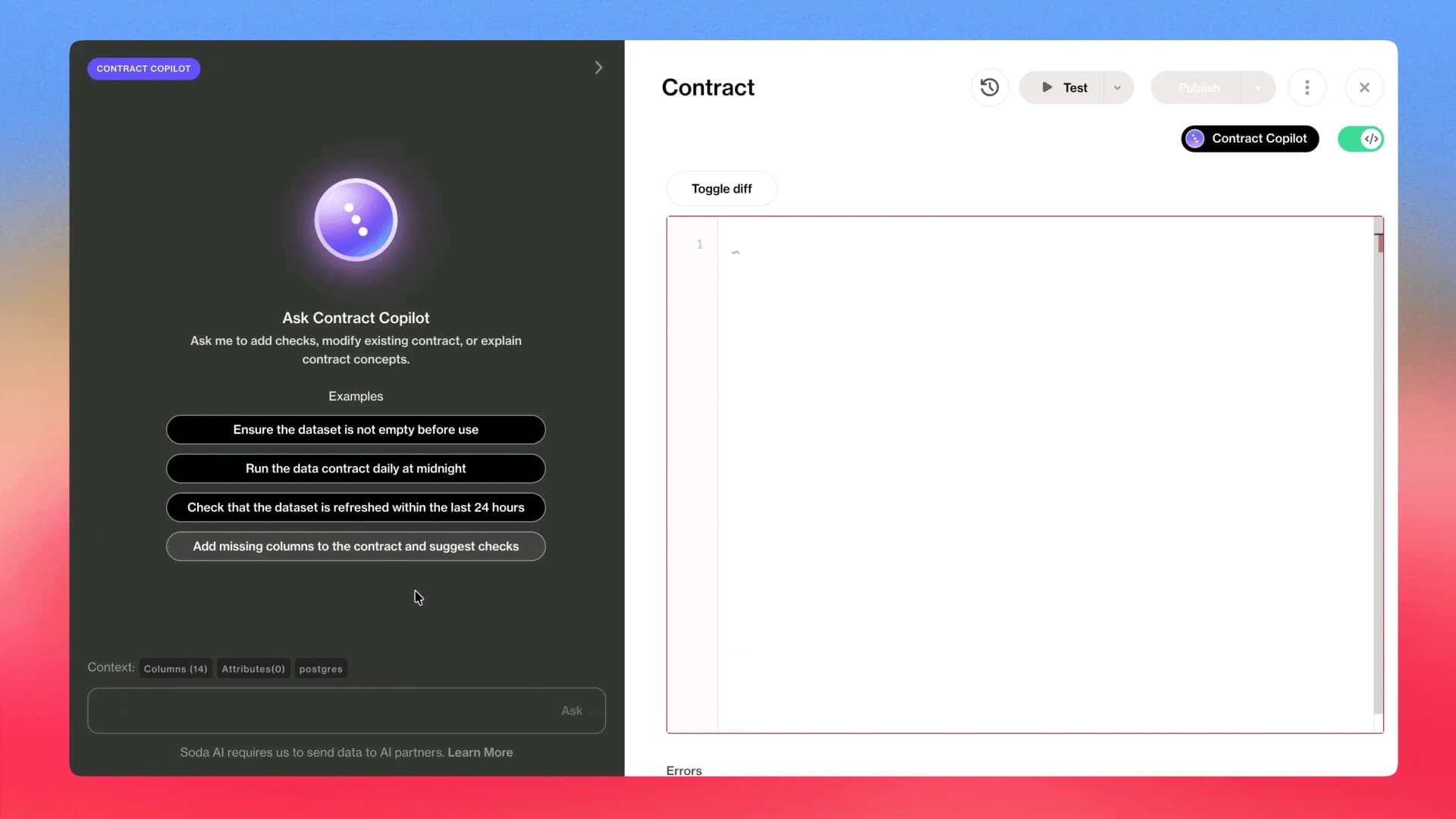
Feature Comparison
| Feature | Select Star | Soda |
|---|---|---|
| Data Discovery & Cataloging | ||
| Automated Data Catalog | Full automated data catalog with Google-like search, data dictionary, business glossary, popularity metrics, and automatic metadata indexing across the data stack | Not a data catalog platform; focuses on data quality checks and contracts rather than metadata discovery or cataloging |
| Data Lineage | End-to-end column-level data lineage automatically detected and displayed across platforms, including cross-platform lineage from source to BI dashboards | Complete traceability of data operations with logs and anomaly capture for auditing, but no cross-platform lineage mapping capability |
| Data Documentation | Auto-generated data documentation with AI-powered Ask AI feature that documents data automatically and answers internal data questions | Data contracts serve as living documentation of data expectations, with AI-powered contract generation and collaborative versioned proposals |
| Data Quality & Monitoring | ||
| Automated Quality Checks | Identifies data quality issues through lineage analysis and downstream impact tracking rather than direct data validation checks | Automated data quality checks with schema validation, freshness monitoring, custom checks written in plain English, and AI-generated contracts |
| Anomaly Detection | No built-in anomaly detection on data values; focuses on metadata changes and usage pattern analysis for data assets | Record-level anomaly detection with AI algorithms claiming 70% fewer false positives than Facebook Prophet, scaling to 1B rows in 64 seconds |
| Data Contracts | No data contracts engine; governance is achieved through cataloging, lineage, and documentation rather than enforcement contracts | Full data contracts engine with collaborative workflows where engineers work in Git and business users in the UI, with versioned proposals and diffs |
| AI & Automation | ||
| AI-Powered Features | MCP Server for Data provides LLM access to metadata, lineage, and semantic models; Ask AI auto-documents data and answers questions for analysts | AI co-pilot creates full data contracts with one click, writes checks in plain English, and powers record-level anomaly detection with peer-reviewed algorithms |
| Semantic Modeling | Reverse-engineers BI dashboard logic to generate semantic models for Snowflake Cortex Analyst and other AI tools automatically | No semantic modeling capabilities; focuses on data quality enforcement rather than semantic layer generation |
| Workflow Automation | Automatic metadata indexing, usage analysis, query analysis, and documentation generation with zero-maintenance operation | Automated detection-to-resolution workflow with AI-powered diagnostics, root cause analytics, and upcoming AI remediation for fixing bad records |
| Governance & Security | ||
| Access Controls | Data access control features with SOC 2 Security, Confidentiality, and Availability standards, enterprise-grade governance | Audit logs, custom roles, RBAC, SSO, and private deployment options available on Team and Enterprise tiers |
| Compliance & Auditing | AICPA SOC 2 certified with security, confidentiality, and availability standards; audit preparation reduced from 10-person to 2-person effort per customer testimony | Complete traceability with every log and anomaly captured for transparent auditing, governance by design with permission control built into data contracts |
| Data Security | Metadata-only approach means source data never leaves your environment; SOC 2 standards for all metadata handling | Security by design with data staying in your cloud, secure, compliant, and fully under your control with diagnostics stored in your own warehouse |
| Integration & Ecosystem | ||
| Data Warehouse Integrations | One-click integrations with Snowflake, AWS Redshift, Google BigQuery, and other major data warehouses with automatic metadata ingestion | Connects to data warehouses for running quality checks and storing diagnostics, supporting modern cloud warehouse environments |
| BI & Transformation Tool Support | Integrates with Tableau, Looker, dbt, and Salesforce for cross-platform lineage and metadata discovery across the entire data stack | Integrates with dbt for pipeline testing, plus alerting and ticketing integrations and catalog integrations available as add-ons |
| Developer & API Access | MCP Server providing a single API for integrating agents and LLMs with enterprise metadata, lineage, and semantic models | Open-source Python library (2,335 GitHub stars) with code-based workflow, API access, and Git-based version control for data contracts |
Data Discovery & Cataloging
Automated Data Catalog
Data Lineage
Data Documentation
Data Quality & Monitoring
Automated Quality Checks
Anomaly Detection
Data Contracts
AI & Automation
AI-Powered Features
Semantic Modeling
Workflow Automation
Governance & Security
Access Controls
Compliance & Auditing
Data Security
Integration & Ecosystem
Data Warehouse Integrations
BI & Transformation Tool Support
Developer & API Access
How they fit together
Select Star and Soda address different layers of the data governance stack. Select Star excels at metadata discovery, automated cataloging, and cross-platform lineage for making data findable and understandable. Soda specializes in proactive data quality enforcement through automated checks, data contracts, and AI-powered anomaly detection. Many teams benefit from using both together -- Select Star to understand data flows and Soda to validate data integrity.
What each one handles
Use Select Star for:
Choose Select Star when your primary challenge is data discovery and understanding. Select Star is the right pick for organizations where analysts spend hours searching for the right datasets, engineers need to understand downstream impacts before making changes, and leadership wants a single source of truth across the data stack. Its automated cataloging, column-level lineage, and MCP Server for AI integration make it particularly valuable for teams preparing their data infrastructure for AI workloads.
Use Soda for:
Choose Soda when your primary challenge is data reliability and quality enforcement. Soda is the right pick for data engineering teams that need to stop data incidents before they reach production, enforce data contracts between producers and consumers, and detect anomalies at the record level with peer-reviewed AI. Its Free tier at $0/month and Team tier at $750/month make it accessible for teams of any size, and the open-source Python library with 2,335 GitHub stars gives engineering teams full control over quality checks in their CI/CD pipelines.
These roles reflect the available product evidence. Most teams run both; which one owns a given job depends on your stack and team.
Frequently Asked Questions
Can Select Star and Soda be used together?
Yes, Select Star and Soda serve complementary functions in the data stack. Select Star handles metadata discovery, data cataloging, and lineage tracking, helping teams find and understand data assets. Soda handles data quality enforcement, running automated checks and data contracts to ensure data reliability. A common pattern is using Select Star to map your data landscape and identify critical data flows, then using Soda to enforce quality standards on those critical pipelines. Both tools integrate with modern data stack components like dbt and major cloud warehouses, making them straightforward to deploy alongside each other.
How do the pricing models compare for a mid-sized data team?
Select Star uses per-user pricing starting at $300/user/month on the Starter plan, with Professional and Enterprise tiers available at custom pricing. Soda uses a tiered model with a Free plan at $0/month that includes pipeline testing and metrics observability, a Team plan at $750/month for data engineering teams with collaborative data contracts and advanced AI features, and custom Enterprise pricing. For a 10-person data team, Select Star would start around $3,000/month on the Starter plan, while Soda Team would cost $750/month regardless of user count.
Which tool is better for ensuring data quality in production pipelines?
Soda is purpose-built for production data quality enforcement. It provides automated data quality checks, data contracts that define expectations between data producers and consumers, record-level anomaly detection, and a diagnostics warehouse that stores all failed records for root cause analysis. Soda's AI algorithms are peer-reviewed and published in NeurIPS, JAIR, and ACML, claiming 70% fewer false positives than Facebook Prophet. Select Star takes an indirect approach to data quality by providing lineage and impact analysis -- it helps you understand where data quality issues originate and what downstream systems they affect, but it does not run validation checks on the data itself.
How do the AI capabilities of each platform compare?
Both platforms invest heavily in AI but in different directions. Select Star focuses AI on metadata understanding -- its MCP Server for Data provides LLMs and AI agents access to metadata, lineage, and semantic models through a single API. Its Ask AI feature auto-documents data and answers analyst questions, and it generates semantic models by reverse-engineering BI dashboard logic for tools like Snowflake Cortex Analyst. Soda focuses AI on data quality automation -- its AI co-pilot generates data contracts with one click, writes quality checks from plain English descriptions, and powers anomaly detection algorithms that scale to 1 billion rows in 64 seconds. Soda's AI research has been published in academic conferences including NeurIPS, JAIR, and ACML.