Decision comparison
Soda vs Great Expectations
Soda and Great Expectations address data quality from fundamentally different angles. Soda delivers an AI-native commercial platform that emphasizes automation, business-engineer collaboration through data contracts, and managed observability. Great Expectations provides a deeply extensible open-source Python framework where teams codify precise validation logic and maintain full control over their data quality infrastructure. The right choice depends on whether your team prioritizes turnkey automation and AI-driven workflows or fine-grained programmatic control and open-source flexibility.
Direct comparison. These are reviewed substitutes bought for the same job, so the differences below are the ones that decide between them.
All 2 are data validation frameworks.
Quick Comparison
| Decision factor | Soda | Great Expectations |
|---|---|---|
| Deployment Model | Commercial SaaS platform with open-source soda-core library | Open-source Python framework with optional GX Cloud managed service |
| Pricing Model | Free tier at $0 per month, Team tier at $750 per month, with enterprise features available | Free and Open-Source, Paid upgrades available |
| Core Architecture | YAML-based data contracts engine with AI-powered automation layer | Python-based expectation suites with pluggable execution backends |
| Primary Interface | Web UI for business users, YAML/CLI for engineers, Git-based versioning | Python API and CLI for developers, GX Cloud web UI for collaboration |
| Pipeline Integration | Native integrations via soda-core; supports Airflow, dbt, and CI/CD pipelines | Direct integrations with Airflow, Dagster, Prefect, and custom orchestrators |
| Data Quality Approach | AI-driven anomaly detection, automated data contracts, record-level diagnostics | Codified expectation suites, multi-backend validation, auto-generated Data Docs |
| Community Size (GitHub Stars) | 2,335 | 11,430 |
Soda
- Deployment Model:
- Commercial SaaS platform with open-source soda-core library
- Pricing Model:
- Free tier at $0 per month, Team tier at $750 per month, with enterprise features available
- Core Architecture:
- YAML-based data contracts engine with AI-powered automation layer
- Primary Interface:
- Web UI for business users, YAML/CLI for engineers, Git-based versioning
- Pipeline Integration:
- Native integrations via soda-core; supports Airflow, dbt, and CI/CD pipelines
- Data Quality Approach:
- AI-driven anomaly detection, automated data contracts, record-level diagnostics
- Community Size (GitHub Stars):
- 2,335
Great Expectations
- Deployment Model:
- Open-source Python framework with optional GX Cloud managed service
- Pricing Model:
- Free and Open-Source, Paid upgrades available
- Core Architecture:
- Python-based expectation suites with pluggable execution backends
- Primary Interface:
- Python API and CLI for developers, GX Cloud web UI for collaboration
- Pipeline Integration:
- Direct integrations with Airflow, Dagster, Prefect, and custom orchestrators
- Data Quality Approach:
- Codified expectation suites, multi-backend validation, auto-generated Data Docs
- Community Size (GitHub Stars):
- 11,430
Public signals
Verified factual signals only. Bars appear only for like-for-like metrics with five weekly assessments for every tool; missing evidence stays explicit. These signals do not establish enterprise adoption, product quality, or total cost.
| Metric | Soda | Great Expectations |
|---|---|---|
| GitHub commits, 90d(Product adoption) | 81 | 169 |
| GitHub stars(Product adoption) | 2,000+ | 11,000+ |
| Search interest(Market interest) | 0 | 0 |
| PyPI weekly downloads(Product adoption) | 405.8k | 4.5M |
| Hacker News mentions, 90d(Community interest) | Not available | 0 |
| Stack Overflow questions(Community interest) | Not available | 148 |
As of September 21, 2026 — updated weekly.
Health & risk evidence
Observed public-source checks for mapped package versions and repositories.
Soda
September 21, 2026Package vulnerabilities
PyPI · soda-core@4.24.0
0 vulnerabilities
across 1 package
Repository security score
Not available
Great Expectations
September 21, 2026Package vulnerabilities
PyPI · great-expectations@1.23.1
0 vulnerabilities
across 1 package
Repository security score
Not available
Interface Preview
Soda
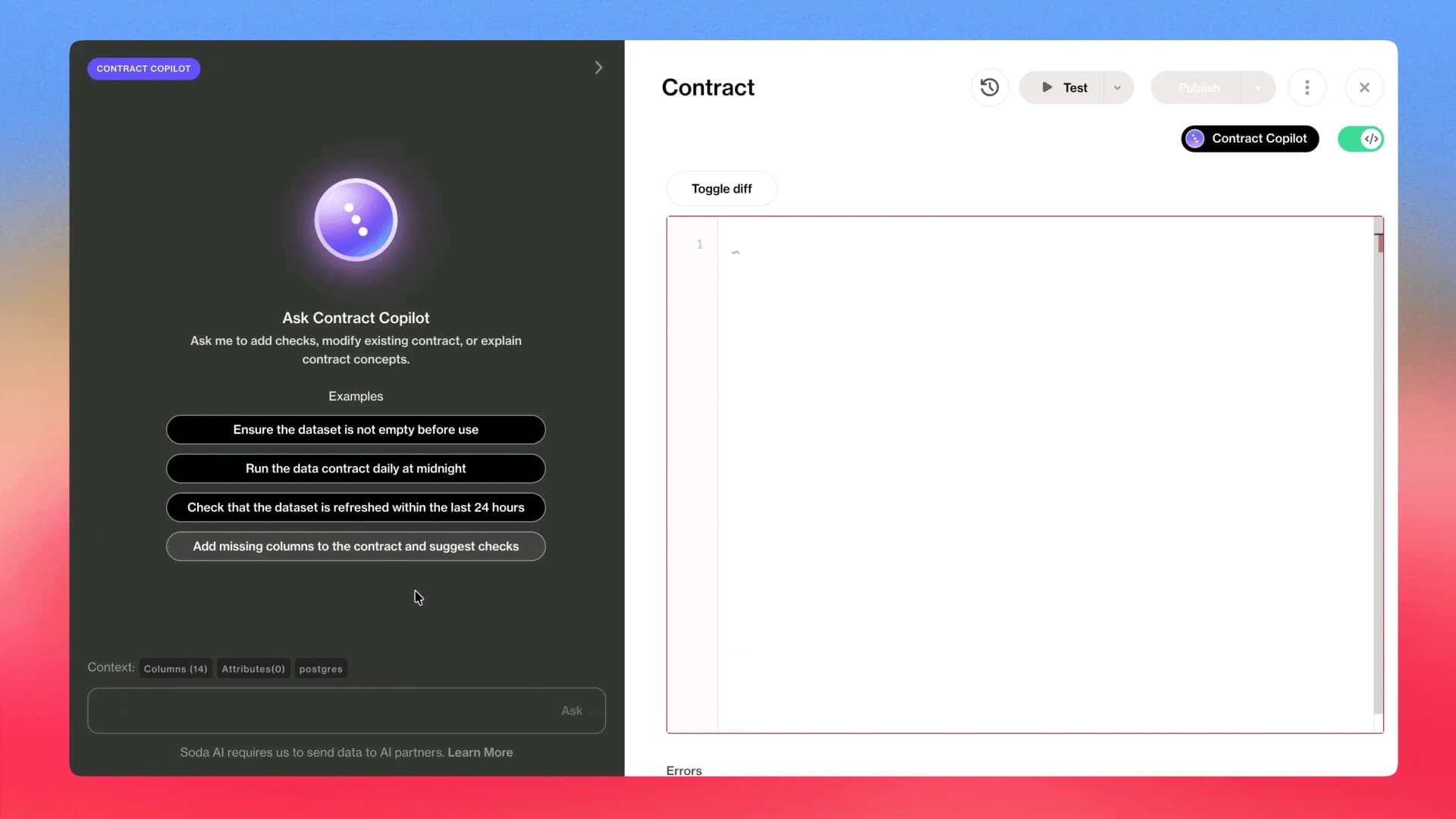
Feature Comparison
| Feature | Soda | Great Expectations |
|---|---|---|
| Data Validation | ||
| Schema Validation | Built into data contracts with automatic schema drift detection via YAML definitions | Implemented through Expectation Suites that codify column presence, types, and ordering rules |
| Custom Business Rules | Defined in YAML-based data contracts with support for plain-English AI-generated checks | Written as Python Expectation classes with parameterized logic and custom validators |
| Freshness Checks | Native freshness threshold checks configured in data contract YAML with time-unit parameters | Implemented through custom expectations or batch request metadata with timestamp comparisons |
| Anomaly Detection | ||
| Record-Level Detection | AI-powered row-level anomaly detection with failed records stored in a diagnostics warehouse | Row-level validation through per-record expectations; failed rows captured in validation results |
| Metrics Monitoring | Automated metrics monitoring with adaptive thresholds that scale to 1 billion rows in 64 seconds | Metric-based expectations tracked over time via GX Cloud dashboards or custom metric stores |
| Historical Analysis | Built-in backfilling and backtesting that analyzes up to one year of historical data patterns | Historical comparison through batch-based validation runs stored in expectation suite histories |
| Collaboration and Governance | ||
| Data Documentation | Contract-based documentation with versioned proposals and diffs accessible in both UI and Git | Auto-generated Data Docs that produce static HTML sites documenting all expectations and results |
| Role-Based Access Control | Enterprise tier includes audit logs, custom roles, RBAC, and SSO for governance compliance | GX Cloud Enterprise tier provides team-based access controls and organization management |
| Data Contracts | Native data contracts engine with collaborative workflows, AI-powered generation, and Git versioning | Expectation Suites serve as implicit data contracts; no dedicated contract management layer |
| Integration and Deployment | ||
| Orchestrator Support | Integrates with Airflow, dbt, and CI/CD systems via the open-source soda-core library | Native integrations with Airflow, Dagster, and Prefect through dedicated operator packages |
| Backend Support | Connects to data warehouses and lakes through configurable data source definitions in YAML | Supports SQL databases, Pandas DataFrames, and Spark through pluggable execution engines |
| CI/CD Integration | Soda-core CLI runs checks in CI/CD pipelines with exit codes for pass/fail gating | Checkpoint-based validation runs integrate into CI/CD with structured JSON result outputs |
| AI and Automation | ||
| AI-Powered Quality Checks | AI co-pilot generates full data contracts with one click and writes checks from plain English | ExpectAI feature auto-generates test suites based on data profiling and column analysis |
| Automated Remediation | Diagnostics warehouse captures failed records; AI remediation for source system fixes is in development | Validation results feed into alerting workflows; remediation handled by downstream orchestration |
| Smart Alerting | Integrated alerting and ticketing system with intelligent thresholds and feedback-based learning | GX Cloud provides real-time monitoring alerts; open-source users configure external alert hooks |
Data Validation
Schema Validation
Custom Business Rules
Freshness Checks
Anomaly Detection
Record-Level Detection
Metrics Monitoring
Historical Analysis
Collaboration and Governance
Data Documentation
Role-Based Access Control
Data Contracts
Integration and Deployment
Orchestrator Support
Backend Support
CI/CD Integration
AI and Automation
AI-Powered Quality Checks
Automated Remediation
Smart Alerting
Which to choose
Soda and Great Expectations address data quality from fundamentally different angles. Soda delivers an AI-native commercial platform that emphasizes automation, business-engineer collaboration through data contracts, and managed observability. Great Expectations provides a deeply extensible open-source Python framework where teams codify precise validation logic and maintain full control over their data quality infrastructure. The right choice depends on whether your team prioritizes turnkey automation and AI-driven workflows or fine-grained programmatic control and open-source flexibility.
Best-fit scenarios
Choose Soda if:
Choose Soda when your organization needs a managed data quality platform that bridges the gap between data engineers and business stakeholders. Soda's AI-powered data contracts engine automates check generation, provides a collaborative web UI for non-technical users, and includes built-in observability with record-level anomaly detection. The $750/month Team tier works well for data engineering teams that want to reduce manual effort through automated quality checks, backfilling, and adaptive metric monitoring. Soda is particularly strong for teams already using YAML-based workflows who want governance features like audit logs, RBAC, and SSO without building them from scratch.
Choose Great Expectations if:
Choose Great Expectations when your team requires full programmatic control over data validation logic and wants to avoid vendor lock-in. The open-source Python framework lets you write highly specific Expectation Suites that encode business rules as testable code, run validation across SQL, Pandas, and Spark backends, and generate comprehensive Data Docs automatically. Great Expectations integrates natively with Airflow, Dagster, and Prefect, making it the stronger choice for teams already invested in Python-based orchestration. With 11,430 GitHub stars and an Apache-2.0 license, it offers a sizable data quality community and a clear upgrade path through GX Cloud for teams that later need managed collaboration features.
These scenarios reflect the available product evidence. Your requirements, existing stack, and team expertise should guide the final decision.
Frequently Asked Questions
Can Soda and Great Expectations be used together in the same data pipeline?
Yes, some teams run both tools in complementary roles within their data pipelines. Great Expectations handles fine-grained expectation validation at specific pipeline checkpoints, while Soda provides broader observability and AI-driven anomaly detection across the entire data estate. In practice, you would configure Great Expectations checkpoints within your Airflow or Dagster DAGs for detailed record-level assertions, and layer Soda's metrics monitoring on top for automated drift detection and business-facing dashboards. This approach works because both tools operate as pipeline steps that produce structured validation results, so their outputs can coexist in the same alerting and reporting infrastructure.
What are the main differences in how Soda and Great Expectations handle pricing?
Soda operates on a freemium model with a free tier at $0 per month that covers basic pipeline testing and metrics observability, a Team tier at $750 per month that adds collaborative data contracts and AI-powered features, and an Enterprise tier with custom pricing for SSO, private deployment, and premium support. Great Expectations takes an open-source-first approach where the core Python framework is completely free under the Apache-2.0 license. GX Cloud provides optional managed services with Developer, Team, and Enterprise tiers for teams that want hosted collaboration, real-time monitoring dashboards, and centralized expectation management without self-hosting infrastructure.
Which tool has better community support and ecosystem maturity?
Great Expectations has a sizable open-source community with 11,000+ GitHub stars compared to Soda's 2,335 stars for its soda-core repository. Great Expectations has been a cornerstone of the open-source data quality ecosystem since its early releases, which means a sizable number of community-contributed expectations, extensive tutorial coverage, and a sizable amount of Stack Overflow answers available. Soda's community is focused but growing steadily, with peer-reviewed AI research published in NeurIPS, JAIR, and ACML conferences lending credibility to its anomaly detection algorithms. Both tools maintain active GitHub repositories with recent releases in April 2026.
How do the two tools differ in their approach to data contracts and governance?
Soda treats data contracts as a first-class feature through its dedicated Data Contracts Engine. Engineers define contracts in YAML and manage them through Git, while business users interact with the same contracts through a web UI. Every change is versioned with proposals and diffs visible in either interface, and AI can automatically generate or refine contracts. Great Expectations implements a similar concept through Expectation Suites, which function as codified data agreements between producers and consumers. However, Great Expectations does not include a dedicated contract management layer with collaborative workflows. Teams using Great Expectations typically manage their expectation definitions in version control alongside pipeline code and rely on Data Docs for stakeholder-facing documentation of data quality rules.