Decision comparison
Mixpanel vs Metabase
Mixpanel and Metabase serve fundamentally different analytics needs. Mixpanel is a purpose-built product analytics platform that excels at tracking user behavior, running experiments, and optimizing conversion funnels. Metabase is an open-source business intelligence tool that turns any database into shareable dashboards and reports without requiring SQL knowledge. The right choice depends on whether you need deep product analytics or broad self-service BI across your existing data infrastructure.
Architecture choice. These take different approaches to the same problem. Read the table as a fit question rather than a feature race.
These are different kinds of product — Product Analytics and BI Platform.
Quick Comparison
| Decision factor | Mixpanel | Metabase |
|---|---|---|
| Best For | Product and growth teams tracking user behavior and conversions | Teams needing self-service BI on top of existing databases |
| Pricing Model | Contact for pricing | Community Edition is free, open-source and self-hosted, with unlimited users. Paid Metabase Cloud plans start with Starter at $100/month, or $90/month billed annually, including the first 5 users, then $6 per user/month. Pro is $575/month, or $517.50/month annually, including the first 10 users, then $12 per user/month. Enterprise is custom pricing starting at $20,000/year. Both paid plans offer a 14 days free trial. |
| Open Source | No | Yes (48,000+ GitHub stars) |
| Primary Strength | Event-based product analytics with AI-driven insights | No-code query builder with embedded analytics |
| Learning Curve | Moderate to steep | Low — designed for non-technical users |
| Deployment | Cloud-hosted only | Cloud or self-hosted |
Mixpanel
- Best For:
- Product and growth teams tracking user behavior and conversions
- Pricing Model:
- Contact for pricing
- Open Source:
- No
- Primary Strength:
- Event-based product analytics with AI-driven insights
- Learning Curve:
- Moderate to steep
- Deployment:
- Cloud-hosted only
Metabase
- Best For:
- Teams needing self-service BI on top of existing databases
- Pricing Model:
- Community Edition is free, open-source and self-hosted, with unlimited users. Paid Metabase Cloud plans start with Starter at $100/month, or $90/month billed annually, including the first 5 users, then $6 per user/month. Pro is $575/month, or $517.50/month annually, including the first 10 users, then $12 per user/month. Enterprise is custom pricing starting at $20,000/year. Both paid plans offer a 14 days free trial.
- Open Source:
- Yes (48,000+ GitHub stars)
- Primary Strength:
- No-code query builder with embedded analytics
- Learning Curve:
- Low — designed for non-technical users
- Deployment:
- Cloud or self-hosted
Public signals
Verified factual signals only. Bars appear only for like-for-like metrics with five weekly assessments for every tool; missing evidence stays explicit. These signals do not establish enterprise adoption, product quality, or total cost.
| Metric | Mixpanel | Metabase |
|---|---|---|
| GitHub commits, 90d(Developer adoption) | 12 | Not available |
| GitHub stars(Developer adoption) | 108 | Not available |
| Search interest(Market interest) | 3 | Not available |
| Hacker News mentions, 90d(Community interest) | 1 | 12 |
| npm weekly downloads(Developer adoption) | 947.2k | 36.8k |
| Product Hunt comments(Community interest) | 2 | 30 |
| Product Hunt rating(Community interest) | 4.9/5 | 4.9/5 |
| Product Hunt reviews(Community interest) | 92 | 24 |
| Product Hunt votes(Community interest) | 28 | 310 |
| PyPI weekly downloads(Developer adoption) | 1.5M | Not available |
| Stack Overflow questions(Community interest) | 540 | 374 |
| Docker Hub pulls(Product adoption) | Not available | 272.7M |
| GitHub commits, 90d(Product adoption) | Not available | 2.0k |
| GitHub stars(Product adoption) | Not available | 49,000+ |
As of September 21, 2026 — updated weekly.
Health & risk evidence
Observed public-source checks for mapped package versions and repositories.
Mixpanel
September 21, 2026Package vulnerabilities
npm · mixpanel@0.24.0 · PyPI · mixpanel@5.4.0
0 vulnerabilities
across 2 packages
Repository security score
github.com/mixpanel/mixpanel-python
6.6/10
Metabase
September 21, 2026Package vulnerabilities
npm · @metabase/embedding-sdk-react@0.63.1
0 vulnerabilities
across 1 package
Repository security score
github.com/metabase/metabase
7.1/10
Interface Preview
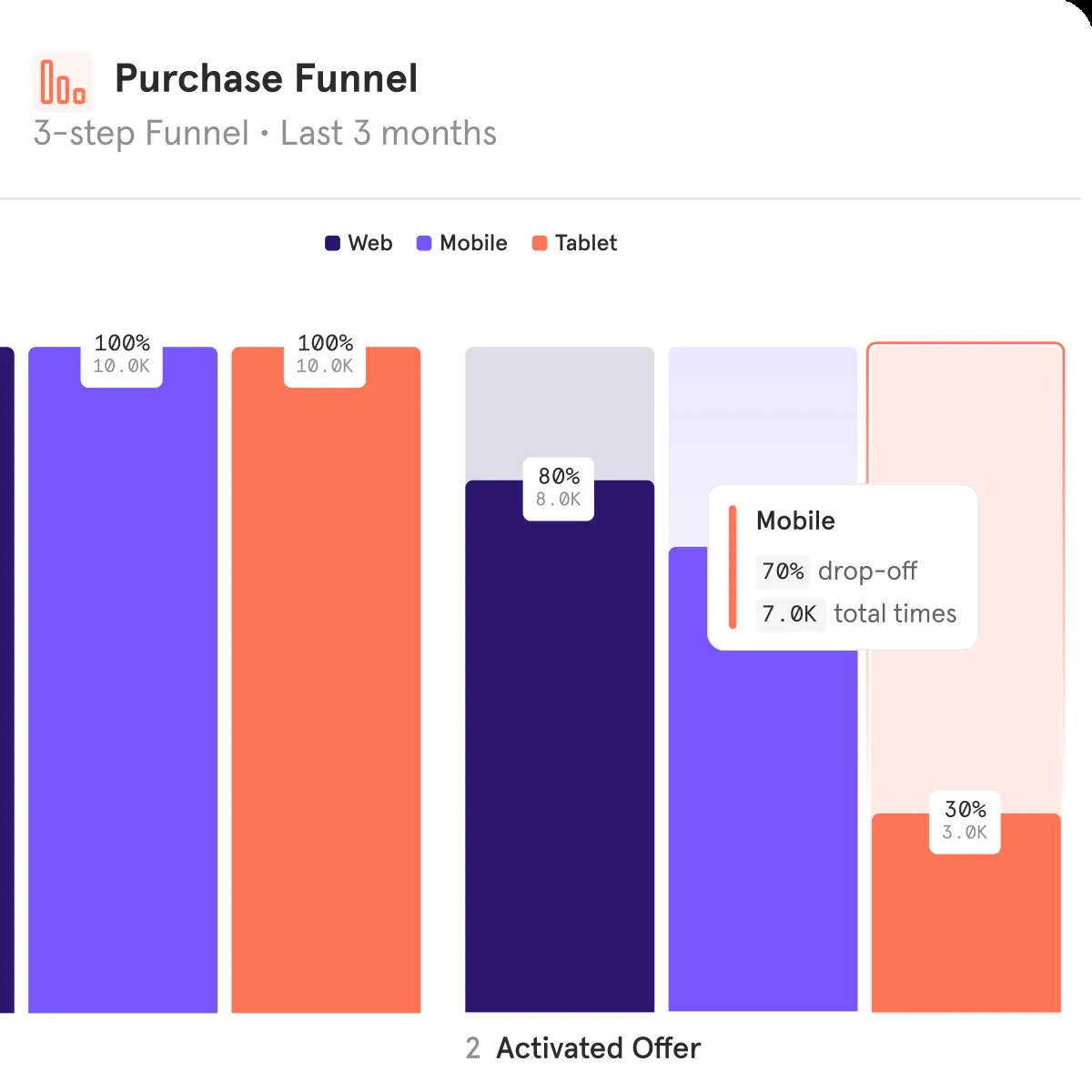
Mixpanel
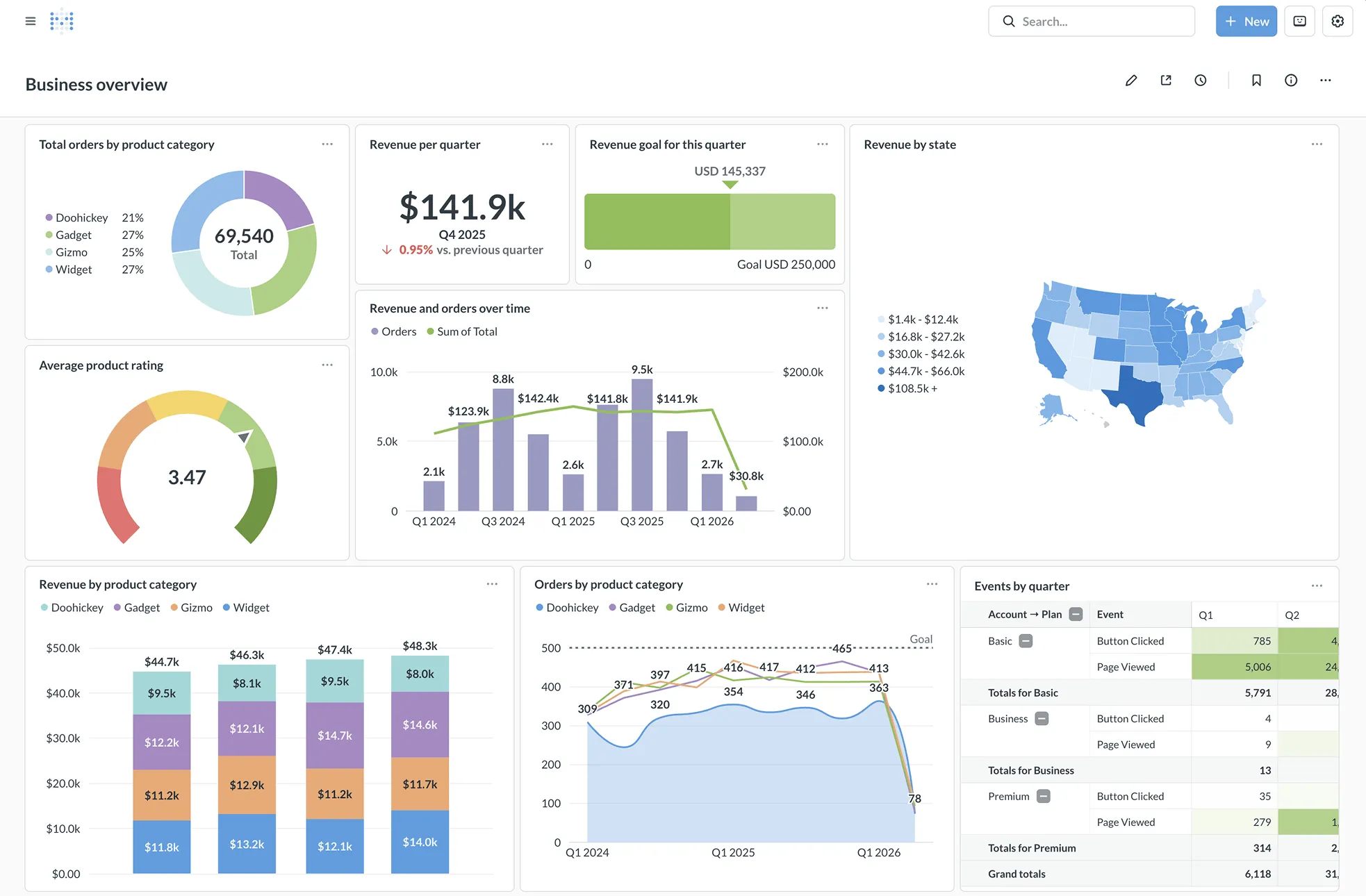
Metabase
Feature Comparison
| Feature | Mixpanel | Metabase |
|---|---|---|
| Data Querying | ||
| Visual Query Builder | Built-in report builder for event-based queries | Full no-code query builder for any connected database |
| SQL Support | Limited — relies on UI-driven analysis | Native SQL editor for power users |
| AI-Powered Analytics | AI-driven instant answers on product performance | Metabot AI for natural-language SQL generation |
| Analytics Capabilities | ||
| Funnel Analysis | Core strength — built-in funnel tracking with drop-off analysis | Possible via custom SQL queries, not built-in |
| Cohort / Retention Analysis | Native cohort tracking over time for churn and loyalty | Requires manual query setup |
| A/B Testing | Built-in experimentation framework | Not verified |
| Real-Time Data | Live view of user behavior in real time | Live queries against database; speed depends on DB |
| Dashboard Creation | Pre-built report templates for product metrics | Drag-and-drop dashboards with interactive drill-through |
| Deployment & Integration | ||
| Database Connectors | Integrates with Segment, BigQuery, reverse ETL tools | 20+ native database connectors including PostgreSQL and MySQL |
| Embedded Analytics | Not a core use case | White-label embedded dashboards via iframes or React SDK |
| Self-Hosted Option | No — cloud only | Yes — Docker, JAR, or cloud deployment |
| Security & Governance | ||
| Compliance | SOC 2 Type II, ISO 27001, HIPAA-ready, SSO/SAML | SOC 1, SOC 2, GDPR, CCPA compliant |
| Permissions & Access Control | Team-based access with audit logs | Row-level, column-level, and collection-based permissions with SSO |
| Usage Analytics | Focused on product usage analytics for end users | Internal dashboard and data usage tracking with alerts |
| Data Residency | Cloud-managed data residency options | Full control when self-hosted; cloud option also available |
Data Querying
Visual Query Builder
SQL Support
AI-Powered Analytics
Analytics Capabilities
Funnel Analysis
Cohort / Retention Analysis
A/B Testing
Real-Time Data
Dashboard Creation
Deployment & Integration
Database Connectors
Embedded Analytics
Self-Hosted Option
Security & Governance
Compliance
Permissions & Access Control
Usage Analytics
Data Residency
Which approach fits
Mixpanel and Metabase serve fundamentally different analytics needs. Mixpanel is a purpose-built product analytics platform that excels at tracking user behavior, running experiments, and optimizing conversion funnels. Metabase is an open-source business intelligence tool that turns any database into shareable dashboards and reports without requiring SQL knowledge. The right choice depends on whether you need deep product analytics or broad self-service BI across your existing data infrastructure.
When each approach fits
Choose Mixpanel if:
Choose Mixpanel when your primary goal is understanding how users interact with your product. Product teams, growth engineers, and marketing teams that need funnel analysis, cohort tracking, A/B testing, and real-time behavioral insights will get the most value from Mixpanel. It is especially strong for SaaS companies and mobile apps that need to track user journeys from acquisition through retention. The AI-driven insight engine reduces time-to-answer for product questions, and the platform scales to handle billions of events per month.
Choose Metabase if:
Choose Metabase when you need a flexible BI layer on top of your existing databases. Teams that want non-technical colleagues to explore data, build dashboards, and schedule reports without writing SQL will benefit most from Metabase. Its open-source model and self-hosting capability make it a strong fit for startups watching costs and enterprises with strict data residency requirements. The embedded analytics SDK also makes Metabase the better option if you need to ship customer-facing dashboards inside your own product.
These scenarios reflect the available product evidence. Your requirements, existing stack, and team expertise should guide the final decision.
Frequently Asked Questions
Can Mixpanel replace Metabase for general business reporting?
No. Mixpanel is designed for product and behavioral analytics, not general-purpose BI. It tracks events like clicks, signups, and feature usage rather than querying arbitrary database tables. If your team needs to run ad-hoc SQL queries against a data warehouse or build reports from operational databases, Metabase is the better fit.
Is Metabase truly free to use?
Metabase offers a fully functional open-source edition that you can self-host at no license cost. Paid plans start at $100/mo for the Starter cloud tier and go up to $575/mo for Pro. The Enterprise plan is custom pricing starting at $20,000 per year and adds priority support, advanced permissions, and additional deployment options.
Can we use Mixpanel and Metabase together?
Yes. Many data teams use Mixpanel for product analytics and Metabase for broader business intelligence. Mixpanel captures behavioral event data, while Metabase connects to your data warehouse or production database for financial, operational, and cross-functional reporting. The two tools complement each other rather than compete directly.
Which tool is easier to set up?
Metabase is faster to get running for general BI — you can spin up a self-hosted instance with a single Docker command and start querying your database within minutes. Mixpanel requires event instrumentation in your codebase, which means engineering effort upfront to define and track the events that matter. Once instrumented, Mixpanel delivers insights quickly, but the initial setup investment is higher.