If you're building data pipelines in 2026, you've encountered the ETL vs ELT debate. The short answer: ELT has won for most use cases. But the long answer is more nuanced — ETL still has legitimate use cases, and understanding when to use each approach can save you months of rework.
This guide explains both approaches with real examples, compares the tools that implement each, and gives you a decision framework based on your actual situation.
The Core Difference in 30 Seconds
ETL (Extract, Transform, Load): Pull data from sources, transform it on a separate processing server, then load the clean data into the destination. The transformation happens before the data reaches the warehouse.
ELT (Extract, Load, Transform): Pull data from sources, load the raw data directly into the warehouse, then transform it inside the warehouse using SQL. The transformation happens after loading.
The difference isn't just the order of letters — it reflects a fundamental shift in where compute happens and who controls the transformation logic.
How ETL Works (Traditional Approach)
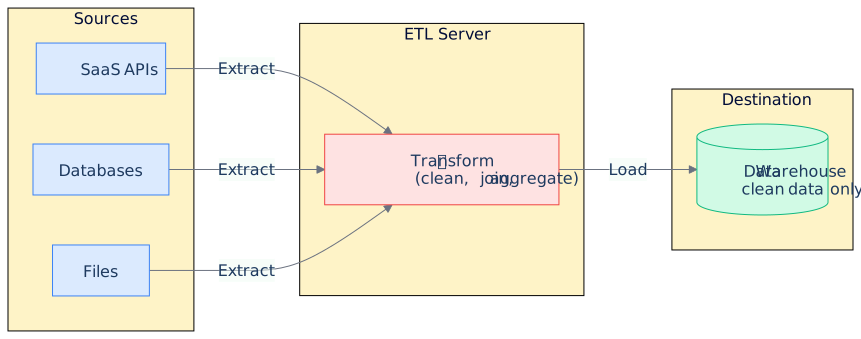
In the ETL model, a dedicated processing engine sits between your sources and your warehouse:
Sources → [Extract] → Processing Server → [Transform] → [Load] → Warehouse
The processing server handles data cleaning, type casting, joining, aggregating, and business logic before any data reaches the warehouse. Tools like Informatica PowerCenter, Talend, and IBM DataStage are built for this model.
Real-World ETL Example
A retail company needs to combine point-of-sale data from 500 stores into a daily sales report:
- Extract: Pull transaction records from each store's database (500 connections)
- Transform (on ETL server): Standardize product codes across stores, convert currencies, calculate tax, deduplicate returns, join with product master data, aggregate to daily totals
- Load: Insert the clean, aggregated daily_sales table into the warehouse
The transformation happens on Informatica's server cluster. The warehouse only sees clean, pre-processed data.
When ETL Made Sense
ETL dominated from the 1990s through the 2010s because:
- Warehouse compute was expensive: On-premise warehouses (Teradata, Oracle, Netezza) charged per-query or per-CPU. Minimizing warehouse compute by pre-processing data was cost-effective.
- Storage was expensive: Loading raw data meant paying for storage you'd eventually discard. Pre-filtering reduced storage costs.
- Compliance requirements: Some regulations required that sensitive data never reach the warehouse in raw form — PII had to be masked or removed before loading.
How ELT Works (Modern Approach)
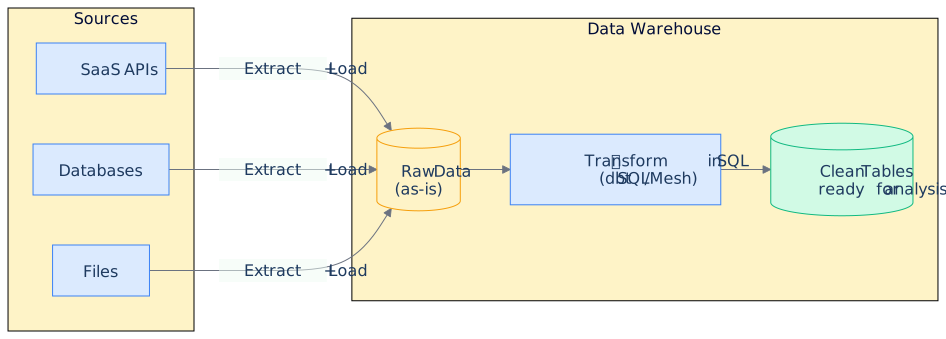
In the ELT model, raw data goes directly into the warehouse, and transformations happen there:
Sources → [Extract] → [Load] → Warehouse → [Transform in SQL] → Clean Tables
Tools like Fivetran, Airbyte, and dlt handle the Extract + Load. Tools like dbt and SQLMesh handle the Transform inside the warehouse.
Real-World ELT Example
The same retail company, but with ELT:
- Extract + Load: Fivetran connects to each store's database and loads raw transaction records into Snowflake (automated, no custom code)
- Transform (in Snowflake via dbt): SQL models in dbt standardize product codes, convert currencies, calculate tax, deduplicate returns, join with product master data, and aggregate to daily totals
The transformation logic is written in SQL, version-controlled in Git, tested with dbt tests, and documented automatically. The warehouse handles all the compute.
Why ELT Won
ELT became the default because cloud warehouses changed the economics:
- Warehouse compute is elastic: Snowflake, BigQuery, and Databricks scale compute on demand. Running transformations in the warehouse costs pennies per query, not thousands per server.
- Storage is cheap: Cloud storage costs $20-40/TB/month. Loading raw data and keeping it indefinitely is affordable.
- SQL is universal: Every data analyst knows SQL. ETL tools required learning proprietary visual interfaces (Informatica mappings, Talend jobs) that only specialists could maintain.
- Separation of concerns: Ingestion tools (Fivetran, Airbyte) focus on reliable extraction. Transformation tools (dbt) focus on business logic. Each does one thing well.
ETL vs ELT: Detailed Comparison
| Dimension | ETL | ELT |
|---|---|---|
| Transform location | Dedicated processing server | Inside the warehouse |
| Primary language | Proprietary (Informatica, Talend) | SQL (dbt, SQLMesh) |
| Raw data in warehouse | No (only transformed data) | Yes (raw + transformed) |
| Latency | Higher (transform before load) | Lower (load first, transform on schedule) |
| Cost model | ETL server licensing + warehouse | Warehouse compute only |
| Flexibility | Must re-run ETL to change transforms | Re-run SQL models; raw data is always available |
| Debugging | Check ETL server logs | Query raw data directly in warehouse |
| Compliance | PII never reaches warehouse | PII in warehouse (requires masking policies) |
| Team skills | ETL specialists | SQL-proficient analysts and engineers |
| Typical cost | $50K–$500K/year (Informatica licensing) | $2K–$20K/year (Fivetran + dbt + warehouse) |
When to Use ETL (Yes, It Still Has Use Cases)
ETL isn't dead. Use it when:
1. Compliance Requires Pre-Load Transformation
Industries like healthcare (HIPAA) and finance (PCI DSS) may require that sensitive data is masked, tokenized, or removed before it enters the warehouse. ETL tools can strip PII during the transform phase, ensuring raw sensitive data never touches the warehouse.
2. Extreme Data Volume Reduction
If your source generates 10TB/day but you only need 100GB after filtering and aggregation, ETL reduces the data before loading, saving significant warehouse storage and compute costs. IoT sensor data and high-frequency trading data often fit this pattern.
3. Legacy System Integration
Organizations with existing Informatica PowerCenter or Talend deployments that work reliably don't need to migrate to ELT for the sake of modernization. If it works, the migration cost may not be justified.
4. Real-Time Streaming Transforms
Stream processing with Apache Kafka + Confluent ksqlDB or Apache Flink is technically ETL — data is transformed in the stream before landing in the destination. Real-time use cases (fraud detection, real-time pricing) require this approach.
When to Use ELT (Most Cases in 2026)
ELT is the right choice when:
1. You're Building a New Data Stack
If you're starting from scratch, ELT is the default. Fivetran or Airbyte for ingestion, Snowflake or BigQuery for storage, dbt for transformation. This stack is well-documented, widely adopted, and cost-effective.
2. Your Team Knows SQL
ELT's biggest advantage is accessibility. Any analyst who knows SQL can write and maintain dbt models. ETL tools require specialized skills that are harder to hire for and more expensive.
3. You Need Flexibility
With ELT, raw data is always available in the warehouse. When business requirements change (and they always do), you can write new transformations against the raw data without re-extracting from sources. With ETL, changing the transformation requires modifying and re-running the ETL pipeline.
4. You Want Version-Controlled Transformations
dbt models are SQL files in a Git repository — version-controlled, code-reviewed, tested, and documented. ETL transformations are typically stored in proprietary formats (Informatica XML, Talend metadata) that don't integrate well with modern development workflows.
The Tools at Each Layer
ETL Tools
| Tool | Type | Pricing | Best For |
|---|---|---|---|
| Informatica PowerCenter | Enterprise ETL | $50K–$500K+/year | Large enterprises with complex legacy integrations |
| Talend | Open-core ETL | Free (open-source) to $12K+/year | Mid-market companies wanting visual ETL with open-source option |
| AWS Glue | Serverless ETL | $0.44/DPU-hour | AWS-native teams wanting managed Spark-based ETL |
| Apache Spark | Processing engine | Free (open-source) | Teams needing distributed processing for massive datasets |
ELT Tools (Ingestion)
| Tool | Type | Pricing | Best For |
|---|---|---|---|
| Fivetran | Managed EL | ~$1/credit ($2K+/month) | Teams wanting zero-maintenance ingestion |
| Airbyte | Open-source EL | Free (self-hosted) to $2.50/credit | Cost-conscious teams, custom connectors |
| dlt | Python EL library | Free | Data engineers who prefer code over UI |
| Stitch | Managed EL | From $100/month | Small teams with simple needs |
ELT Tools (Transformation)
| Tool | Type | Pricing | Best For |
|---|---|---|---|
| dbt | SQL transformation | Free (Core) to $100/dev/month (Cloud) | Most teams — largest ecosystem |
| SQLMesh | SQL transformation | Free (open-source) | Teams with large datasets, cost optimization |
| Dataform | SQL transformation | Free (with BigQuery) | BigQuery-only teams |
Decision Framework
Ask these questions in order:
-
Are you building new or maintaining existing?
- New → ELT
- Existing ETL that works → Keep it (migration cost may not be justified)
-
Do compliance rules require pre-load transformation?
- Yes → ETL (or ELT with warehouse-level masking policies)
- No → ELT
-
Is your data volume reduction ratio > 100:1?
- Yes → Consider ETL to reduce warehouse costs
- No → ELT
-
Does your team know SQL?
- Yes → ELT with dbt
- No (but knows Python) → ELT with dlt or custom scripts
- No (uses visual tools) → ETL with Talend or Informatica
Conclusion
ELT is the default for new data stacks in 2026. Cloud warehouses have made the economics overwhelmingly favorable: cheap storage, elastic compute, and SQL-based transformations that any analyst can maintain. ETL remains relevant for compliance-heavy industries, extreme data reduction scenarios, and organizations with working legacy pipelines.
The practical advice: start with ELT (Fivetran or Airbyte + dbt + your warehouse of choice), and only reach for ETL when you hit a specific limitation that ELT can't solve.
Browse our data pipeline tools for detailed reviews of every ingestion and transformation tool mentioned in this guide.