Decision comparison
Elementary vs Metaplane
Elementary and Metaplane both deliver strong data observability capabilities, but they serve different team profiles. Elementary is the clear choice for dbt-centric teams that want code-first control and open-source flexibility, while Metaplane appeals to teams that prioritize fast ML-powered setup with usage-based pricing.
Direct comparison. These are reviewed substitutes bought for the same job, so the differences below are the ones that decide between them.
All 2 are data observability.
Quick Comparison
| Decision factor | Elementary | Metaplane |
|---|---|---|
| Best For | dbt-native teams wanting code-first observability with open-source foundations | Data teams needing ML-powered monitoring with usage-based pay-for-what-you-use pricing |
| Deployment Model | Self-hosted open-source package or managed cloud service with premium features | Cloud-hosted SaaS platform with Snowflake native app deployment option |
| Monitoring Approach | Automated monitors for freshness, volume, schema changes with anomaly detection | ML-based anomaly detection accounting for seasonality and trends automatically |
| Lineage Capabilities | End-to-end column-level lineage from code to BI tools across full stack | End-to-end column-level lineage generated from metadata with no manual setup |
| Pricing Model | Elementary publishes no amounts. Its open-source dbt package is free and self-hosted. Elementary Cloud is priced by seats and environments: Scale covers up to 10 editor seats and 1K tables, Enterprise up to 20 editor and 40 viewer seats and 3K tables, and Unlimited removes the seat caps; extra tables are charged per additional 1K. A free trial covers the Essentials feature set. Every paid tier is quote-only. | Free $0. Pro is usage-based — pay for what you use. Enterprise is quote-only. All three tiers list the same warehouse connectors. |
| Setup Time | Integrates directly into dbt projects with minimal configuration required | 15-minute setup with alerts appearing within 3 days of deployment |
Elementary
- Best For:
- dbt-native teams wanting code-first observability with open-source foundations
- Deployment Model:
- Self-hosted open-source package or managed cloud service with premium features
- Monitoring Approach:
- Automated monitors for freshness, volume, schema changes with anomaly detection
- Lineage Capabilities:
- End-to-end column-level lineage from code to BI tools across full stack
- Pricing Model:
- Elementary publishes no amounts. Its open-source dbt package is free and self-hosted. Elementary Cloud is priced by seats and environments: Scale covers up to 10 editor seats and 1K tables, Enterprise up to 20 editor and 40 viewer seats and 3K tables, and Unlimited removes the seat caps; extra tables are charged per additional 1K. A free trial covers the Essentials feature set. Every paid tier is quote-only.
- Setup Time:
- Integrates directly into dbt projects with minimal configuration required
Metaplane
- Best For:
- Data teams needing ML-powered monitoring with usage-based pay-for-what-you-use pricing
- Deployment Model:
- Cloud-hosted SaaS platform with Snowflake native app deployment option
- Monitoring Approach:
- ML-based anomaly detection accounting for seasonality and trends automatically
- Lineage Capabilities:
- End-to-end column-level lineage generated from metadata with no manual setup
- Pricing Model:
- Free $0. Pro is usage-based — pay for what you use. Enterprise is quote-only. All three tiers list the same warehouse connectors.
- Setup Time:
- 15-minute setup with alerts appearing within 3 days of deployment
Public signals
Verified factual signals only. Bars appear only for like-for-like metrics with five weekly assessments for every tool; missing evidence stays explicit. These signals do not establish enterprise adoption, product quality, or total cost.
| Metric | Elementary | Metaplane |
|---|---|---|
| GitHub commits, 90d(Product adoption) | 19 | Not available |
| GitHub stars(Product adoption) | 2,000+ | Not available |
| PyPI weekly downloads(Product adoption) | 215.3k | Not available |
| Hacker News mentions, 90d(Community interest) | Not available | 0 |
| Product Hunt comments(Community interest) | Not available | 44 |
| Product Hunt rating(Community interest) | Not available | 5.0/5 |
| Product Hunt reviews(Community interest) | Not available | 2 |
| Product Hunt votes(Community interest) | Not available | 136 |
As of September 21, 2026 — updated weekly.
Health & risk evidence
Observed public-source checks for mapped package versions and repositories.
Elementary
September 21, 2026Package vulnerabilities
PyPI · elementary-data@0.26.0
0 vulnerabilities
across 1 package
Repository security score
github.com/elementary-data/elementary
7.4/10
Metaplane
Package vulnerabilities
Not available
Repository security score
Not available
Interface Preview
Elementary
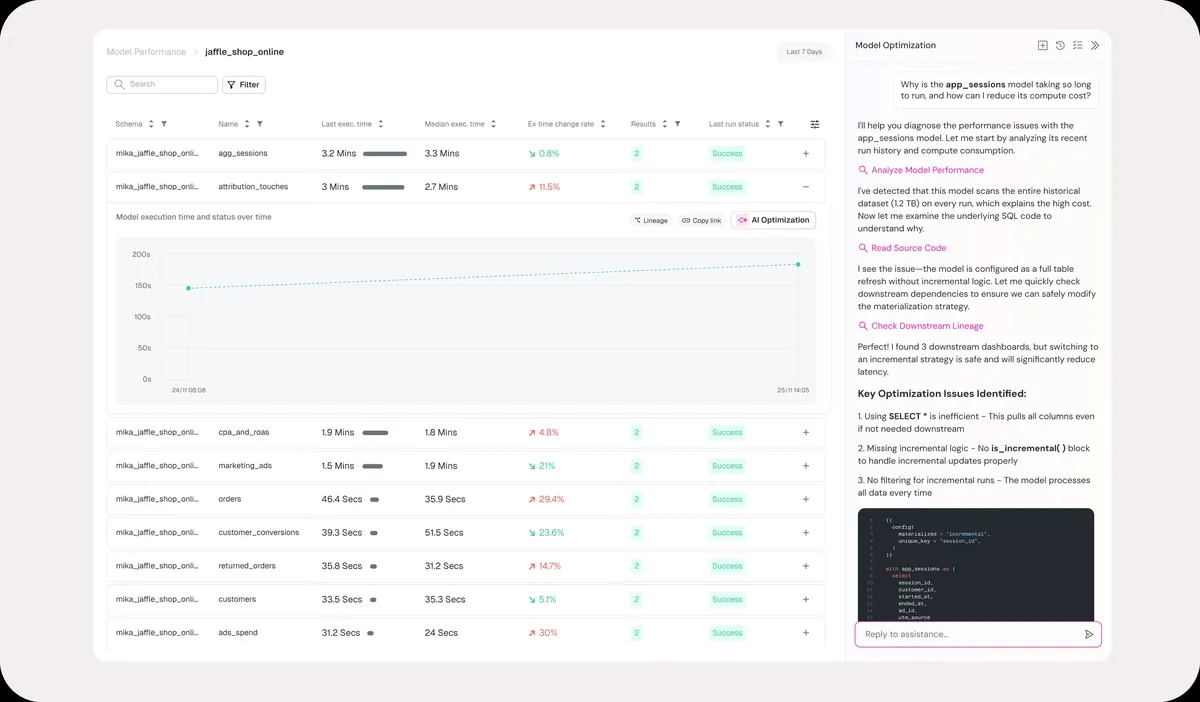
Feature Comparison
| Feature | Elementary | Metaplane |
|---|---|---|
| Data Monitoring | ||
| Automated Anomaly Detection | ML-based monitors with configurable seasonality, sensitivity, and where expressions | ML-based monitoring accounting for seasonality and trends with model feedback |
| Freshness and Volume Monitoring | Out-of-the-box monitors activated automatically with low compute cost | Built-in volume and freshness monitors with automated threshold detection |
| Schema Change Detection | Automated schema change monitoring for production tables | Schema change alerts for all tables including unmonitored ones |
| Lineage and Discovery | ||
| Column-Level Lineage | Automated column-level lineage from code, data warehouse, sources, and BI tools | End-to-end column-level lineage from sources to BI tools with no manual setup |
| Data Catalog | Built-in catalog with asset definitions, ownership, tags, tests, usage, and health | Data insights showing usage patterns, frequency, and data debt indicators |
| Impact Analysis | Lineage enriched with test results to show incidents across the DAG | Forecast downstream changes from model updates via GitHub App integration |
| Alerting and Incident Management | ||
| Alert Routing | Route alerts to different recipients and owners with customizable formats | Targeted notifications to Slack, Email, MS Teams, PagerDuty, API, and Webhooks |
| Incident Management | Group related failures into managed incidents with context-aware severity routing | Group monitors, objects, and incidents into custom dashboards with audit history |
| Alert Customization | Enrich alerts with additional properties and custom formats per channel | Adjust alert sensitivity and types with model feedback for noise reduction |
| Developer Experience | ||
| dbt Integration | dbt-native by design with seamless package integration into dbt projects | Supports dbt Core and Cloud with dbt Alerting and dbt Inspector tools |
| Configuration Approach | Configuration as Code with version control, code review, and CI/CD support | No-code monitor setup with optional SQL customization for advanced users |
| Data CI/CD | Prevent breaking changes at the PR level with policy enforcement | Automated regression and impact tests when merging pull requests |
| Security and Enterprise | ||
| Security Compliance | SSO and RBAC available on Enterprise tier with advanced deployment options | SOC 2 Type II compliant with GDPR, CCPA, and HIPAA adherence |
| Data Access Model | Self-hosted option keeps data within your infrastructure | Read-only metadata access with no PII storage or direct data access |
| Warehouse Integrations | Snowflake, BigQuery, Redshift, Databricks, and PostgreSQL support | Snowflake, BigQuery, Redshift, Clickhouse, Postgres, MySQL, SQL Server, Databricks |
Data Monitoring
Automated Anomaly Detection
Freshness and Volume Monitoring
Schema Change Detection
Lineage and Discovery
Column-Level Lineage
Data Catalog
Impact Analysis
Alerting and Incident Management
Alert Routing
Incident Management
Alert Customization
Developer Experience
dbt Integration
Configuration Approach
Data CI/CD
Security and Enterprise
Security Compliance
Data Access Model
Warehouse Integrations
Which to choose
Elementary and Metaplane both deliver strong data observability capabilities, but they serve different team profiles. Elementary is the clear choice for dbt-centric teams that want code-first control and open-source flexibility, while Metaplane appeals to teams that prioritize fast ML-powered setup with usage-based pricing.
Best-fit scenarios
Choose Elementary if:
Elementary is purpose-built for dbt workflows, making it the stronger choice for data and analytics engineers who want observability managed directly in their codebase. The dbt-native package integrates seamlessly into existing projects, and all configurations live alongside your transformation code. This means version control, code review, and CI/CD apply to your observability setup just as they do to your data models. The open-source foundation with over 2,300 GitHub stars gives your team transparency into the tool's internals, and the self-hosted option keeps data within your infrastructure for teams with strict compliance requirements.
Choose Metaplane if:
Metaplane stands out for teams that want to get data observability running quickly without deep dbt expertise or code-level configuration. The platform promises a 15-minute setup with ML-based monitors that automatically account for seasonality and trends, which means less manual threshold tuning. The usage-based pricing model lets you monitor only the tables you care about, avoiding the cost of warehouse-wide monitoring. Metaplane also offers a Snowflake native app that runs directly inside your warehouse using existing compute credits, and its broader warehouse support including Clickhouse, MySQL, and SQL Server makes it suitable for teams with diverse data infrastructure.
These scenarios reflect the available product evidence. Your requirements, existing stack, and team expertise should guide the final decision.
Frequently Asked Questions
What are the main differences between Elementary and Metaplane for data observability?
The primary difference lies in their approach to monitoring and configuration. Elementary takes a code-first, dbt-native approach where all observability configurations are managed directly in your dbt project code. This means engineers version-control their monitors alongside data models. Metaplane, on the other hand, offers a no-code setup experience with ML-powered monitors that automatically learn your data patterns and adjust thresholds. Elementary provides an open-source foundation that you can self-host, while Metaplane operates as a cloud-hosted SaaS platform with an optional Snowflake native app. Both provide column-level lineage and anomaly detection, but Elementary embeds these capabilities directly into the dbt DAG, whereas Metaplane generates lineage from metadata across your full stack independently.
How do Elementary and Metaplane compare on pricing and cost structure?
Elementary offers tiered pricing based on seats and table counts. The Scale tier supports up to 10 editor seats and 5,000 tables, with additional tables available at extra cost per 1,000 tables. The Enterprise tier adds SSO, RBAC, and advanced deployment options for up to 20 editor seats and 10,000 tables. The Unlimited tier removes seat caps and adds dedicated customer support. Metaplane follows a usage-based model where you pay only for the tables you actively monitor. Their free tier allows monitoring up to 10 tables with 1 user. The Pro tier is usage-based, and Enterprise pricing is custom. This difference means Elementary costs are more predictable based on team size, while Metaplane costs scale directly with monitoring scope.
Which tool has better integration support for modern data stacks?
Both tools integrate with the core components of modern data stacks, but their coverage differs in specific areas. Elementary integrates with Snowflake, BigQuery, Redshift, Databricks, and PostgreSQL for warehouses, and connects to BI tools like Tableau and Looker. It also supports communication tools including Slack, Microsoft Teams, Opsgenie, and PagerDuty, plus code repositories like GitHub and GitLab. Metaplane covers a wider range of warehouses by also supporting Clickhouse, MySQL, and SQL Server in addition to the standard options. Metaplane connects to the same BI tools (Looker, Tableau, Metabase, Mode, Sigma, PowerBI) and offers Slack, Email, MS Teams, PagerDuty, plus API and Webhook destinations on Enterprise. Metaplane also provides a Snowflake native app that runs within your warehouse environment.
Can Elementary and Metaplane detect data quality issues before they reach production?
Yes, both platforms offer data CI/CD capabilities designed to catch issues at the pull request stage. Elementary lets you run tests and preview the impact of your PR on the pipeline before merging, with policy enforcement to maintain high data quality standards. This integrates directly with your existing dbt CI/CD workflow. Metaplane provides Data CI/CD with automated regression and impact tests that run when merging pull requests. It includes Data Impact Previews and Data Test Previews that show downstream changes before commits. Metaplane also supports CI/CD with both GitHub and GitLab alongside dbt Core and Cloud workflows. Both approaches help teams shift left on data quality, but Elementary's approach is more tightly coupled to the dbt development workflow, while Metaplane operates as a standalone layer.