Decision comparison
Metaplane vs Soda
Metaplane and Soda both deliver strong data quality capabilities but serve different team workflows and organizational needs. Metaplane excels as a turnkey data observability platform with ML-powered monitoring, end-to-end column-level lineage, and Data CI/CD that integrates tightly into dbt and BI tool workflows. Soda wins for teams that want a code-first data contracts engine, open-source flexibility, and peer-reviewed AI algorithms with a collaborative workflow bridging engineering and business stakeholders. Your choice depends on whether you need fast, no-code observability with deep lineage or structured data contracts with developer-native tooling.
Architecture choice. These take different approaches to the same problem. Read the table as a fit question rather than a feature race.
These are different kinds of product — Data Observability and Data Validation Framework.
Quick Comparison
| Decision factor | Metaplane | Soda |
|---|---|---|
| Best For | Data teams needing end-to-end data observability with ML-powered monitoring, column-level lineage, and Data CI/CD integrated into their dbt and BI workflows | Data engineering teams needing collaborative data contracts with AI-powered quality checks, record-level anomaly detection, and a code-first workflow |
| Architecture | Closed-source SaaS platform with Snowflake native app option; read-only metadata access ensures data never leaves your warehouse | Open-source Python core (2,000+ GitHub stars) with SaaS cloud layer; security-by-design keeps data in your cloud environment |
| Pricing Model | Free $0. Pro is usage-based — pay for what you use. Enterprise is quote-only. All three tiers list the same warehouse connectors. | Free tier at $0 per month, Team tier at $750 per month, with enterprise features available |
| Ease of Use | 15-minute setup with no-code monitor configuration; ML models train within 3 days; suggested monitors eliminate manual configuration for critical tables | Engineers work in Git with YAML-based checks; business users use no-code UI; AI co-pilot generates data contracts from plain English with one click |
| Scalability | Usage-based Pro tier scales monitored tables from 10 to 100+; partition monitors and rolling window monitors available on paid tiers for high-volume tables | Anomaly detection algorithms scale to 1 billion rows in 64 seconds with 70% fewer false positives than Facebook Prophet; monitors thousands of tables simultaneously |
| Community/Support | Email support on Free and Pro tiers; Enterprise includes premium support, shared Slack channel, dedicated CSM, and engineering time; free OSS tools for dbt alerting and schema tracking | Open-source community with 2,000+ GitHub stars; active development with v4.7.0 released April 2026; premium support on Team tier and above |
Metaplane
- Best For:
- Data teams needing end-to-end data observability with ML-powered monitoring, column-level lineage, and Data CI/CD integrated into their dbt and BI workflows
- Architecture:
- Closed-source SaaS platform with Snowflake native app option; read-only metadata access ensures data never leaves your warehouse
- Pricing Model:
- Free $0. Pro is usage-based — pay for what you use. Enterprise is quote-only. All three tiers list the same warehouse connectors.
- Ease of Use:
- 15-minute setup with no-code monitor configuration; ML models train within 3 days; suggested monitors eliminate manual configuration for critical tables
- Scalability:
- Usage-based Pro tier scales monitored tables from 10 to 100+; partition monitors and rolling window monitors available on paid tiers for high-volume tables
- Community/Support:
- Email support on Free and Pro tiers; Enterprise includes premium support, shared Slack channel, dedicated CSM, and engineering time; free OSS tools for dbt alerting and schema tracking
Soda
- Best For:
- Data engineering teams needing collaborative data contracts with AI-powered quality checks, record-level anomaly detection, and a code-first workflow
- Architecture:
- Open-source Python core (2,000+ GitHub stars) with SaaS cloud layer; security-by-design keeps data in your cloud environment
- Pricing Model:
- Free tier at $0 per month, Team tier at $750 per month, with enterprise features available
- Ease of Use:
- Engineers work in Git with YAML-based checks; business users use no-code UI; AI co-pilot generates data contracts from plain English with one click
- Scalability:
- Anomaly detection algorithms scale to 1 billion rows in 64 seconds with 70% fewer false positives than Facebook Prophet; monitors thousands of tables simultaneously
- Community/Support:
- Open-source community with 2,000+ GitHub stars; active development with v4.7.0 released April 2026; premium support on Team tier and above
Public signals
Verified factual signals only. Bars appear only for like-for-like metrics with five weekly assessments for every tool; missing evidence stays explicit. These signals do not establish enterprise adoption, product quality, or total cost.
| Metric | Metaplane | Soda |
|---|---|---|
| Search interest(Market interest) | Unavailable | 0 |
| Hacker News mentions, 90d(Community interest) | 0 | Not available |
| Product Hunt comments(Community interest) | 44 | Not available |
| Product Hunt rating(Community interest) | 5.0/5 | Not available |
| Product Hunt reviews(Community interest) | 2 | Not available |
| Product Hunt votes(Community interest) | 136 | Not available |
| GitHub commits, 90d(Product adoption) | Not available | 81 |
| GitHub stars(Product adoption) | Not available | 2,000+ |
| PyPI weekly downloads(Product adoption) | Not available | 405.8k |
As of September 21, 2026 — updated weekly.
Health & risk evidence
Observed public-source checks for mapped package versions and repositories.
Metaplane
Package vulnerabilities
Not available
Repository security score
Not available
Soda
September 21, 2026Package vulnerabilities
PyPI · soda-core@4.24.0
0 vulnerabilities
across 1 package
Repository security score
Not available
Interface Preview
Soda
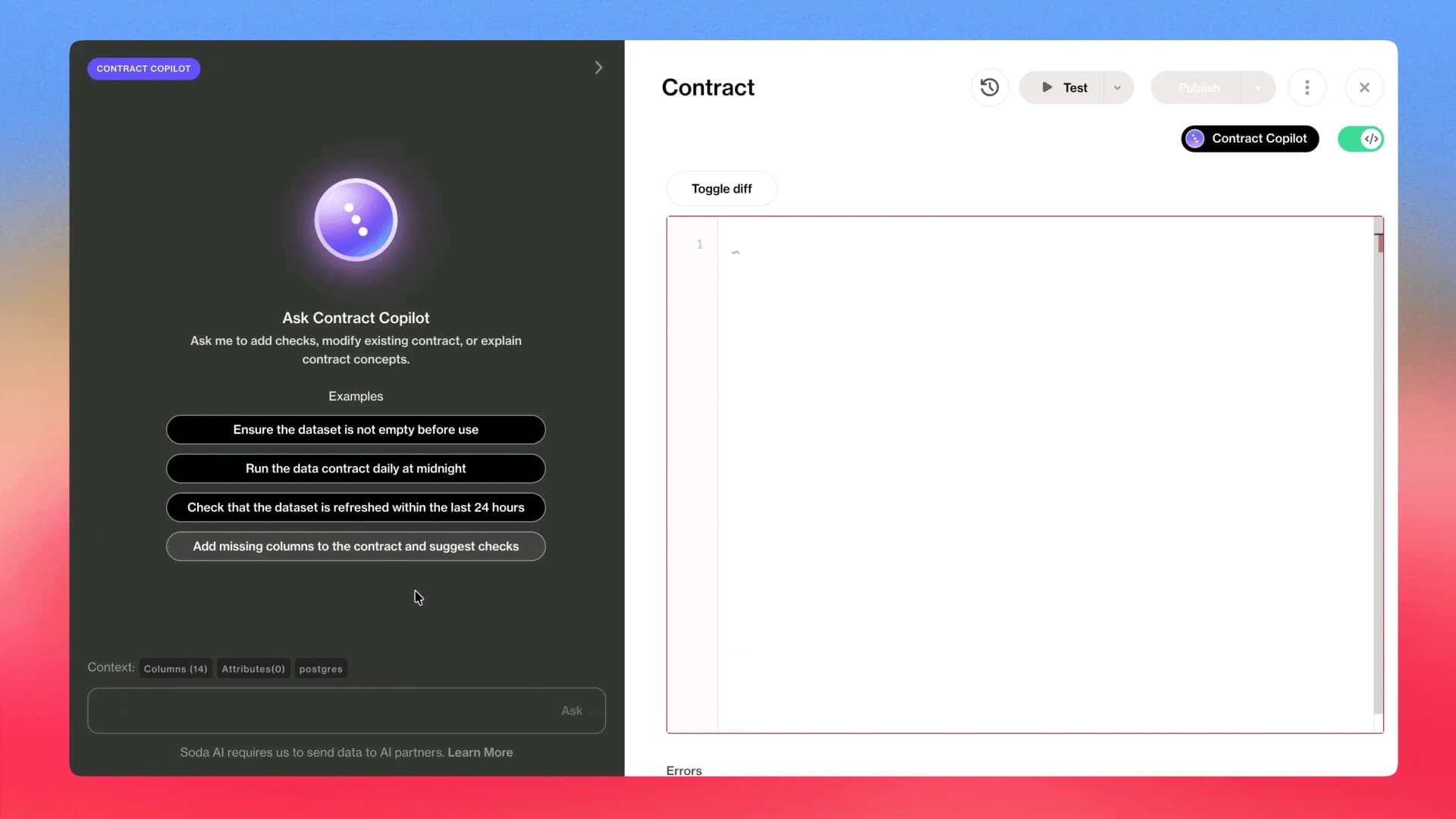
Feature Comparison
| Feature | Metaplane | Soda |
|---|---|---|
| Data Quality Monitoring | ||
| Anomaly Detection | ML-based anomaly detection that accounts for seasonality and trends; models self-adjust tolerance as data evolves based on user feedback | Record-level anomaly detection with peer-reviewed algorithms published in NeurIPS, JAIR, and ACML; 70% fewer false positives than Facebook Prophet |
| Schema Change Detection | Schema change alerts for all tables including unmonitored ones; notifications when databases, schemas, tables, or columns are added, renamed, or removed | Schema checks enforced via YAML-based data contracts with versioned proposals and diffs available in both Git and UI views |
| Data Freshness Monitoring | Built-in freshness monitors alongside volume, uniqueness, nullness, and statistical distribution monitors; available on all tiers | Column-level freshness thresholds defined in data contracts with configurable time units and automatic alerting |
| Lineage and Root Cause Analysis | ||
| Data Lineage | End-to-end column-level lineage from sources to BI tools with no manual setup; covers Snowflake, BigQuery, Redshift, Clickhouse, Postgres, MySQL, SQL Server, Databricks | Complete traceability with diagnostics warehouse storing all failed records and anomaly logs for transparent auditing |
| Impact Analysis | Data CI/CD forecasts downstream table and dashboard impact before merging pull requests; compares data between production and PR branches | Data contracts with governance-by-design track every change with proposals and diffs for complete auditability |
| Root Cause Diagnostics | Incident and monitor audit history provides context to accelerate triage; dependency and usage indicators identify critical tables | Diagnostics warehouse stores all failed records automatically; root cause analytics isolate, manage, and fix bad data at the source |
| AI and Automation | ||
| AI-Powered Monitoring | ML models account for seasonality and trends; suggested monitors automatically identify important tables to monitor | Proprietary AI algorithms with peer-reviewed research; metrics monitoring scales to 1 billion rows in 64 seconds |
| Automated Check Generation | Suggested monitors recommend which tables to monitor based on usage and dependency analysis | AI co-pilot generates full data contracts with one click from plain English descriptions |
| Historical Data Analysis | ML models train on historical data within 3 days of setup to establish baselines for anomaly detection | Built-in backfilling and backtesting instantly analyze one year of historical data to reveal patterns and trends |
| Collaboration and Workflows | ||
| Data Contracts | Not a core feature; focuses on monitor-based observability with custom SQL monitors and threshold configuration | Dedicated data contracts engine with collaborative workflows; engineers work in Git while business users contribute through no-code UI |
| CI/CD Integration | Data CI/CD runs automated regression and impact tests on pull requests; supports GitHub, GitLab, dbt Core, and dbt Cloud | Pipeline testing included in free tier; engineers define YAML-based checks managed through Git versioning workflows |
| Alerting Channels | Free tier: Slack and Email; Pro adds MS Teams; Enterprise adds PagerDuty, API, and Webhooks with model adjustment to user feedback | Alerting and ticketing integrations included in free tier; advanced integrations and catalog connections on paid tiers |
| Deployment and Security | ||
| Deployment Options | SaaS platform plus Snowflake native app that runs directly inside your warehouse using existing Snowflake credits | SaaS cloud with private deployment option on Team tier; open-source CLI for self-hosted pipeline testing |
| Security and Compliance | SOC 2 Type II, GDPR, CCPA, and HIPAA compliant; read-only metadata access with no PII storage | Security-by-design architecture where data stays in your cloud; audit logs, custom roles, and RBAC on Team tier |
| Open Source Components | Free OSS tools: dbt Alerting for Slack/MS Teams routing, dbt Inspector for run analysis, and Schema Change Tracker for Snowflake | Open-source Python core with 2,000+ GitHub stars; active development with latest release v4.7.0 in April 2026 |
Data Quality Monitoring
Anomaly Detection
Schema Change Detection
Data Freshness Monitoring
Lineage and Root Cause Analysis
Data Lineage
Impact Analysis
Root Cause Diagnostics
AI and Automation
AI-Powered Monitoring
Automated Check Generation
Historical Data Analysis
Collaboration and Workflows
Data Contracts
CI/CD Integration
Alerting Channels
Deployment and Security
Deployment Options
Security and Compliance
Open Source Components
Which approach fits
Metaplane and Soda both deliver strong data quality capabilities but serve different team workflows and organizational needs. Metaplane excels as a turnkey data observability platform with ML-powered monitoring, end-to-end column-level lineage, and Data CI/CD that integrates tightly into dbt and BI tool workflows. Soda wins for teams that want a code-first data contracts engine, open-source flexibility, and peer-reviewed AI algorithms with a collaborative workflow bridging engineering and business stakeholders. Your choice depends on whether you need fast, no-code observability with deep lineage or structured data contracts with developer-native tooling.
When each approach fits
Choose Metaplane if:
Choose Metaplane when your team needs a fast-to-deploy data observability platform with deep integration into the modern data stack. Metaplane is the right fit if you want ML-powered monitoring that self-adjusts as your data evolves, with no-code configuration that gets you from setup to actionable alerts within 3 days. Its end-to-end column-level lineage covers sources through BI tools without manual setup, making root cause analysis fast and reliable. Data CI/CD is a standout capability -- it forecasts downstream impact and runs regression tests on pull requests before code merges, which is valuable for teams practicing continuous deployment on their data models. The Snowflake native app is a strong differentiator for Snowflake-centric organizations, letting you run observability inside your warehouse using existing credits. Metaplane's free tier with 10 monitored tables provides a meaningful starting point, and the usage-based Pro tier keeps costs aligned with actual monitoring needs. We recommend Metaplane for teams that prioritize quick time-to-value, comprehensive lineage, and tight dbt integration over code-first contract definitions.
Choose Soda if:
Choose Soda when your data engineering team wants a developer-native platform built around data contracts and code-first workflows. Soda is ideal for organizations where engineers define quality rules in YAML through Git while business users contribute via a no-code interface with versioned proposals and diffs. Its open-source Python core with 2,335 GitHub stars gives teams the transparency to inspect and extend the platform, and the CLI integrates directly into CI/CD pipelines. Soda's AI capabilities are backed by peer-reviewed research published in NeurIPS, JAIR, and ACML, with anomaly detection that scales to 1 billion rows in 64 seconds and delivers 70% fewer false positives than Facebook Prophet. The built-in backfilling and backtesting let you analyze one year of historical data instantly, and the diagnostics warehouse stores all failed records for root cause analysis in your own environment. At $750/mo for the Team tier with data contracts, RBAC, SSO, and advanced AI features, Soda offers strong value for teams that need structured data governance alongside quality automation.
These scenarios reflect the available product evidence. Your requirements, existing stack, and team expertise should guide the final decision.
Frequently Asked Questions
What is the main difference between Metaplane and Soda?
Metaplane is an end-to-end data observability platform focused on ML-powered monitoring and column-level lineage across your entire data stack. It takes a no-code approach where you configure monitors without writing code, and its machine learning models automatically detect anomalies by accounting for seasonality and trends. Soda is an AI-native data quality platform built around data contracts -- engineers define quality checks in YAML through Git workflows while business users collaborate via a no-code interface. Soda's open-source Python core (2,335 GitHub stars) provides transparency and extensibility, and its AI algorithms are peer-reviewed with publications in NeurIPS, JAIR, and ACML. The fundamental distinction is that Metaplane emphasizes observability-first monitoring with deep lineage, while Soda emphasizes contract-first quality enforcement with collaborative governance.
How do Metaplane and Soda compare on pricing?
Both tools offer free tiers but structure their paid plans differently. Metaplane's Free tier includes 1 user and 10 monitored tables with volume, schema, freshness, uniqueness, nullness, statistical distribution, and custom SQL monitors. The Pro tier is usage-based and expands to 100 tables with 5 users, adding partition monitors, rolling window monitors, dbt job monitoring, query monitoring, and MS Teams alerting. Enterprise pricing is custom with unlimited tables and users. Soda's Free tier at $0/mo includes pipeline testing, metrics observability, alerting integrations, and unlimited users. The Team tier at $750/mo adds collaborative data contracts, a no-code interface, advanced AI features, audit logs, custom roles, RBAC, private deployment, and SSO. Enterprise pricing is custom. For small teams, Metaplane's free tier is more feature-rich for monitoring, while Soda's free tier provides broader pipeline testing capabilities.
Which tool has better lineage and root cause analysis capabilities?
Metaplane has a clear advantage in data lineage. It provides end-to-end column-level lineage from data sources through transformations to BI tools like Looker, Tableau, Metabase, Mode, Sigma, and PowerBI, all generated automatically from metadata with no manual setup. Its Data CI/CD feature adds impact forecasting that shows which downstream tables and dashboards will be affected by code changes before you merge a pull request. Soda takes a different approach to root cause analysis with its diagnostics warehouse, which automatically stores all failed records flagged by data contracts or anomaly detection in your data warehouse. This gives teams complete traceability for every log and anomaly. Soda excels at isolating and managing bad data at the source, while Metaplane excels at tracing the flow and impact of data issues across your entire stack.
Can I use both Metaplane and Soda together?
Yes, and some data teams do run complementary data quality tools. Metaplane and Soda serve different primary functions that can work alongside each other. You could use Soda's data contracts engine to enforce schema, freshness, and validation rules through Git-managed YAML definitions in your CI/CD pipeline, while using Metaplane for always-on ML-powered monitoring, column-level lineage visualization, and downstream impact analysis across your BI tools. Metaplane's Snowflake native app runs inside your warehouse, so it does not conflict with Soda's cloud-based or self-hosted checks. That said, there is significant feature overlap in anomaly detection, schema monitoring, and alerting, so most teams will find that one platform covers their primary needs without requiring both.