Decision comparison
Marquez vs Soda
Marquez and Soda address different layers of the data operations stack. Marquez is an open-source metadata service purpose-built for data lineage tracking and dependency management across pipelines and orchestration platforms. Soda is an AI-powered data quality platform designed for automated checks, data contracts, and anomaly detection. These tools are complementary rather than direct competitors -- many organizations benefit from running both. Your choice depends on whether your primary gap is metadata and lineage visibility or active data quality validation and enforcement.
Used together. These are normally used together rather than chosen between. The comparison explains what each one does in the stack.
These are different kinds of product — Data Catalog and Data Validation Framework.
Quick Comparison
| Decision factor | Marquez | Soda |
|---|---|---|
| Best For | Data platform teams needing an open-source metadata service for tracking data lineage and dependencies across multiple pipelines and orchestration platforms | Data engineering teams needing AI-powered data quality checks, collaborative data contracts, and record-level anomaly detection from table to record level |
| Architecture | Open-source Java-based metadata server (Apache-2.0 license, 2,000+ GitHub stars) with OpenLineage-compatible REST API and web UI for lineage visualization | Open-source Python core (2,000+ GitHub stars) with commercial SaaS cloud layer; data stays in your cloud for security-by-design compliance |
| Pricing Model | Free and open source | Free tier at $0 per month, Team tier at $750 per month, with enterprise features available |
| Ease of Use | Web UI provides a unified visual graph for browsing metadata, viewing job inputs/outputs, and tracing dataset lineage; Lineage API enables programmatic access | Engineers define YAML-based checks in Git; business users collaborate through a no-code interface; AI co-pilot generates full data contracts with one click |
| Scalability | Designed as a centralized metadata repository for real-time collection across distributed pipelines, orchestrators, and processing frameworks | Anomaly detection algorithms scale to 1 billion rows in 64 seconds with 70% fewer false positives than Facebook Prophet |
| Community/Support | Open-source community with 2,000+ GitHub stars; reference implementation of OpenLineage; integrations with Apache Airflow, Apache Spark, Apache Flink, dbt, and Dagster | Open-source community with 2,000+ GitHub stars; active development with v4.7.0 released April 2026; premium support available on Team tier and above |
Marquez
- Best For:
- Data platform teams needing an open-source metadata service for tracking data lineage and dependencies across multiple pipelines and orchestration platforms
- Architecture:
- Open-source Java-based metadata server (Apache-2.0 license, 2,000+ GitHub stars) with OpenLineage-compatible REST API and web UI for lineage visualization
- Pricing Model:
- Free and open source
- Ease of Use:
- Web UI provides a unified visual graph for browsing metadata, viewing job inputs/outputs, and tracing dataset lineage; Lineage API enables programmatic access
- Scalability:
- Designed as a centralized metadata repository for real-time collection across distributed pipelines, orchestrators, and processing frameworks
- Community/Support:
- Open-source community with 2,000+ GitHub stars; reference implementation of OpenLineage; integrations with Apache Airflow, Apache Spark, Apache Flink, dbt, and Dagster
Soda
- Best For:
- Data engineering teams needing AI-powered data quality checks, collaborative data contracts, and record-level anomaly detection from table to record level
- Architecture:
- Open-source Python core (2,000+ GitHub stars) with commercial SaaS cloud layer; data stays in your cloud for security-by-design compliance
- Pricing Model:
- Free tier at $0 per month, Team tier at $750 per month, with enterprise features available
- Ease of Use:
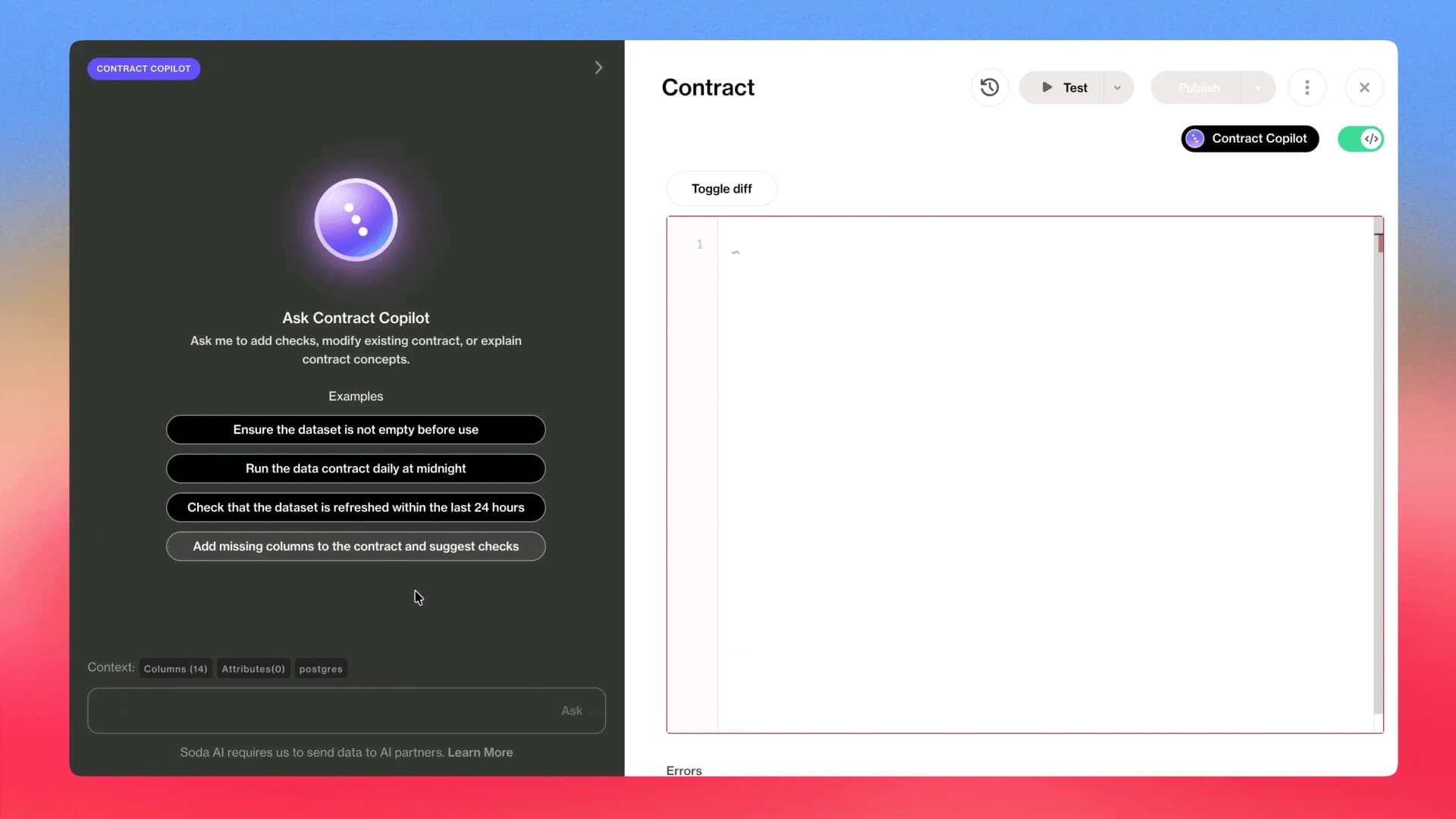
- Engineers define YAML-based checks in Git; business users collaborate through a no-code interface; AI co-pilot generates full data contracts with one click
- Scalability:
- Anomaly detection algorithms scale to 1 billion rows in 64 seconds with 70% fewer false positives than Facebook Prophet
- Community/Support:
- Open-source community with 2,000+ GitHub stars; active development with v4.7.0 released April 2026; premium support available on Team tier and above
Public signals
Verified factual signals only. Bars appear only for like-for-like metrics with five weekly assessments for every tool; missing evidence stays explicit. These signals do not establish enterprise adoption, product quality, or total cost.
| Metric | Marquez | Soda |
|---|---|---|
| Docker Hub pulls(Product adoption) | 1.1M | Not available |
| GitHub commits, 90d(Product adoption) | 0 | 81 |
| GitHub stars(Product adoption) | 2,000+ | 2,000+ |
| Search interest(Market interest) | Unavailable | 0 |
| PyPI weekly downloads(Developer adoption) | 84 | Not available |
| PyPI weekly downloads(Product adoption) | Not available | 405.8k |
As of September 21, 2026 — updated weekly.
Health & risk evidence
Observed public-source checks for mapped package versions and repositories.
Marquez
September 21, 2026Package vulnerabilities
PyPI · marquez-python@0.50.0
0 vulnerabilities
across 1 package
Repository security score
github.com/MarquezProject/marquez
4.0/10
Soda
September 21, 2026Package vulnerabilities
PyPI · soda-core@4.24.0
0 vulnerabilities
across 1 package
Repository security score
Not available
Interface Preview
Soda
Feature Comparison
| Feature | Marquez | Soda |
|---|---|---|
| Core Purpose and Data Focus | ||
| Primary Function | Metadata service for collecting, aggregating, and visualizing data lineage across an entire data ecosystem | Data quality platform for automated checks, data contracts, anomaly detection, and root cause analytics |
| Data Lineage Tracking | Core strength: real-time lineage collection via OpenLineage-compatible endpoint with a unified visual graph showing complex interdependencies | Complete traceability for quality events with diagnostics warehouse storing all failed records and anomaly logs |
| Data Quality Checks | Not a primary function; Marquez focuses on metadata and lineage rather than active data quality validation | Core strength: automated checks for schema, freshness, validity, and custom rules defined in YAML-based data contracts |
| AI and Automation Capabilities | ||
| AI-Powered Features | No built-in AI features; provides metadata and lineage data that can feed into external AI and automation systems | Peer-reviewed AI algorithms published in NeurIPS, JAIR, and ACML; AI co-pilot generates data contracts from plain English |
| Anomaly Detection | Not included; Marquez tracks metadata about datasets and jobs rather than inspecting actual data values | Record-level anomaly detection with smart adaptive thresholds and feedback loops for continuous algorithm improvement |
| Automated Remediation | Lineage API enables automation of backfills and root cause analysis through programmatic dependency traversal | Diagnostics warehouse isolates failed records; AI remediation for fixing bad records at source is on the roadmap |
| Integration Ecosystem | ||
| Orchestrator Integrations | Native integrations with Apache Airflow, Apache Spark, Apache Flink, dbt, and Dagster through the OpenLineage standard | Alerting and ticketing integrations included in free tier; catalog integrations available on paid tiers |
| API Access | Flexible Lineage API for querying metadata, traversing dependency trees, and enriching data catalogs and quality systems | SaaS API with programmatic access to quality checks, contract management, and observability data |
| Open Standards Support | Reference implementation of the OpenLineage standard; all OpenLineage community integrations work out of the box | Proprietary data contracts format with Git-based versioning; works with popular data warehouses and cloud platforms |
| Collaboration and Governance | ||
| Data Contracts | No data contracts functionality; focuses on metadata collection and lineage tracking rather than quality enforcement | Dedicated data contracts engine with collaborative workflows where engineers use Git and business users use the UI |
| Business-Engineering Collaboration | Web UI for browsing metadata is accessible to all stakeholders; API enables custom tooling for different audiences | Engineers work in Git with YAML checks while business users contribute through a no-code interface with versioned proposals |
| Access Control and Audit | Self-hosted deployment gives teams full control over access; no built-in RBAC or audit logging in the open-source version | Role-Based Access Control with audit logs, custom roles, and SSO available on Team tier; governance by design |
| Deployment and Operations | ||
| Deployment Model | Self-hosted only; teams deploy and manage their own Marquez server instance in their infrastructure | SaaS cloud platform with private deployment option on Team tier; open-source CLI available for self-hosted use |
| Historical Data Analysis | Maintains a centralized repository of historical metadata and lineage for tracking dataset lifecycle over time | Built-in backfilling and backtesting instantly analyzes up to one year of historical data to reveal patterns |
| Observability Scope | Focused on metadata observability: tracking which jobs produce and consume which datasets across the ecosystem | Focused on data quality observability: monitoring thousands of tables with interactive visualizations and smart thresholds |
Core Purpose and Data Focus
Primary Function
Data Lineage Tracking
Data Quality Checks
AI and Automation Capabilities
AI-Powered Features
Anomaly Detection
Automated Remediation
Integration Ecosystem
Orchestrator Integrations
API Access
Open Standards Support
Collaboration and Governance
Data Contracts
Business-Engineering Collaboration
Access Control and Audit
Deployment and Operations
Deployment Model
Historical Data Analysis
Observability Scope
How they fit together
Marquez and Soda address different layers of the data operations stack. Marquez is an open-source metadata service purpose-built for data lineage tracking and dependency management across pipelines and orchestration platforms. Soda is an AI-powered data quality platform designed for automated checks, data contracts, and anomaly detection. These tools are complementary rather than direct competitors -- many organizations benefit from running both. Your choice depends on whether your primary gap is metadata and lineage visibility or active data quality validation and enforcement.
What each one handles
Use Marquez for:
Choose Marquez when your primary need is understanding data dependencies and lineage across a complex data ecosystem. Marquez is the right fit for data platform teams that operate multiple orchestrators like Apache Airflow, Apache Spark, Apache Flink, dbt, and Dagster and need a single, centralized view of how datasets flow between jobs. As the reference implementation of OpenLineage, Marquez provides a standards-based approach to metadata collection that avoids vendor lock-in. Its completely free, Apache-2.0-licensed model means there are no licensing costs at any scale. We recommend Marquez for organizations that need to automate backfill decisions, trace root causes through dependency graphs, or enrich their data catalogs with lineage data from a unified metadata repository.
Use Soda for:
Choose Soda when your primary need is actively validating data quality and enforcing standards across your data products. Soda is the better fit for data engineering teams that need to define quality checks in YAML, collaborate with business stakeholders through data contracts, and detect anomalies at the record level. The free tier at $0/mo provides pipeline testing, metrics observability, and alerting integrations, while the Team tier at $750/mo adds collaborative data contracts, a no-code interface, advanced AI features, RBAC, and SSO. We recommend Soda for teams that value peer-reviewed AI algorithms (published in NeurIPS, JAIR, and ACML), need anomaly detection that scales to 1 billion rows in 64 seconds, or want built-in backfilling and backtesting to analyze historical data patterns.
These roles reflect the available product evidence. Most teams run both; which one owns a given job depends on your stack and team.
Frequently Asked Questions
What is the main difference between Marquez and Soda?
Marquez and Soda serve different purposes in the data stack. Marquez is an open-source metadata service focused on collecting, aggregating, and visualizing data lineage. It provides a centralized repository that tracks how datasets flow between jobs across your entire data ecosystem, with a unified visual graph showing complex interdependencies. Soda is a data quality platform focused on actively validating data through automated checks, data contracts, and anomaly detection. It catches, explains, and resolves data quality issues at the moment they appear, from table-level to record-level. Marquez tells you where your data comes from and where it goes; Soda tells you whether that data is correct and trustworthy.
Can Marquez and Soda be used together?
Yes, Marquez and Soda are complementary tools that work well together. Marquez provides the lineage and metadata layer that tracks data dependencies across pipelines and orchestrators, while Soda provides the quality validation layer that checks data correctness and enforces standards. Marquez's Lineage API is explicitly designed to enrich data quality systems with dependency context. When a data quality issue surfaces in Soda, the lineage information in Marquez helps trace the root cause back to the originating pipeline or dataset. Many data platform teams deploy both: Marquez for understanding data flow and dependencies, and Soda for enforcing quality rules and detecting anomalies.
How do Marquez and Soda compare on pricing?
Marquez is completely free and open source under the Apache-2.0 license, with no paid tiers, commercial editions, or usage limits. The only costs are infrastructure expenses for self-hosting the Marquez server. Soda offers a tiered pricing model: a Free tier at $0/mo includes pipeline testing, metrics observability, alerting and ticketing integrations, and unlimited users. The Team tier at $750/mo adds collaborative data contracts, a no-code interface, advanced AI-powered data quality features, audit logs, custom roles, RBAC, private deployment, and SSO. Enterprise pricing is custom and includes annual billing with volume discounts. For teams on tight budgets, Marquez delivers its full feature set at zero cost.
Which tool has better integrations with popular data orchestrators?
Marquez has the stronger integration story for data orchestrators. As the reference implementation of the OpenLineage standard, Marquez works out of the box with all integrations developed by the OpenLineage community, including Apache Airflow, Apache Spark, Apache Flink, dbt, and Dagster. These integrations automatically send lineage metadata to Marquez in real time as jobs run. Soda integrates with popular data tools through alerting and ticketing integrations on the free tier and catalog integrations on paid tiers, but its primary focus is on connecting to data warehouses and storage layers for quality checks rather than capturing orchestrator-level metadata and lineage.
Do Marquez and Soda offer AI-powered features?
Soda has significantly more AI capabilities than Marquez. Soda 4.0 introduced advanced AI features backed by peer-reviewed research published in NeurIPS, JAIR, and ACML. Its AI co-pilot generates full data contracts from plain English descriptions, and its anomaly detection algorithms deliver 70% fewer false positives than Facebook Prophet while scaling to 1 billion rows in 64 seconds. Soda also offers record-level anomaly detection with adaptive thresholds that improve through user feedback. Marquez does not include built-in AI features. It focuses on providing a metadata and lineage foundation that other tools, including AI systems, can consume through its Lineage API to power automation, root cause analysis, and dependency-aware decision making.